What is amorphophallus konjac?
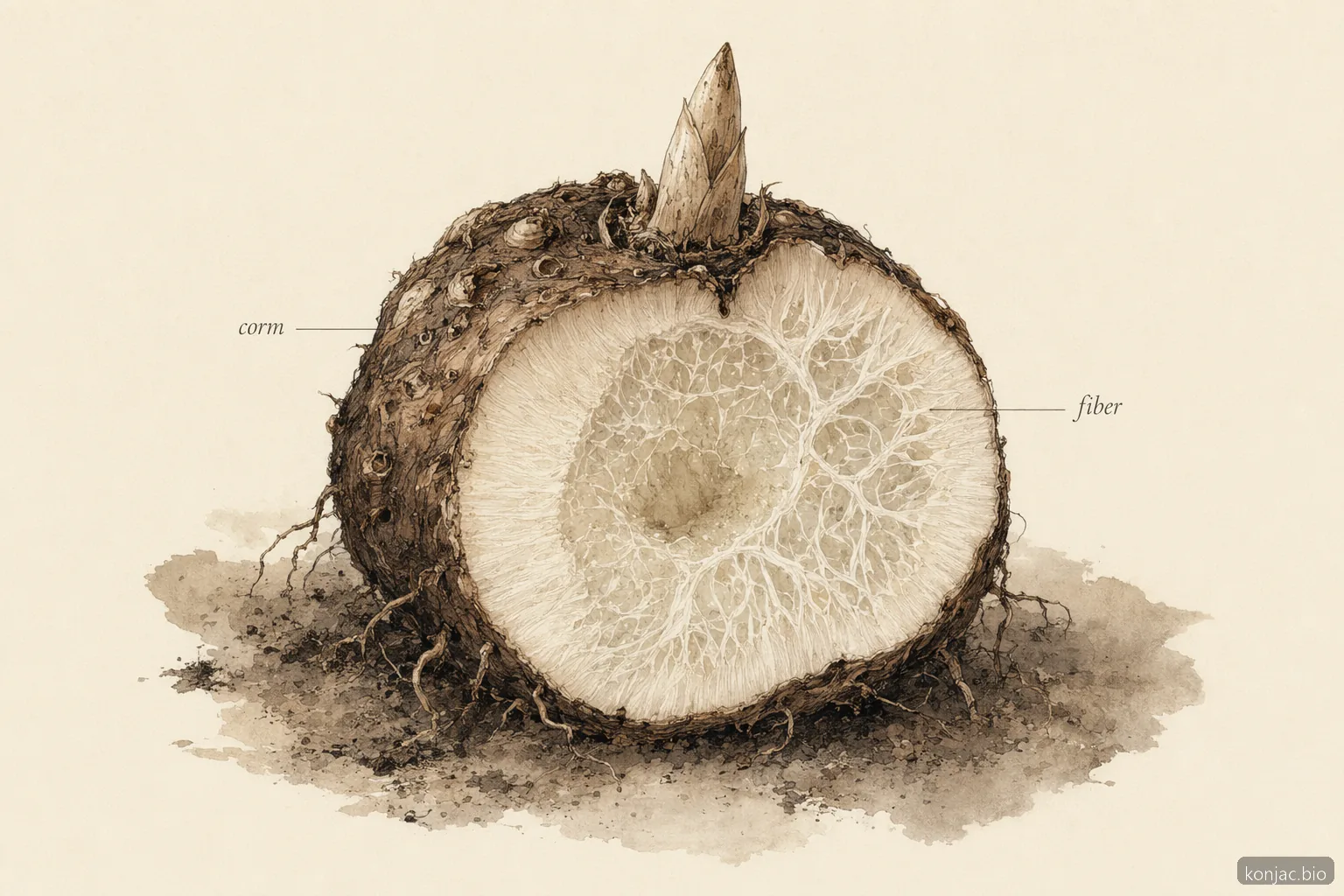
Amorphophallus konjac is a perennial plant in the Araceae family grown for its starch-like corm and glucomannan content. The accepted botanical name is Amorphophallus konjac K. Koch, and its taxonomy is listed by Kew Plants.
The plant is often called konjac, konjaku, elephant yam, or voodoo lily in trade and horticulture. In food supply chains, the useful part is not the leaf or flower, but the swollen underground corm.
The corm is processed into konjac flour, konjac gum, and purified glucomannan. A Food Hydrocolloids review describes konjac glucomannan as a high-molecular-weight polysaccharide built mainly from D-mannose and D-glucose units, with properties that support strong water binding and viscosity in food systems via konjac glucomannan.
Botanically, amorphophallus konjac is unusual because it cycles between a single umbrella-like compound leaf and, in mature plants, a short-lived inflorescence. For ingredient buyers, the crop is better understood as a multi-year corm crop where size, maturity, and drying method determine final flour performance.
Where does amorphophallus konjac grow best?
Amorphophallus konjac grows best in warm, humid regions with loose, well-drained soil and partial shade. Its native and cultivated range is associated with East Asia, including China and Japan, with occurrence records summarized by Kew Plants.
Commercial growers usually focus on three field conditions:
- Drainage: the corm expands underground and is sensitive to waterlogging.
- Warmth: the active growing season requires enough heat for leaf growth and corm enlargement.
- Shade: filtered light supports broad leaf development without excessive heat stress.
Konjac is commonly planted from small seed corms or cut corm pieces rather than seed. The crop then builds mass through one or more growing seasons before harvest. A related field guide on konjac growing conditions covers site selection, slope, and moisture control in more detail.
Because the market value comes from the corm, cultivation planning starts with underground growth. Farmers aim for uniform planting material, consistent spacing, and harvest timing that balances corm size with glucomannan quality.
Why is the amorphophallus konjac corm valuable?
The amorphophallus konjac corm is valuable because it stores glucomannan, a soluble dietary fiber used to build viscosity, elasticity, and gel texture. EFSA evaluated konjac mannan, also called glucomannan, for several health-related food claims in its EFSA opinion.
The EFSA-authorized weight-management wording is: "Glucomannan in the context of an energy restricted diet contributes to weight loss." EFSA specifies that the claim may be used only for foods that provide 1 g of glucomannan per quantified portion, with consumers informed that the beneficial effect is obtained with 3 g daily in three doses of 1 g each, taken with 1 to 2 glasses of water before meals via the EFSA opinion.
In food manufacturing, the corm matters for functional reasons as much as nutrition. Konjac flour can thicken sauces, stabilize water, improve noodle bite, and form thermo-irreversible gels when used with suitable alkali systems.
| Corm-derived material | Typical role | Common use |
|---|---|---|
| Konjac flour | Viscosity and water binding | Noodles, sauces, bakery systems |
| Konjac gum | Texture control | Plant-based gels and dairy alternatives |
| Purified glucomannan | Standardized soluble fiber | Capsules, sachets, formulated foods |
For plant anatomy, storage behavior, and harvest decisions, see our sibling guide to the konjac corm.
From field plant to food ingredient
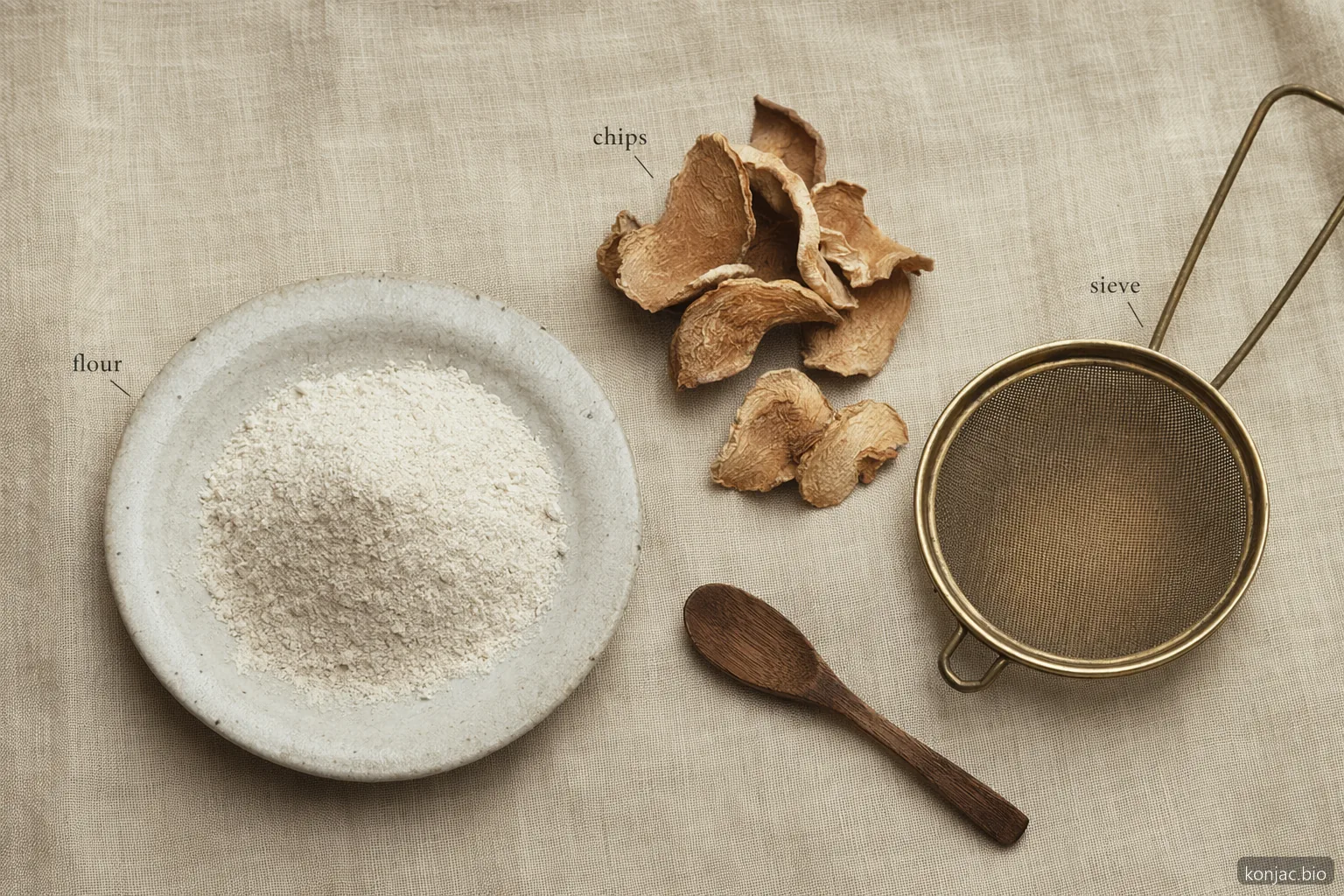
The path from amorphophallus konjac to food ingredient begins with mature corms, not fresh leaves or flowers. After harvest, corms are cleaned, sliced, dried, milled, and graded into flour or gum fractions.
A typical ingredient workflow uses five steps:
- Harvest: mature corms are lifted after the growing season when above-ground growth declines.
- Cleaning: soil, roots, and damaged tissue are removed before slicing.
- Drying: sliced corm is dried to stabilize quality and reduce spoilage risk.
- Milling: dried chips are ground into flour or further refined.
- Grading: batches are checked for viscosity, particle size, moisture, and color.
Food safety requirements depend on format. The U.S. FDA has specifically warned against mini-cup gel candies containing konjac because they may pose a choking hazard, especially when gels are firm and designed to be swallowed whole via the FDA warning.
That safety history does not apply equally to every konjac format. Shirataki noodles, powdered glucomannan, sauces, and blended food systems have different texture, serving size, hydration, and labeling considerations. Formulators should evaluate gel strength, bite size, water availability, and intended consumer use for each product format.
How buyers evaluate amorphophallus konjac quality
Buyers evaluate amorphophallus konjac quality by testing viscosity, purity, moisture, particle size, color, odor, and microbiological results. The same species can produce very different ingredient performance depending on corm maturity, drying temperature, and milling precision.
Common quality checks include:
- Viscosity: a key marker for thickening strength and batch consistency.
- Moisture: lower moisture supports shelf stability and easier storage.
- Particle size: finer powders hydrate differently from coarse flour.
- Color: lighter grades are often preferred for neutral foods.
- Odor: clean, low-odor material is easier to formulate into delicate systems.
- Documentation: certificates of analysis, allergen statements, and food safety system records reduce procurement risk.
For product teams, konjac.bio sources konjac ingredients at wholesale scale and can help match flour, gum, or glucomannan specifications to your application. Contact the team at wholesale konjac for pricing and documentation.
For food brands, the practical question is not only botanical identity. It is whether the batch performs consistently in hydration speed, finished texture, processing temperature, and finished-product labeling.
Frequently asked questions
01 Is amorphophallus konjac the same as konjac?
02 Which part of amorphophallus konjac is used for food?
03 What is glucomannan in amorphophallus konjac?
04 Where is amorphophallus konjac grown commercially?
05 Is amorphophallus konjac safe in food products?
06 How long does amorphophallus konjac take to grow?
- Amorphophallus konjac K.Koch · Plants of the World Online, Royal Botanic Gardens, Kew · 2024
- Scientific Opinion on health claims related to konjac mannan, glucomannan · European Food Safety Authority · 2010
- FDA Warns Consumers Not to Eat Mini-Cup Gel Candies Containing Konjac · U.S. Food and Drug Administration · 2001
- Konjac glucomannan: A review of structure, physicochemical properties, and applications · Food Hydrocolloids, ScienceDirect · 2013