What is glucomannan?
Glucomannan is a high-viscosity soluble fiber extracted mainly from the corm of Amorphophallus konjac. The plant is a member of the Araceae family and is taxonomically listed as Amorphophallus konjac K. Koch by [Kew](https://powo.science.kew.org/taxon/urn:lsid:ipni.org:names:84458-1).
In plain language, glucomannan is the fiber-rich fraction of konjac. When purified, dried, and milled, it becomes konjac glucomannan powder. When hydrated and set with alkaline coagulants, it helps form shirataki noodles, konjac rice, and many low-calorie konjac foods.
The term “glucomannan glucomannan” sometimes appears in search queries because shoppers see both “konjac glucomannan” and “glucomannan” on labels. They refer to the same main polysaccharide family, although commercial grades vary by purity, viscosity, moisture, ash, particle size, and manufacturing standard.
| Term | What it usually means | Common use |
|---|---|---|
| Glucomannan | Soluble fiber polysaccharide | Capsules, tablets, powders |
| Konjac glucomannan | Glucomannan sourced from konjac corm | Supplements and food ingredients |
| Konjac flour | Less purified konjac powder grade | Noodles, gels, thickeners |
| Konjac gum, E425 | Food additive form | Thickening and gelling systems |
Consumers often meet glucomannan through dietary supplements, but the same ingredient family also supports the texture of shirataki noodles, konjac rice, and konjac flour. For ingredient buyers, the commercial question is not only “what is glucomannan,” but which specification matches the intended food, supplement, or private-label application.
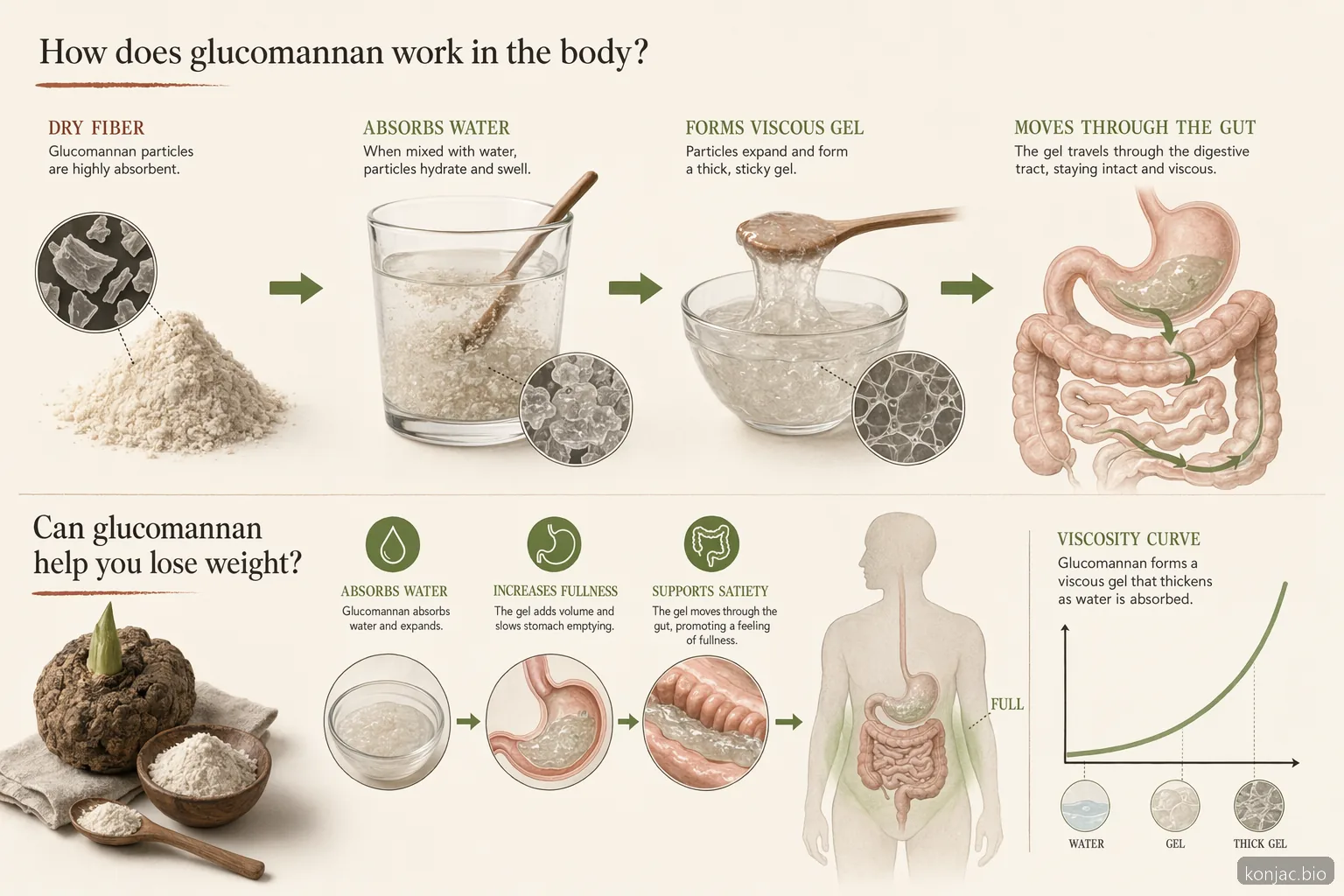
How does glucomannan work in the body?
Glucomannan works by absorbing water, increasing viscosity, and contributing soluble fiber bulk in the digestive tract. This physical gel-forming behavior is the main reason it is used in weight-management supplements and low-calorie konjac foods.
Glucomannan is not absorbed like a sugar or starch. It hydrates and swells, which can increase the thickness of stomach contents and may support fullness when taken before meals with sufficient water. EFSA’s weight-management wording is tied to specific intake conditions, not to casual use of small amounts [EFSA opinion](https://www.efsa.europa.eu/en/efsajournal/pub/1798).
The gel property also explains the texture of konjac foods. In shirataki, hydrated konjac flour reacts with an alkaline setting solution to form resilient strands. In konjac jelly, the same fiber network creates a firm gel, which is why portion shape and chewing safety matter for mini-cup formats.
- Water binding: glucomannan can hold many times its weight in water, depending on grade and processing.
- Viscosity: higher-viscosity grades usually produce thicker hydrated systems at the same concentration.
- Fermentation: soluble fibers can be fermented by gut microbes, producing short-chain fatty acids, a general fiber mechanism described by [NIH ODS](https://ods.od.nih.gov/factsheets/WeightLoss-HealthProfessional/).
- Energy density: konjac foods are often low in calories because much of the finished food is water held in a gel matrix.
Because glucomannan expands with water, dry powder and compressed tablets need careful use. The practical rule is simple: take it with plenty of liquid and avoid taking dry powder by the spoonful.
What glucomannan benefits are supported by evidence?
The best-supported glucomannan benefits are its role as a soluble fiber, its EU-authorized weight-management claim under defined conditions, and its EU-authorized claim for maintaining normal blood cholesterol at a specified intake. These are structure and function claims linked to fiber intake, not promises of broad health outcomes.
The EU register authorizes the wording “Glucomannan in the context of an energy restricted diet contributes to weight loss” when the product provides 3 g daily in three 1 g doses before meals with 1 to 2 glasses of water [EU register](https://eur-lex.europa.eu/legal-content/EN/TXT/?uri=CELEX:32012R0432). The same EU register also authorizes “Glucomannan contributes to the maintenance of normal blood cholesterol levels” when 4 g of glucomannan is consumed daily [EU register](https://eur-lex.europa.eu/legal-content/EN/TXT/?uri=CELEX:32012R0432).
Clinical evidence is mixed rather than uniform. A systematic review indexed in PubMed reported favorable findings in some trials, while later analyses have noted differences in dose, trial length, diet control, and participant adherence [PubMed review](https://pubmed.ncbi.nlm.nih.gov/18842808/). The strongest interpretation is cautious: glucomannan may support a calorie-restricted plan when the dose, timing, and water intake match label directions.
| Benefit area | Evidence status | Practical meaning |
|---|---|---|
| Weight management | EU-authorized claim at 3 g daily under conditions | Take 1 g before each main meal with water and calorie control |
| Normal cholesterol maintenance | EU-authorized claim at 4 g daily | Daily intake must reach the specified amount |
| Dietary fiber intake | Consistent with fiber nutrition principles | Adds soluble fiber without many calories |
| Fullness support | Mechanistically plausible, results vary | Most relevant before meals, not after large meals |
Consumers searching for “benefits of glucomannan” should separate evidence-based claims from marketing exaggeration. A responsible glucomannan dietary supplement label should list the amount per serving, directions with water, and realistic wording such as “may support fullness” or the exact EU claim where legally permitted.
Can glucomannan help you lose weight?
Glucomannan may support weight loss only when used in the context of a calorie-restricted diet and at the studied intake pattern. The EU-authorized condition is 3 g per day, divided into three 1 g servings taken before meals with 1 to 2 glasses of water [EU register](https://eur-lex.europa.eu/legal-content/EN/TXT/?uri=CELEX:32012R0432).
Searches such as “glucomannan lose weight,” “glucomannan to lose weight,” and “glucomannan supplements for weight loss” usually point to the same practical question: does the fiber help reduce calorie intake? The plausible mechanism is satiety support from water-binding and gel formation, but results depend on meal structure, total calories, hydration, and regular use.
A glucomannan weight loss supplement is not the same as a complete diet plan. It does not replace protein, vegetables, movement, sleep, or a measurable calorie target. The most defensible use is as one tool inside a structured eating pattern, especially for people who already tolerate fiber well.
- Use before meals: the EU condition is before meals, not after meals.
- Use enough water: dry glucomannan expands quickly, so liquid is part of safe use.
- Track total intake: weight outcomes depend on sustained calorie balance.
- Assess tolerance: bloating, gas, or loose stools can occur when fiber rises too quickly.
For a broader konjac food approach, see the konjac keto weight loss guide. Foods such as shirataki and konjac rice can reduce meal energy density, while capsules and powders provide measured fiber servings.

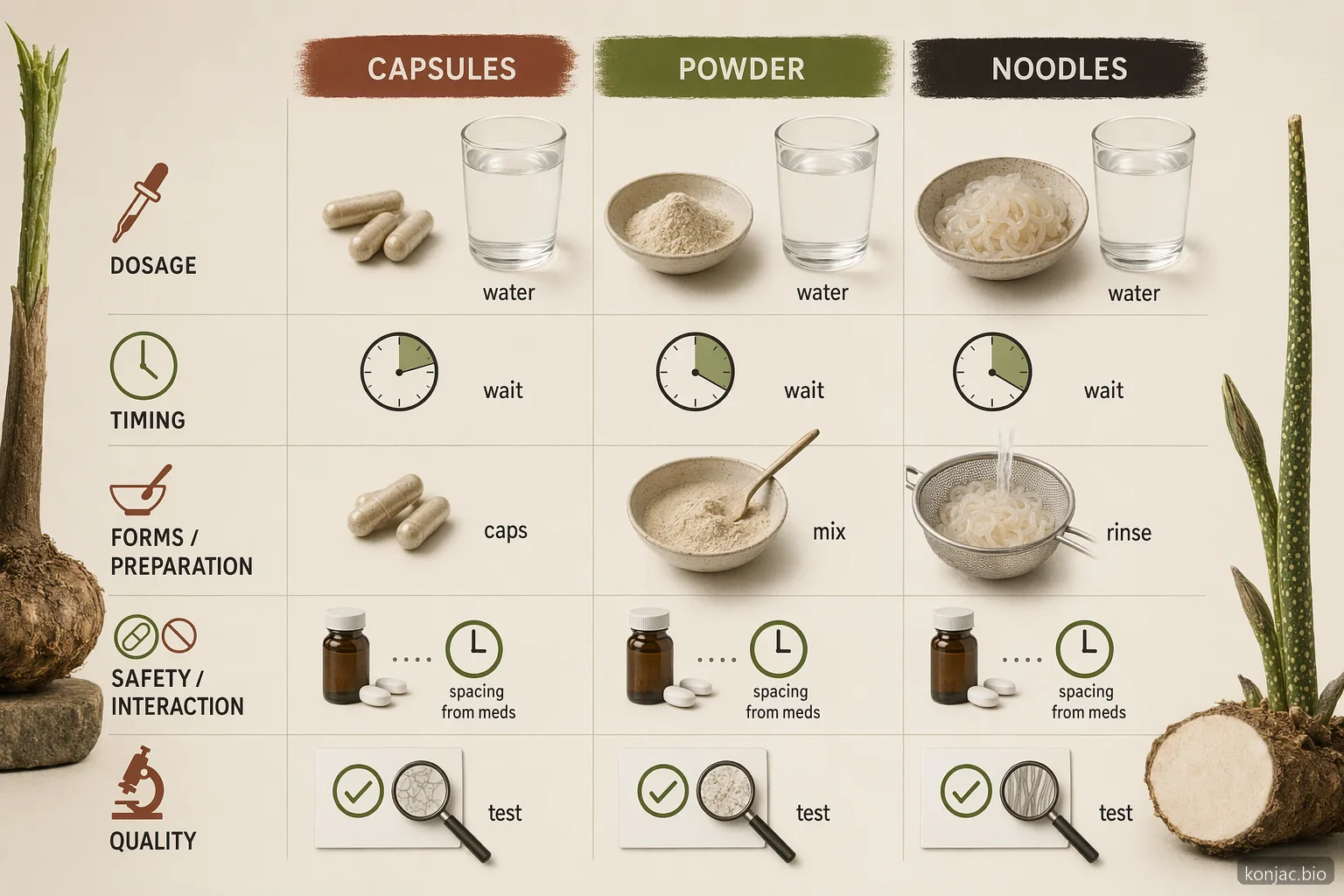
Glucomannan dosage and timing for capsules, powder, and supplements
Glucomannan dosage depends on the intended claim, but the most cited EU weight-management condition is 3 g daily in three 1 g portions before meals. For normal blood cholesterol maintenance under the EU claim, the specified daily intake is 4 g [EU register](https://eur-lex.europa.eu/legal-content/EN/TXT/?uri=CELEX:32012R0432).
Capsules are convenient because they divide the serving into fixed amounts. Powder is more flexible because it can be mixed into water, smoothies, sauces, or bakery systems, but it requires careful measuring and quick mixing to avoid clumps.
| Form | Typical serving logic | Best fit | Watch point |
|---|---|---|---|
| Capsules | Usually 500 mg to 1 g per labeled serving | Measured supplement routines | May require multiple capsules per serving |
| Powder | Measured by gram scale or scoop | Custom fiber drinks and food formulation | Clumps quickly in water |
| Tablets | Compressed measured portions | Portable supplement format | Must be taken with enough liquid |
| Foods | Varies by recipe and grade | Shirataki, rice, jelly, sauces | Nutrition panel may show small fiber amounts per serving |
People new to soluble fiber often start below the target serving and increase over several days. This approach can improve digestive comfort because a sudden jump in fiber may cause gas or bloating.
Timing matters because the satiety use case is meal-linked. A typical schedule is 1 g before breakfast, 1 g before lunch, and 1 g before dinner, each with 1 to 2 glasses of water, matching the EU condition for the weight-management claim.
Keep powder away from moisture during storage. Glucomannan’s value depends on hydration behavior, so humidity, open containers, and poor sealing can affect flow, clumping, and dosing accuracy.
Glucomannan noodles, powder, and food uses compared
Glucomannan appears in foods as noodles, rice, jelly, thickened sauces, vegan gel systems, and dry blends. The same fiber can behave very differently depending on grade, hydration, pH, heat, alkaline setting, and the presence of other hydrocolloids.
Glucomannan noodles are usually known as shirataki noodles. They are made by hydrating konjac flour or purified glucomannan, then setting the hydrated gel into strands. The finished product is mostly water, which is why plain shirataki is very low in calories compared with wheat pasta.
Glucomannan powder is more concentrated and more versatile than finished noodles. It can be used in supplements, beverage sticks, sauces, bakery blends, plant-based gels, and dry mixes. Food manufacturers may choose konjac flour for cost and texture, or purified glucomannan powder for cleaner color, higher viscosity, and tighter specifications.
| Use case | Main ingredient form | Consumer value | Manufacturer value |
|---|---|---|---|
| Shirataki noodles | Konjac flour or glucomannan | Low-calorie pasta alternative | Stable gel texture and long shelf life |
| Konjac rice | Konjac gel granules | Lower-energy rice-style bowl base | Portion control and neutral flavor |
| Supplement capsules | Purified glucomannan powder | Measured soluble fiber | Label-friendly active amount |
| Jelly and gels | Konjac gum blends | Chewy texture | Elasticity and water binding |
| Sauces | Fine powder | Thicker texture | Viscosity at low usage levels |
For recipe inspiration, visit konjac recipes. For product format comparisons, the broader konjac guide explains how the plant becomes flour, gum, noodles, rice, jelly, and skincare materials.

Is glucomannan safe, and who should be careful?
Glucomannan is generally used as a dietary fiber ingredient, but it must be taken with enough water because it expands and thickens quickly. The main practical safety issue is physical swelling before the fiber reaches the stomach.
EU conditions for the weight-management claim require taking glucomannan with 1 to 2 glasses of water before meals [EU register](https://eur-lex.europa.eu/legal-content/EN/TXT/?uri=CELEX:32012R0432). That instruction is not decorative. It reduces the chance of dry fiber sticking or expanding too early.
Common tolerance issues are similar to other fermentable fibers: bloating, gas, abdominal fullness, and changes in stool pattern. Starting with a smaller amount and increasing gradually can make use more comfortable.
- Use water: capsules, tablets, and powders should be taken with a full glass or more.
- Avoid dry swallowing: never swallow loose dry powder directly.
- Separate timing: take other supplements at a different time if label directions advise spacing.
- Check labels: serving size, fiber amount, allergen handling, and warnings vary by product.
- Use extra caution: people with swallowing difficulty should avoid forms that can expand before reaching the stomach.
Konjac jelly deserves separate attention because shape and texture affect chewing safety. FDA has warned about mini-cup gel candies that present a choking hazard, especially when firm gels are swallowed whole [FDA warning](https://www.fda.gov/food/alerts-advisories-safety-information/fda-warns-consumers-not-eat-mini-cup-gel-candies).
For supplement users, the safest routine is boring and consistent: measured serving, enough water, gradual fiber increase, and realistic expectations. Anyone with a specific medical condition, pregnancy, or a complex supplement routine should ask a qualified clinician before adding concentrated fiber.
How should buyers choose glucomannan powder or supplements for quality?
Buyers should choose glucomannan powder or supplements by checking identity, purity, viscosity, mesh size, microbiology, heavy metals, moisture, and manufacturing certifications. These specifications matter because two products labeled “glucomannan” can behave differently in capsules, beverages, noodles, and gels.
For consumer supplements, the label should state the amount of glucomannan per serving, directions with water, and the number of servings needed to reach the intended daily intake. For powders, a gram scale is more accurate than a loose scoop because powder density changes with milling and packing.
For B2B procurement, request a current specification sheet, certificate of analysis, allergen statement, country of origin, and manufacturing flow chart. Food and supplement buyers often ask for ISO 22000, HACCP, GMP, kosher, halal, pesticide screening, and heavy metal results, depending on market and format.
B2B aside: konjac.bio can help brands source konjac glucomannan, konjac flour, and private-label/OEM formats with MOQ flexibility. For wholesale specifications or a quote, contact the sourcing team at /contact/.
| Specification | Why it matters | Typical buyer question |
|---|---|---|
| Viscosity | Controls thickness and gel performance | What is the tested viscosity method and range? |
| Purity | Affects label positioning and dosage confidence | What percentage is glucomannan on dry basis? |
| Mesh size | Changes hydration speed and mouthfeel | Is it suitable for capsules, drinks, or gels? |
| Moisture | Affects shelf life and flow | What is the maximum moisture specification? |
| Microbiology | Supports food safety compliance | Are yeast, mold, and pathogens tested? |
| Documentation | Supports import and retailer review | Are COA, SDS, and certifications available? |
Regulatory framing also matters. In the United States, FDA recognizes certain isolated or synthetic non-digestible carbohydrates as dietary fiber when they have a beneficial physiological effect [FDA fiber](https://www.fda.gov/food/food-labeling-nutrition/questions-and-answers-dietary-fiber). In the EU, on-pack health wording must match authorized claim language and conditions of use.
Frequently asked questions
01 What is glucomannan?
02 What are the main glucomannan benefits?
03 Can glucomannan help you lose weight?
04 Are glucomannan supplements for weight loss different from powder?
05 What is the usual glucomannan dosage?
06 What are glucomannan noodles?
07 Is glucomannan powder safe to mix into drinks?
08 Why do some labels say konjac glucomannan?
- Scientific opinion on glucomannan and body weight · EFSA · 2010
- EU authorized health claims register regulation · European Union · 2012
- Glucomannan and body weight review · PubMed · 2008
- Dietary supplements for weight management fact sheet · NIH Office of Dietary Supplements · 2024
- Questions and answers on dietary fiber · FDA · 2024
- Amorphophallus konjac taxon record · Kew Plants of the World Online · 2024
- FDA warning on mini cup gel candies · FDA · 2001