What is Japan konjac in food and farming?
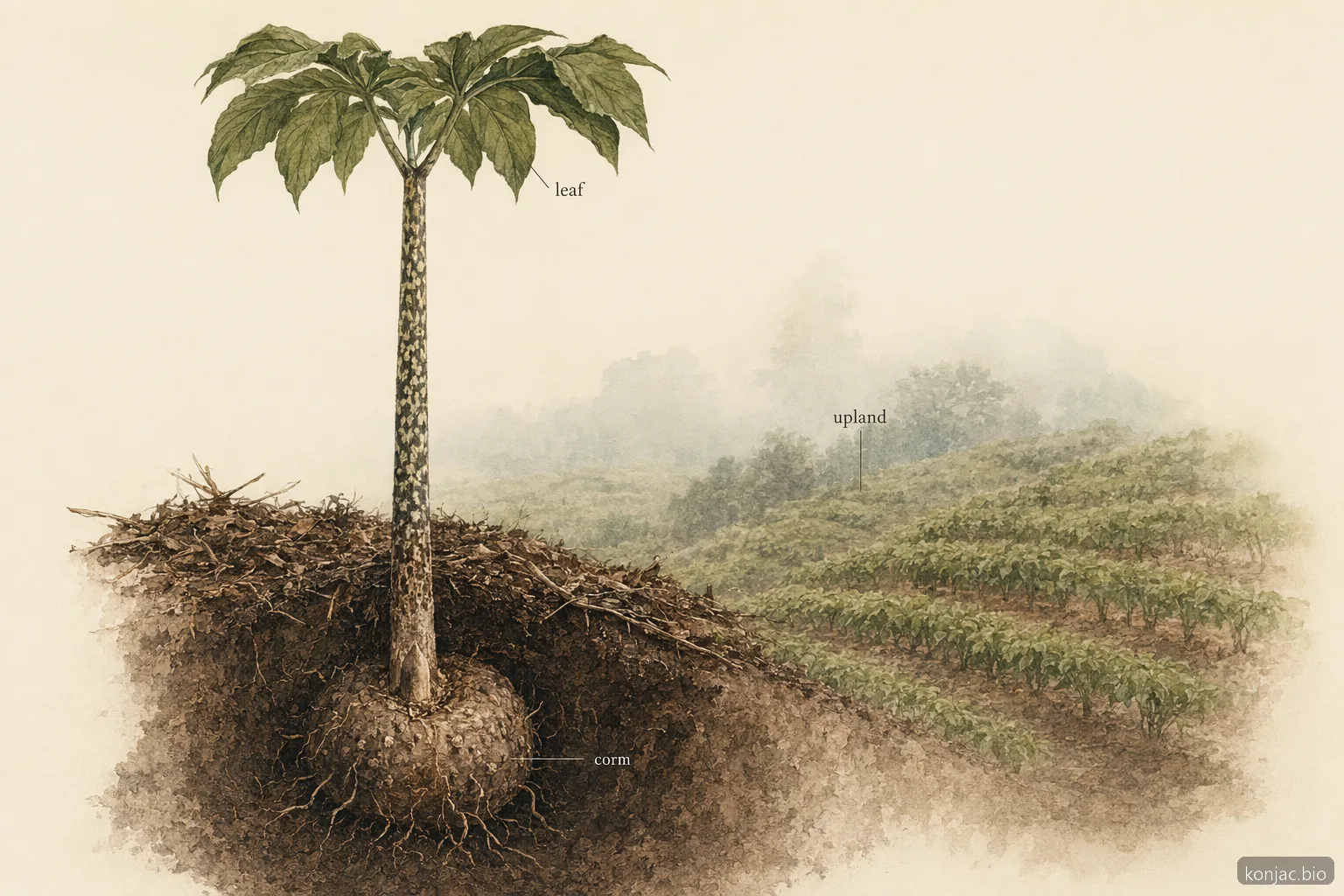
Japan konjac is the Japanese food and farming system built around the starchy corm of Amorphophallus konjac. The edible material is not the leaf or flower, but the underground corm, which is processed into konnyaku gel, shirataki noodles, and purified glucomannan ingredients.
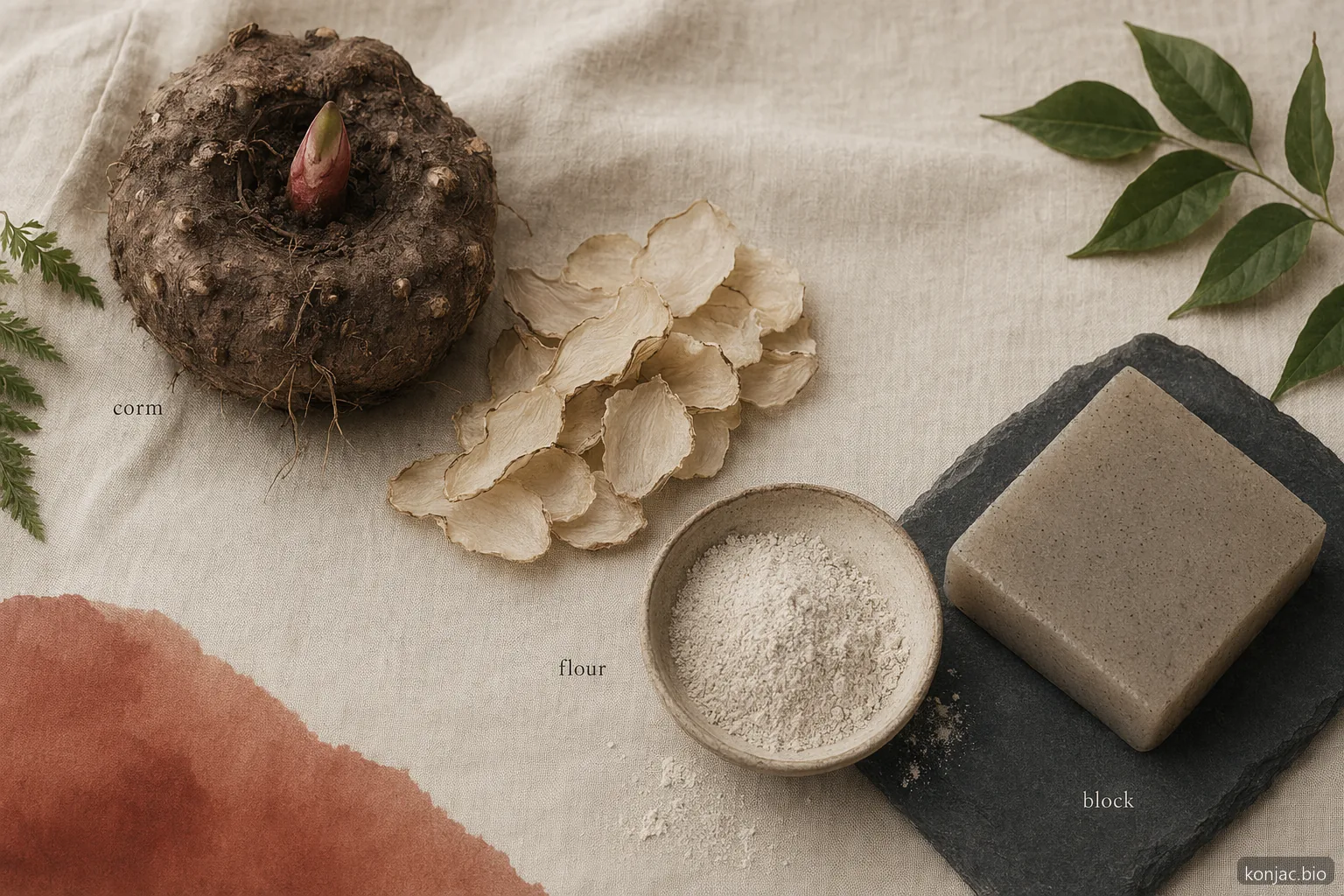
Botanically, Amorphophallus konjac is an aroid, placed in Araceae by [Kew POWO](https://powo.science.kew.org/taxon/urn:lsid:ipni.org:names:84471-1). In Japanese food culture, the plant is usually discussed through its finished foods: konnyaku, a firm gel block, and shirataki, thin translucent strands used in hot pots, simmered dishes, and low-calorie noodle applications.
The crop is valued because konjac glucomannan forms a strong, heat-stable gel when hydrated and alkalized. That single functional trait connects field agronomy, milling, hydration, alkaline setting, texture control, and food safety into one supply chain.
For cultivation background, including corm biology, dormancy, and field conditions, see the parent guide: The Konjac Plant: Cultivation, History, and Botany. Japan’s use case is narrower: it focuses on corms that can become consistent, neutral-tasting food gels.
Where is Japan konjac grown?
Japan konjac is grown mainly in cool upland production areas, with Gunma the country’s most recognized konnyaku region. Japan’s Ministry of Agriculture, Forestry and Fisheries lists konnyaku as a representative local food from Gunma in its regional cuisine database [MAFF cuisine](https://www.maff.go.jp/e/policies/market/k_ryouri/search_menu/menu/konnyaku_gunma.html).
Konjac production favors sites where growers can manage summer leaf growth, autumn corm expansion, and winter dormancy. Practical field priorities include loose soil, reliable drainage, wind protection, and rotations that reduce corm damage at harvest.
A simplified Japanese production calendar looks like this:
| Stage | Typical timing | Buyer relevance |
|---|---|---|
| Seed corm selection | Late winter to spring | Sets size uniformity and field vigor |
| Planting | Spring | Drainage and spacing affect corm shape |
| Vegetative growth | Summer | Leaf health drives corm carbohydrate storage |
| Harvest | Autumn | Handling affects bruising and storage loss |
| Drying or processing | Post-harvest | Impacts color, odor, viscosity, and shelf life |
For regional comparison, buyers often evaluate Japanese konjac against Chinese konjac because China supplies a large share of global konjac flour. See China konjac cultivation for a neighboring production model with different scale and sourcing dynamics.
How did Japan konjac become konnyaku and shirataki?
Japan konjac becomes konnyaku or shirataki when konjac glucomannan is hydrated, mixed with an alkaline coagulant, heated, and set into gel. The same hydrocolloid behavior creates two familiar formats: block konnyaku and noodle-like shirataki.
The basic processing flow is straightforward:
- Corm cleaning: Soil, peel, and damaged tissue are removed.
- Slicing or drying: Corms may be dried into chips for storage and milling.
- Milling: Dried material is ground and refined into konjac flour or purified glucomannan.
- Hydration: Powder is dispersed in water to swell the glucomannan.
- Alkaline setting: Calcium hydroxide or a comparable alkali creates the elastic gel texture.
- Heating and cooling: Finished gel is stabilized, cut, packed, or extruded as shirataki.
Konnyaku blocks are usually cut for oden, simmered vegetables, and miso-based dishes. Shirataki is extruded into strands for sukiyaki, hot pot, chilled salads, and calorie-controlled noodle applications.
Texture is the main craft variable. A firmer konnyaku block needs a different water ratio, particle size, and alkali balance than soft shirataki strands. For industrial buyers, small processing shifts can change bite, syneresis, odor, and pack stability.
Japan konjac quality markers for buyers
Japan konjac quality is judged by corm origin, powder refinement, gel strength, odor control, and food safety documentation. The best specification depends on the finished application, because konnyaku blocks, shirataki, gummies, vegan seafood analogs, and capsules require different functional targets.
Common procurement checkpoints include:
| Marker | What to check | Why it matters |
|---|---|---|
| Glucomannan content | Assay basis and purity grade | Predicts viscosity and gel strength |
| Viscosity | Method, concentration, temperature | Controls hydration and mouthfeel |
| Particle size | Mesh or micron range | Affects dispersion speed and smoothness |
| Odor | Neutrality after hydration | Critical for beverages, desserts, and neutral foods |
| Ash and color | Refining level | Signals mineral load and visual cleanliness |
| Food safety | HACCP, ISO 22000, COA | Supports audits and retailer compliance |
ISO 22000 is a food safety management standard for organizations in the food chain, described by the International Organization for Standardization [ISO 22000](https://www.iso.org/iso-22000-food-safety-management.html). Buyers should also request lot-level certificates of analysis covering moisture, microbiology, heavy metals, and declared viscosity method.
For manufacturers comparing Japanese-style texture with other origins, konjac growing conditions can help connect field variables with ingredient performance. Konjac.bio sources konjac ingredients at wholesale scale and can help match flour or glucomannan specifications to your format through the contact page.
How is Japan konjac regulated for safety and health claims?
Japan konjac should be marketed with clear food safety controls and cautious health language. Konjac foods are widely eaten, but certain formats and claims require special care, especially gels for children and concentrated glucomannan products.
The U.S. Food and Drug Administration has warned against small jelly cups containing konjac gel because they may present a choking hazard in that specific format [FDA konjac](https://www.fda.gov/regulatory-information/search-fda-guidance-documents/cpg-sec-555875-confections-containing-konjac-gel). This concern is about product geometry and gel firmness, not ordinary cooked shirataki or sliced konnyaku used in meals.
For weight-management wording in the European Union, the EFSA-approved claim is: 'Glucomannan in the context of an energy restricted diet contributes to weight loss' [EFSA claim](https://www.efsa.europa.eu/en/efsajournal/pub/1798). Marketing should preserve the condition of use and avoid broad promises that go beyond the authorized language.
Safe commercial positioning usually separates three topics:
- Food identity: Konnyaku, shirataki, or konjac flour as a food ingredient.
- Functional performance: Thickening, gelling, water binding, and texture.
- Health wording: EFSA-style language or conservative phrasing such as 'may support satiety' where legally appropriate.
Labels should be reviewed for each sales market. Japan, the European Union, the United States, and China use different food, supplement, additive, and claim frameworks.
Frequently asked questions
01 Is Japan konjac the same as konnyaku?
02 Why is Gunma associated with Japan konjac?
03 What foods are made from Japan konjac?
04 Does konjac glucomannan have an approved health claim?
05 Are there safety concerns with konjac foods?
- Amorphophallus konjac taxon record · Plants of the World Online, Royal Botanic Gardens, Kew · 2024
- Konnyaku, Gunma local cuisine · Ministry of Agriculture, Forestry and Fisheries of Japan · 2024
- Scientific Opinion on glucomannan related health claims · European Food Safety Authority · 2010
- CPG Sec. 555.875 Confections Containing Konjac Gel · U.S. Food and Drug Administration · 2024
- ISO 22000 Food safety management · International Organization for Standardization · 2024