What are the main konjac powder benefits?
The main konjac powder benefits are viscosity, fullness support, lower-calorie texture building, and soluble fiber enrichment.
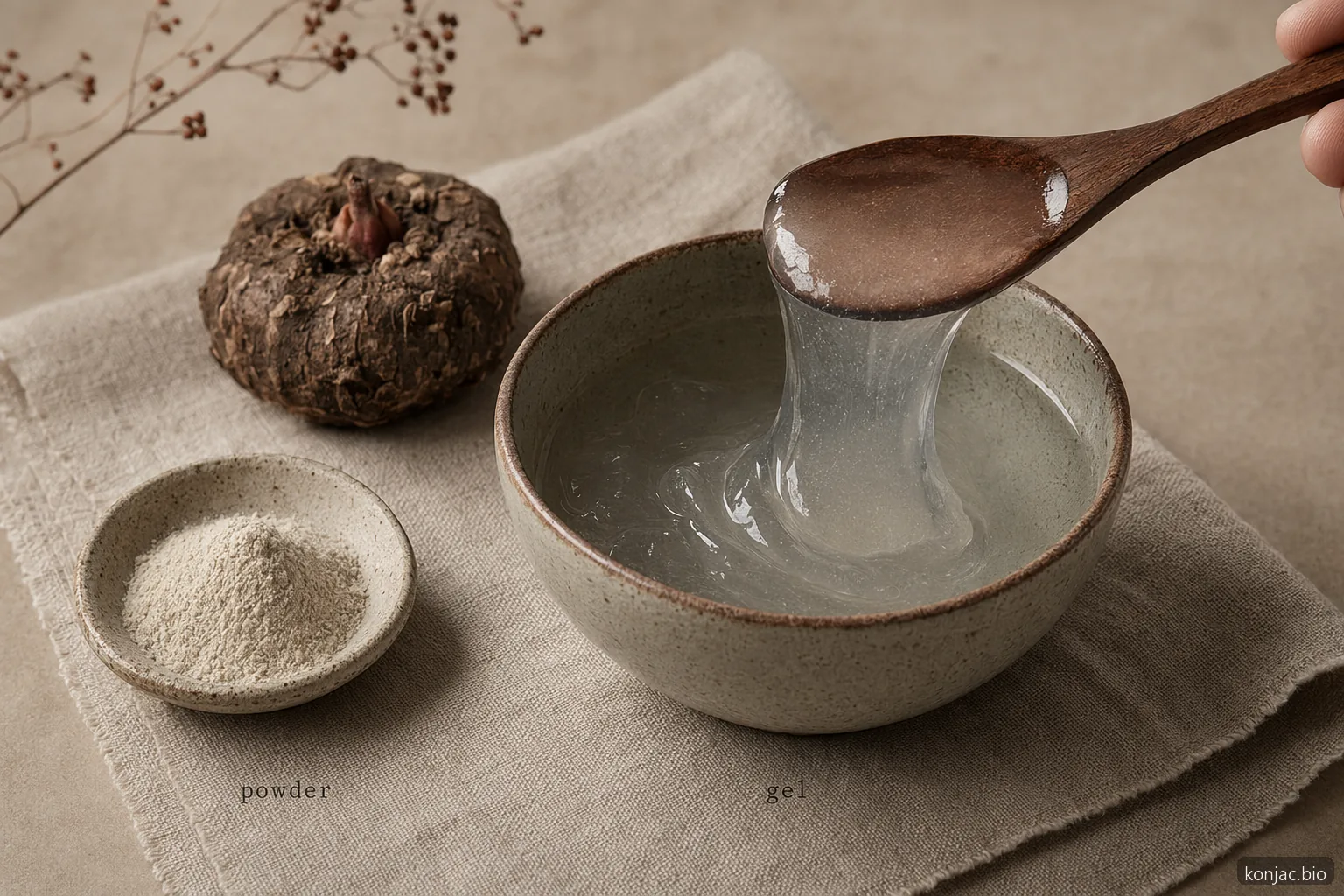
Konjac powder is produced from the corm of Amorphophallus konjac, a plant listed by Kew as a member of the Araceae family under the accepted name Amorphophallus konjac K. Koch [Kew Plants](https://powo.science.kew.org/taxon/urn:lsid:ipni.org:names:84473-1). Its key functional component is glucomannan, a water-soluble polysaccharide that hydrates into a thick, smooth gel.
- Texture: Adds body to sauces, beverages, fillings, noodle doughs, and plant-based foods.
- Fiber: Helps formulate products with added soluble fiber without grain starch.
- Satiety: May support fullness because hydrated glucomannan forms a viscous gel.
- Calorie reduction: Replaces some starch, fat, or sugar structure with water-bound texture.
- Clean processing: Works in hot or cold systems when dispersed and hydrated correctly.
For consumer-facing health language, the strongest wording comes from EFSA. The approved wording is: "Glucomannan in the context of an energy restricted diet contributes to weight loss" [EFSA opinion](https://www.efsa.europa.eu/en/efsajournal/pub/1798). EFSA links that claim to 3 g of glucomannan daily, taken as three 1 g doses with 1 to 2 glasses of water before meals.
Brands should keep the wording precise. The U.S. NIH weight-loss ingredient review describes glucomannan evidence as mixed, so konjac powder benefits should be presented as formulation and fiber advantages first, with cautious health wording [NIH review](https://ods.od.nih.gov/factsheets/WeightLoss-HealthProfessional/).
How do konjac powder benefits work in the body?
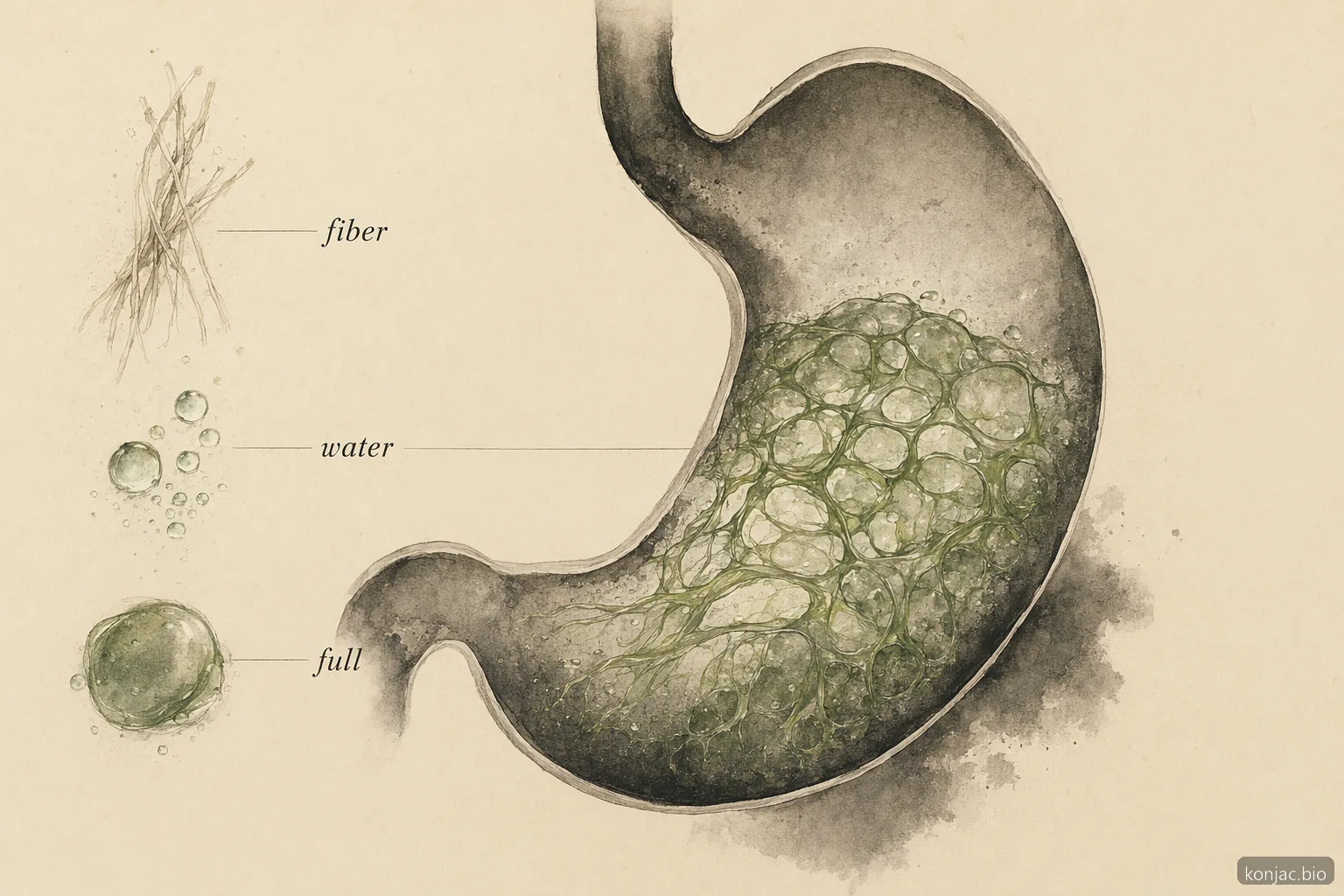
Konjac powder benefits work because glucomannan absorbs water and forms a viscous gel during digestion.
That gel behavior is the reason glucomannan has been studied for appetite, body-weight outcomes, and normal cholesterol support. A PubMed-indexed critical review describes glucomannan as a soluble fiber with high viscosity and a long history of use in Asian foods [critical review](https://pubmed.ncbi.nlm.nih.gov/16320857/).
- Hydration: Powder particles absorb water, swell, and create viscosity.
- Volume: The hydrated fiber increases bulk without adding digestible starch.
- Texture in meals: Higher viscosity can make foods feel thicker and more filling.
- Fiber effect: Soluble fiber intake is associated with digestive regularity and normal lipid metabolism.
EFSA has also approved the wording "Glucomannan contributes to the maintenance of normal blood cholesterol levels" when the food provides a daily intake of 4 g glucomannan [EFSA opinion](https://www.efsa.europa.eu/en/efsajournal/pub/1798). This wording applies to glucomannan intake, not to every konjac-containing food automatically.
Water is not optional. Dry konjac powder should not be consumed by the spoonful because rapid swelling can create a choking hazard. Finished foods, beverages, and supplement formats should be designed so the powder is fully dispersed or paired with clear water-use directions.
Konjac powder benefits for food formulation
Food developers often choose konjac powder for process performance before they market its fiber content. A small percentage can change mouthfeel, water retention, and gel strength more dramatically than many familiar gums.
Konjac glucomannan can form firm gels when processed with alkaline coagulants such as calcium hydroxide. Hydrocolloid literature links this gelation to deacetylation of the glucomannan chain, which changes how the polymer network forms [hydrocolloid review](https://www.sciencedirect.com/science/article/abs/pii/S0268005X07001428).
| Application | Typical role | Practical benefit |
|---|---|---|
| Shirataki and low-calorie noodles | Gel network | Elastic bite and very high water content |
| Sauces and dressings | Thickener | Cling, suspension, and reduced watery separation |
| Plant-based meat analogues | Binder | Juiciness and sliceable structure |
| Bakery fillings | Water binder | Less syneresis during storage |
| Functional beverages | Viscosity builder | Smoother body at low solids |
Starting use levels vary by grade and formula. Beverage systems may begin around 0.1% to 0.3%, sauces often begin around 0.2% to 0.8%, and firm gel systems may require higher levels plus calcium or alkaline processing. Pilot testing is essential because hydration speed, particle size, pH, shear, salts, and heat all affect final texture.
Konjac powder performs best when preblended with sugar, starch, or another dry carrier before adding it to water. Direct addition to still water can cause fish eyes, which are dry powder cores trapped inside hydrated clumps.
What makes konjac powder different from other fibers?
Konjac powder is different from most fibers because it combines very high water binding with strong gel-forming behavior at low inclusion rates.
Many fibers add nutrition but limited texture. Konjac glucomannan adds both, which is why it appears in noodles, gels, sauces, beverages, and reduced-calorie food systems. It is also more process-sensitive than simple insoluble fibers because hydration, pH, shear, and minerals can shift viscosity.
| Ingredient | Main function | Texture impact | Best use case |
|---|---|---|---|
| Konjac powder | Soluble fiber and hydrocolloid | Very high viscosity, gel potential | Noodles, sauces, gels, high-fiber foods |
| Psyllium husk | Soluble and insoluble fiber blend | Thick, grainy gel | Bakery, capsules, fiber blends |
| Inulin | Soluble prebiotic fiber | Mild body, slight sweetness | Bars, dairy alternatives, beverages |
| Xanthan gum | Microbial hydrocolloid | Stable viscosity, no fiber positioning in many markets | Dressings, sauces, gluten-free baking |
| Cellulose fiber | Mostly insoluble fiber | Bulk and water hold, limited gel | Bakery, meat systems, fiber fortification |
This dual identity matters for product claims. If the purchase goal is nutrition, compare glucomannan content, fiber declaration, and serving size. If the purchase goal is texture, compare viscosity grade, mesh size, odor, color, and gel strength.
For a deeper ingredient identity comparison, see the internal guide on konjac flour vs glucomannan. For broader ingredient context, the parent Konjac Flour & Powder guide explains grades, sourcing, and processing terms.
Safe use, labeling, and buyer checklist
Safe konjac use starts with hydration, serving-size control, and the right food format. The main practical risk is not the ingredient in a hydrated food, but rapid swelling or firm gel formats that can be hard to swallow.
The FDA has warned about mini-cup gel candies containing konjac because their shape, firmness, and suction-style consumption created a choking concern [FDA warning](https://www.fda.gov/food/alerts-advisories-safety-information/fda-warns-consumers-not-eat-mini-cup-gel-candies). That warning is format-specific, but it is a useful reminder for developers designing firm gels, shots, and high-viscosity single-serve products.
For ingredient purchasing, evaluate konjac powder like a functional hydrocolloid, not a commodity flour. A reliable specification should include glucomannan content, viscosity range, moisture, ash, sulfur dioxide if used, microbiology, heavy metals, mesh size, and country of origin.
- Request a current COA for each lot.
- Match viscosity grade to the processing system.
- Confirm allergen, gluten, vegan, halal, kosher, and non-GMO needs.
- Ask whether the facility uses HACCP, ISO 22000, BRCGS, or equivalent controls.
- Run a bench trial before scaling to a production batch.
B2B note: konjac.bio sources konjac powder for wholesale ingredient programs, and formulation teams can request specifications, samples, and pricing through contact.
For usage ratios, dispersion steps, and application troubleshooting, use the internal how to use konjac flour guide alongside this benefits overview.
Frequently asked questions
01 What are the main konjac powder benefits?
02 Is konjac powder the same as glucomannan?
03 Does konjac powder help with weight management?
04 How much konjac powder is used in food formulations?
05 Is konjac powder safe to use?
- Scientific Opinion on the substantiation of health claims related to glucomannan · EFSA Journal · 2010
- Dietary Supplements for Weight Loss: Fact Sheet for Health Professionals · NIH Office of Dietary Supplements · 2024
- Glucomannan and obesity: a critical review · PubMed · 2005
- Konjac glucomannan: a review · Food Hydrocolloids · 2008
- FDA Warns Consumers Not to Eat Mini-Cup Gel Candies · U.S. Food and Drug Administration · 2001
- Amorphophallus konjac K.Koch · Plants of the World Online, Kew · 2024