What are the main konjac jelly benefits?
The main konjac jelly benefits are satiety support, lower calorie dessert design, distinctive chew, and flexible formulation with fruit flavors or reduced sugar systems.
Konjac jelly is built around water, sweetener, flavor, acid, and konjac-derived hydrocolloids. Its appeal is practical: a small pouch or cup can feel more substantial than a drink while remaining lighter than many baked snacks, dairy desserts, or fried sweets.
Four benefits matter most for shoppers and product developers:
- Fullness cue: glucomannan forms a viscous gel, which can slow eating speed and increase the perception of volume.
- Portion control: single-serve formats commonly range from 100 g to 150 g, making intake easier to measure.
- Sugar flexibility: formulas can use fruit juice, non-nutritive sweeteners, sugar alcohols, or blended systems.
- Texture differentiation: konjac creates a springy bite that differs from gelatin, pectin, starch, or agar gels.
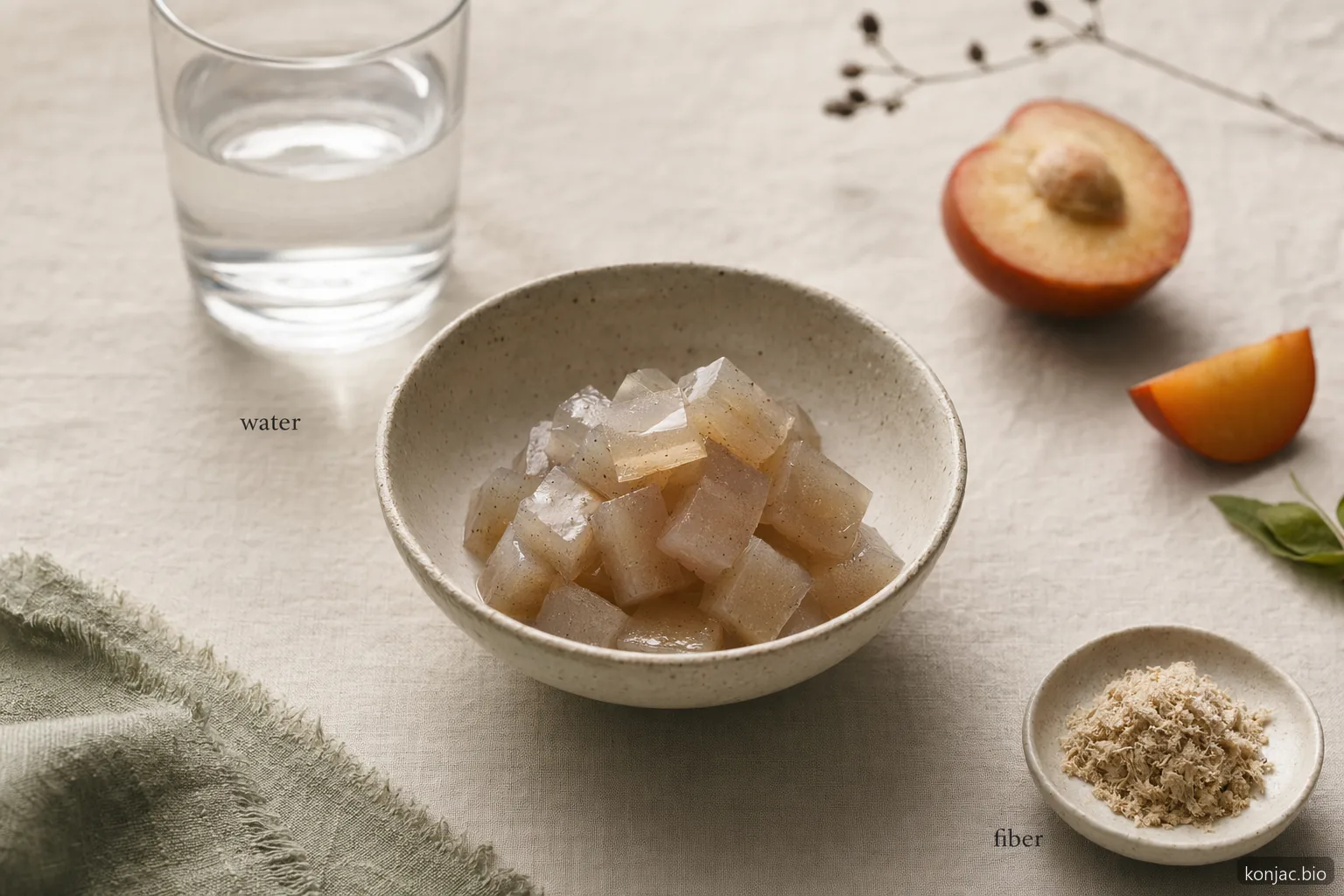
The ingredient behind the texture is glucomannan, a soluble polysaccharide associated with the corm of Amorphophallus konjac. Food science references describe glucomannan as a high water-binding hydrocolloid used in gel, noodle, and thickening systems [glucomannan](https://www.sciencedirect.com/topics/chemistry/glucomannan).
How does glucomannan create konjac jelly benefits?
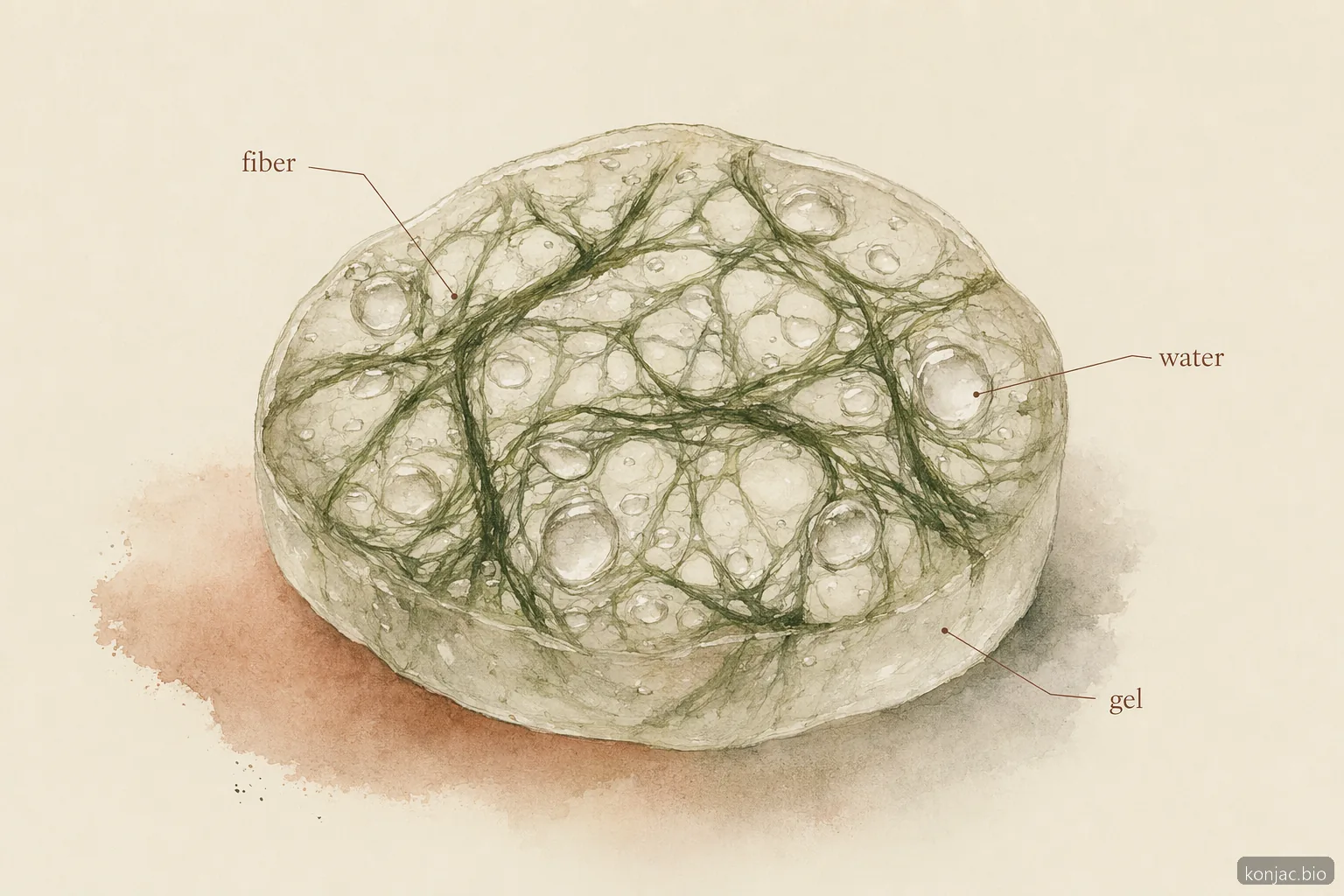
Glucomannan creates konjac jelly benefits by binding water into a firm, elastic gel that adds volume, chew, and soluble fiber to the dessert.
Konjac glucomannan is valued because a small percentage can change the structure of a high-water food. In jelly applications, it is commonly combined with alkali processing, carrageenan, locust bean gum, xanthan gum, or other hydrocolloids to tune bite, clarity, syneresis, and heat stability.
The sensory benefit is especially important. A konjac jelly pouch can be sucked slowly, chewed deliberately, or spooned from a cup depending on the format. That eating pattern gives the product more time in the mouth than a thin beverage, which can make a modest serving feel more satisfying.
Nutrition benefits depend on the final formula. A jelly with 1 g to 3 g fiber per serving is different from a jelly with trace fiber and high added sugar. Shoppers should compare serving size, total sugars, calories, and fiber on the nutrition panel rather than assuming every konjac jelly has the same profile.
For brands, texture is also a commercial benefit. Konjac.bio sources konjac ingredients at wholesale scale for product teams building jelly, noodle, and gelled snack lines. Contact the team at [/contact/](/contact/) for specification and pricing support.
Konjac jelly benefits for weight-conscious snacking
Konjac jelly can fit weight-conscious snacking when it replaces higher calorie desserts, uses a reasonable serving size, and avoids excessive added sugar.
The strongest authorized European wording for glucomannan and weight is specific, not open-ended: “Glucomannan in the context of an energy restricted diet contributes to weight loss.” EFSA’s opinion ties the claim to a defined intake pattern and diet context, not to unlimited dessert consumption [EFSA claim](https://www.efsa.europa.eu/en/efsajournal/pub/1798).
That distinction matters for konjac jelly. A pouch with a small amount of glucomannan is not automatically equivalent to the intake used for the EFSA claim. Product developers that want to communicate fiber-related benefits should verify the actual grams of glucomannan per serving, the number of servings expected per day, and the local rules for permitted wording.
Human studies on glucomannan have used different doses, food matrices, and dietary controls. Reviews indexed by PubMed describe variable findings, which is why careful wording such as “may support fullness” is more accurate than broad promises [PubMed review](https://pubmed.ncbi.nlm.nih.gov/18842808/).
A practical snack comparison can help:
| Snack type | Typical strength | Watch point |
|---|---|---|
| Konjac jelly | High water content, chewy texture, portionable | Choking risk if format is too firm or small |
| Gelatin dessert | Soft gel, familiar mouthfeel | Often lower in fiber |
| Fruit gummies | Portable and sweet | Often higher sugar density |
| Sweet drinks | Fast refreshment | Less chewing and less texture-based satiety |
What safety limits matter with konjac jelly benefits?
The main safety limits are choking risk, gel firmness, serving size, and clear directions to chew thoroughly before swallowing.
Konjac jelly’s greatest advantage, a resilient gel, can become a problem in formats that are small, slippery, and difficult to break apart. The U.S. Food and Drug Administration has warned about mini-cup gel candies because some products can lodge in the throat, especially when squeezed directly from a small cup [mini-cup jelly](https://www.fda.gov/food/alerts-advisories-safety-information/consumer-advisory-mini-cup-gel-candies).
Safety-minded product design starts with mechanics, not marketing. Brands should evaluate gel rupture force, cup opening size, portion shape, and whether the product encourages sucking without chewing. Labels should use plain instructions such as “chew thoroughly” and should avoid serving formats aimed at very young children unless local safety review supports the design.
Three controls are especially useful:
- Format control: use pouches, spoons, or soft gels that reduce whole-piece swallowing risk.
- Texture control: avoid overly firm gels that resist biting or do not fragment easily.
- Consumer control: place visible chewing guidance near the opening or front panel.
For a deeper safety-focused companion piece, see our guide to [konjac jelly safety](/konjac-jelly-safety/). Safety does not cancel the benefits of konjac jelly, but it determines whether those benefits are delivered responsibly.
Label and formulation choices that change the benefits
Konjac jelly benefits change sharply with formulation, because sugar level, fiber amount, acids, flavors, and co-gelling agents shape both nutrition and eating experience.
A product called konjac jelly may contain very different ingredients from one market to another. Some formulas emphasize fruit flavor and sweetness. Others emphasize low sugar, prebiotic positioning, added vitamins, or a beverage-like pouch experience.
Shoppers can use a five-point label check:
- Calories per serving: compare the full pouch or cup, not only 100 g values.
- Total sugars: fruit juice concentrates and syrups can raise sugar quickly.
- Dietary fiber: look for the grams per serving, not only the presence of konjac.
- Sweeteners: check whether the product uses sugar alcohols, high-intensity sweeteners, or blended systems.
- Warnings: chewing instructions and age guidance signal responsible product design.
Product teams should also verify additive status by market. In the United States, the FDA maintains a food additive status list for many ingredients and use categories, but finished product compliance still depends on formula, format, and label claims [FDA additives](https://www.fda.gov/food/food-additives-petitions/food-additive-status-list).
Konjac jelly is also different from gelatin desserts. Gelatin is animal-derived collagen protein, while konjac gel is plant-derived hydrocolloid from Amorphophallus konjac. For a format-by-format comparison, see [konjac jelly vs gelatin](/konjac-jelly-vs-gelatin/).
Frequently asked questions
01 What are the biggest konjac jelly benefits for everyday snacking?
02 Does konjac jelly help with fullness?
03 Is konjac jelly low calorie?
04 Is konjac jelly safe to eat?
05 Is konjac jelly vegan?
06 How is konjac jelly different from gelatin dessert?
- Scientific Opinion on glucomannan and weight loss · European Food Safety Authority · 2010
- Consumer Advisory on Mini-Cup Gel Candies · U.S. Food and Drug Administration · 2002
- Glucomannan overview · ScienceDirect · 2024
- Glucomannan and weight outcomes review · PubMed · 2008
- Food Additive Status List · U.S. Food and Drug Administration · 2024