What is a konjac jelly pouch?
A konjac jelly pouch is a soft, squeezable jelly snack packaged in a flexible spout pouch or tear-top sachet. The gel structure comes from konjac glucomannan, a soluble fiber from Amorphophallus konjac, combined with water, acids, sweeteners, flavors, and sometimes fruit juice.
The format differs from spoonable cups because the pouch is designed for controlled squeezing. A typical retail pouch is a single serving, commonly positioned for snacking, lunchboxes, convenience stores, and low-calorie dessert shelves.
Konjac flour is recognized in U.S. food regulations for functions such as gelling, thickening, film forming, and water retention under the [FDA listing](https://www.ecfr.gov/current/title-21/chapter-I/subchapter-B/part-184/subpart-B/section-184.1374). That technical role explains why a small amount of konjac can create a firm, elastic mouthfeel in a high-water product.
| Feature | What it means |
|---|---|
| Package | Flexible pouch, spout pouch, or tear-top sachet |
| Main texture system | Konjac glucomannan with hydrocolloids or stabilizers |
| Use case | Portable dessert, snack, or fruit-style jelly |
| Buyer check | Calories, choking warning, sweetener type, serving size |
What ingredients are in a konjac jelly pouch?
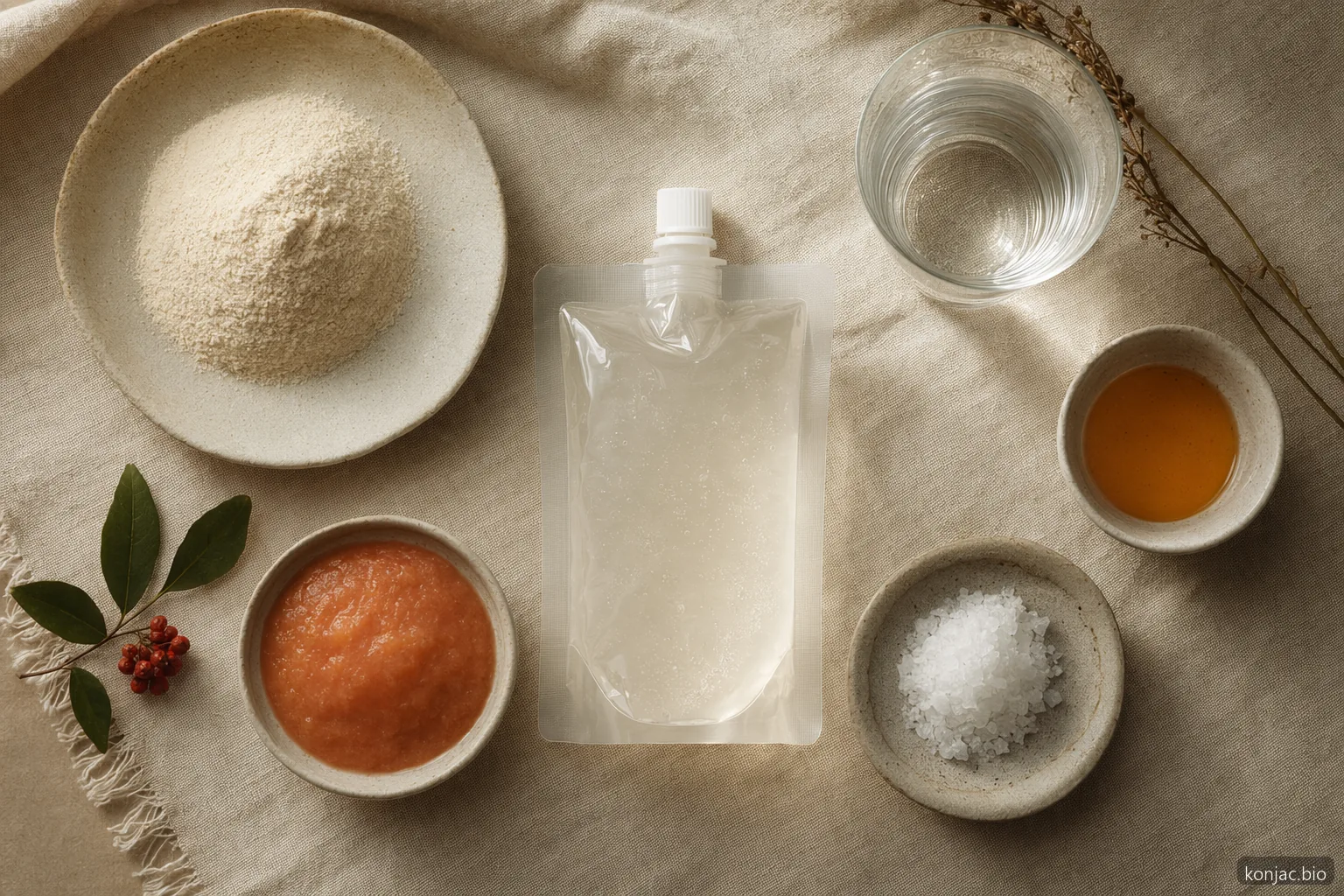
A konjac jelly pouch usually contains water, konjac flour or konjac gum, sweetener, acidulant, flavor, color, and a stabilizer system. Fruit juice, puree, collagen, vitamins, caffeine, or electrolytes may be added depending on the market position.
Konjac glucomannan is the signature ingredient, but it rarely works alone in commercial jelly pouches. Brands often combine it with carrageenan, xanthan gum, gellan gum, locust bean gum, calcium salts, or potassium salts to control bite, squeeze flow, syneresis, and shelf stability.
Sweetness changes the nutrition profile more than the konjac itself. A pouch sweetened with sugar, honey, or fruit concentrate can have several times more calories than one sweetened with erythritol, allulose, stevia, sucralose, or monk fruit extract. U.S. Nutrition Facts panels must declare serving size, calories, total carbohydrate, total sugars, and added sugars under [FDA labels](https://www.fda.gov/food/nutrition-facts-label/how-understand-and-use-nutrition-facts-label).
Common acidulants include citric acid, malic acid, and sodium citrate. These help create a fruit-like flavor profile and support product consistency, especially in shelf-stable pouches that need a defined pH target.
- Base: water plus konjac flour or konjac gum.
- Flavor system: juice, natural flavors, acids, and colors.
- Sweetener system: sugar, polyols, high-intensity sweeteners, or blends.
- Texture system: hydrocolloids and salts that tune firmness and squeezeability.
How many calories are in a konjac jelly pouch?
A konjac jelly pouch can range from very low calorie to moderate calorie, depending on sugar content, fruit solids, and serving size. The most reliable number is the calories-per-serving value on the pouch label, then the calories per 100 g for cross-brand comparison.
Konjac itself contributes little usable energy because glucomannan is a soluble dietary fiber. The calorie swing usually comes from added sugar, fruit concentrate, and portion size. A 150 g pouch with high-intensity sweeteners may sit near the low end, while a juice-heavy pouch with sucrose may be closer to a conventional fruit dessert.
For health-positioned products, avoid assuming that any konjac pouch automatically qualifies for a formal weight-management claim. EFSA approved the exact claim: “Glucomannan in the context of an energy restricted diet contributes to weight loss,” with conditions including 3 g of glucomannan per day in three 1 g doses with water before meals under the [EFSA opinion](https://www.efsa.europa.eu/en/efsajournal/pub/1798). Most snack pouches do not disclose enough glucomannan to verify that condition.
| Label item | Why it matters |
|---|---|
| Serving size | One pouch may be one serving or multiple servings |
| Calories | Best quick comparison for shoppers |
| Total sugars | Shows sugar impact beyond konjac fiber |
| Dietary fiber | May include glucomannan and other fibers |
| Sweetener names | Explains low-calorie or sugar-free positioning |
Konjac jelly pouch safety labels to check
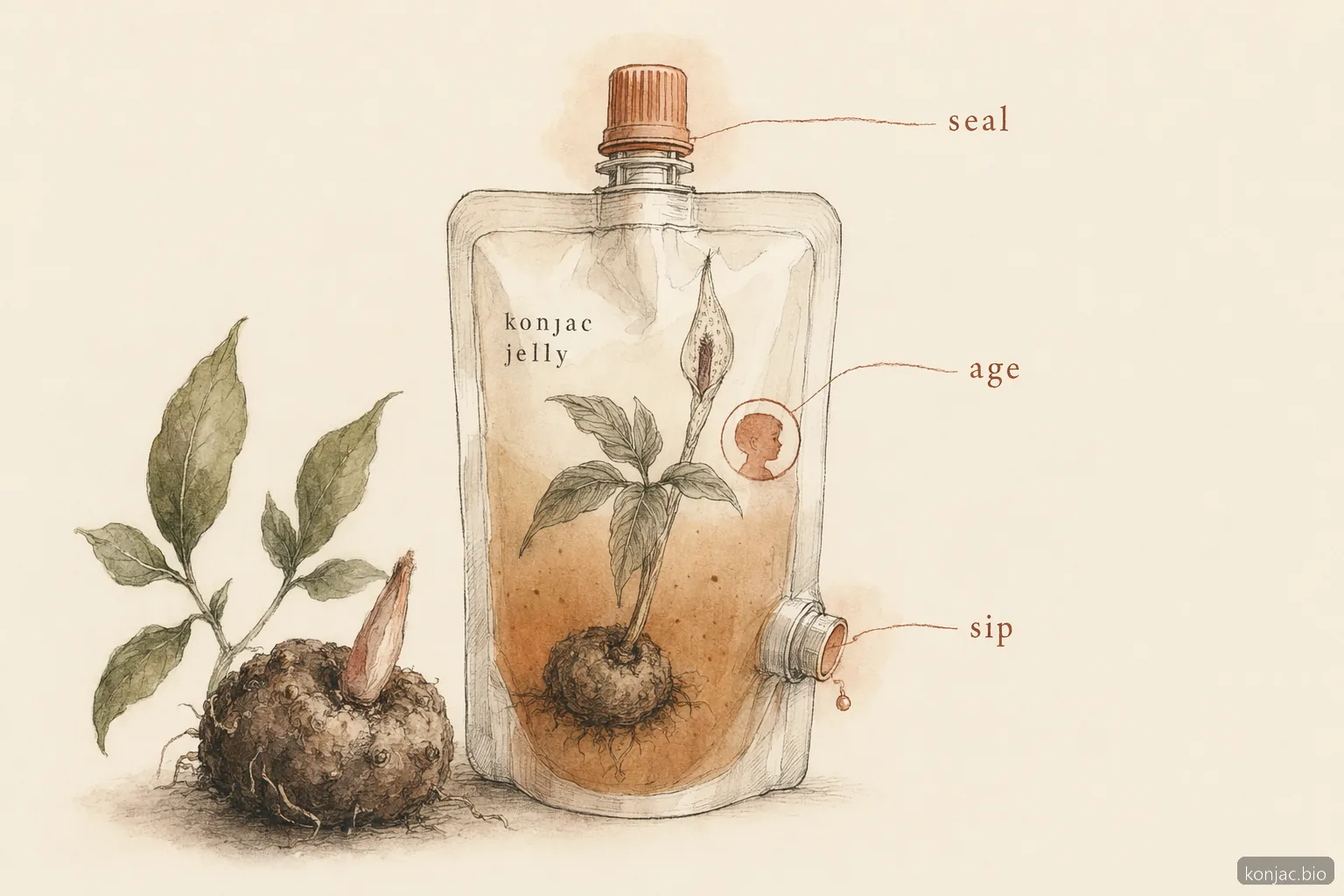
Safety checks for a konjac jelly pouch start with texture, serving instructions, age guidance, and choking warnings. Konjac gels can be elastic, so the safest products are designed to be squeezed, chewed, and swallowed in small amounts rather than swallowed whole.
The strongest regulatory concern has historically focused on firm mini-cup gel candies, not all konjac jelly formats. FDA import controls identify gel candies that may pose a choking hazard, especially products meant to be consumed in one piece, under [Import Alert](https://www.accessdata.fda.gov/cms_ia/importalert_116.html). A pouch format can reduce that specific mini-cup use pattern, but the label still matters.
Check the front, back, and cap area before buying. A well-designed pouch should make age guidance, storage instructions, allergen information, and lot coding easy to find. Products for young children should be reviewed especially carefully because suction, running, laughing, or eating while reclined can increase choking risk with many jelly foods.
Manufacturers should also validate pouch integrity, seal strength, cap security, pH, heat process, and microbial limits. Retail buyers can ask for a specification sheet, certificate of analysis, allergen statement, and food safety certification such as ISO 22000, BRCGS, SQF, or HACCP documentation.
For related label and formulation checks, see konjac jelly safety and konjac jelly ingredients.
Pouches versus cups: format, texture, and retail fit
Pouches and cups serve different eating occasions even when the jelly base is similar. Pouches are portable, resealable when fitted with a cap, and easy to merchandise as an on-the-go snack. Cups are better for spoonable desserts, multipacks, and visual fruit inclusions.
Texture should match the package. A pouch needs controlled squeeze flow, so the gel cannot be too brittle or too firm. A cup can hold a cleaner cube-like or spoonable gel because the consumer does not need to push it through a spout or tear opening.
Retail positioning also changes. Pouches fit checkout coolers, lunchbox shelves, wellness snack aisles, and e-commerce variety packs. Cups fit dessert sections, Asian grocery multipacks, and family pantry packs.
| Format | Best fit | Key formulation concern |
|---|---|---|
| Pouch | Portable snacking and portion control | Squeezeability without watery separation |
| Cup | Spoonable dessert and multipacks | Clean gel set and stable fruit suspension |
| Mini cup | Small dessert portions | Choking-risk review and age guidance |
For B2B teams, konjac.bio sources konjac ingredients at wholesale scale for jelly, beverage, noodle, and functional food applications. Contact konjac.bio for specification review, MOQ discussion, and wholesale pricing.
Frequently asked questions
01 Is a konjac jelly pouch the same as konjac jelly?
02 Does a konjac jelly pouch contain real fiber?
03 Are konjac jelly pouches low in sugar?
04 Can children eat konjac jelly pouches?
05 What should brands ask suppliers before launching a konjac jelly pouch?
- 21 CFR 184.1374 Konjac Flour · U.S. Food and Drug Administration via eCFR · 2024
- Scientific Opinion on the substantiation of health claims related to konjac mannan glucomannan · European Food Safety Authority · 2010
- How to Understand and Use the Nutrition Facts Label · U.S. Food and Drug Administration · 2024
- Import Alert 33-15: Gel Candies That May Pose a Choking Hazard · U.S. Food and Drug Administration · 2024
- Glucomannan and Obesity: A Critical Review · PubMed · 2007