What is a konjac jelly snack?
A konjac jelly snack is a single-serve gel snack thickened with glucomannan from Amorphophallus konjac. The same ingredient family appears in shirataki noodles, konjac powders, jelly cups, and squeeze pouches, but snack formulas add fruit flavor, acid, sweetener, and stabilizers for a dessert-like bite.
Konjac glucomannan is a high-viscosity soluble fiber extracted from the konjac corm, a storage organ used across East and Southeast Asian food systems. In the United States, konjac flour is listed by the FDA for food use as a stabilizer, thickener, texturizer, film former, and gelling agent under [konjac flour](https://www.accessdata.fda.gov/scripts/cdrh/cfdocs/cfcfr/CFRSearch.cfm?fr=172.880).
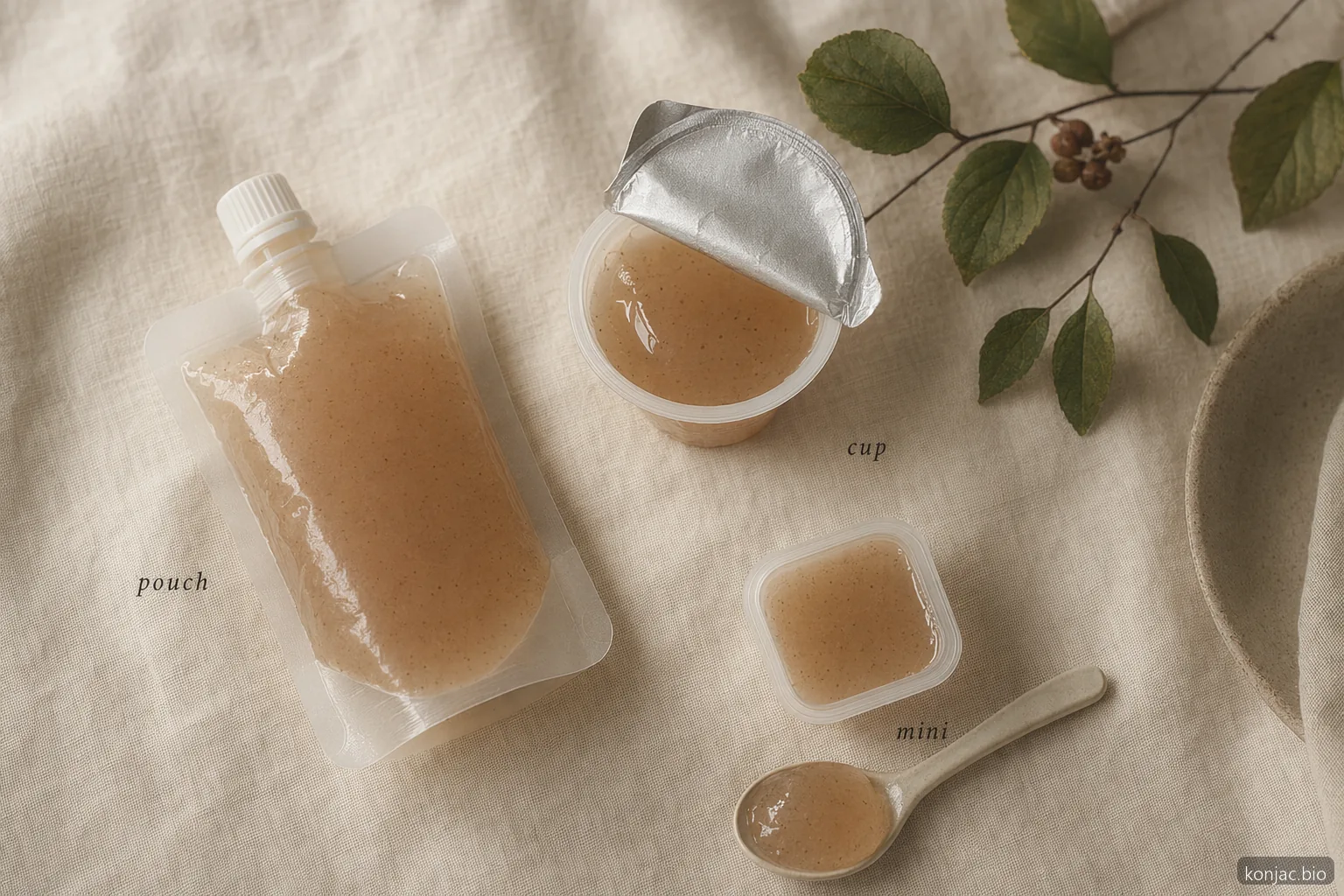
A typical konjac jelly snack appears in 3 retail formats:
- Mini cups: bite-sized molded gels, often sold in multipacks.
- Squeeze pouches: drinkable or spoonable gels, popular for portion control.
- Tray or tub gels: larger dessert portions eaten with a spoon.
For a wider category map, including Asian dessert origins and Western product styles, see Konjac Jelly: The Asian Dessert and Its Western Successors. Format matters because texture, swallowing behavior, and label expectations differ between a soft pouch gel and a firm mini cup.
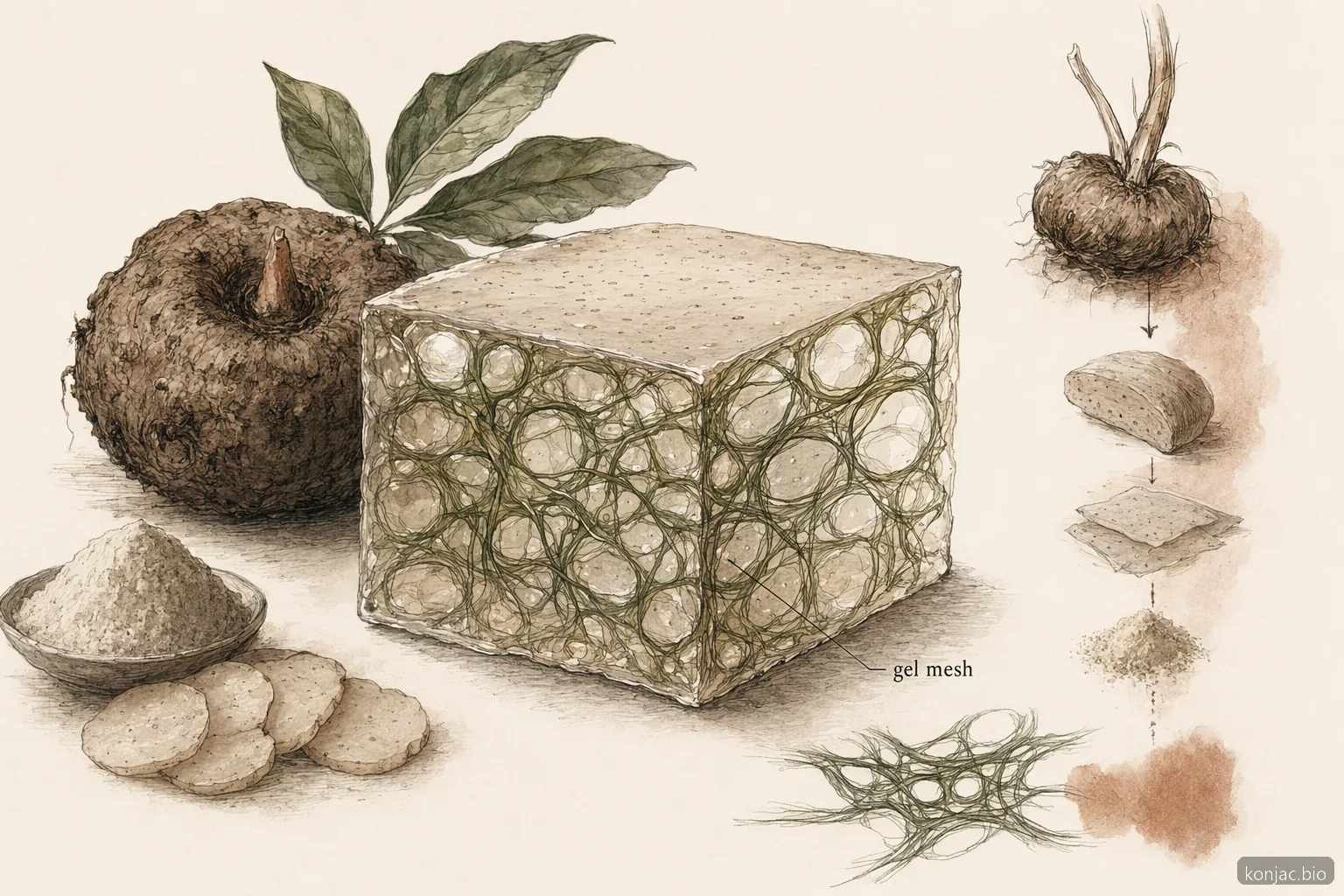
How does a konjac jelly snack get its chewy texture?
A konjac jelly snack gets its chewy texture when glucomannan hydrates in water and forms a thick, elastic gel with help from pH, heat, minerals, or other hydrocolloids. The result is firmer than gelatin dessert and more elastic than many pectin fruit gels.
Glucomannan is valued because it absorbs water and increases viscosity at low usage levels. Food formulators often blend it with carrageenan, xanthan gum, locust bean gum, agar, or gellan gum to adjust bite, clarity, syneresis, and heat tolerance. The FDA food additive listing recognizes konjac flour for gelling and thickening functions in foods, including texture systems built around hydrated konjac [FDA listing](https://www.accessdata.fda.gov/scripts/cdrh/cfdocs/cfcfr/CFRSearch.cfm?fr=172.880).
Texture usually depends on 5 controllable variables:
- Konjac level: higher usage generally increases chew and firmness.
- Hydration time: under-hydrated powder can create grainy or uneven gels.
- Acidity: fruit acids brighten flavor but can change gel strength.
- Sweetener load: sugar, erythritol, allulose, or sucralose affect body and aftertaste.
- Process heat: pasteurization and hot filling influence shelf stability and final texture.
For ingredient-system details, see konjac jelly ingredients. A good product feels springy, cuts cleanly with teeth, and does not require sucking a firm plug from a small container.
Konjac jelly snack nutrition and label checks
Nutrition varies more than shoppers expect because konjac is only one part of the formula. One pouch may be built around fiber and non-nutritive sweeteners, while another may contain fruit juice, sugar, and only a small amount of konjac flour.
Use this label checklist before buying:
| Label item | What to look for | Why it matters |
|---|---|---|
| Calories | Often 5 to 60 per serving | Depends on sugar, juice, and serving size |
| Dietary fiber | Listed grams per pouch or cup | Shows whether glucomannan meaningfully contributes fiber |
| Sweeteners | Sugar, allulose, erythritol, sucralose, stevia | Affects taste, calories, and digestive tolerance |
| Acids | Citric acid, malic acid, lactic acid | Creates fruit brightness and helps balance sweetness |
| Warnings | Chew well, age guidance, do not swallow whole | Especially important for firm mini-cup gels |
Konjac glucomannan has been evaluated for weight-management claims, but snack labels should not overstate what one jelly can do. EFSA’s authorized wording is precise: "Glucomannan in the context of an energy-restricted diet contributes to weight loss" [EFSA claim](https://www.efsa.europa.eu/en/efsajournal/pub/1798). EFSA also specified conditions of use, including 3 g of glucomannan daily in three 1 g doses with water before meals.
A 2013 systematic review of randomized controlled trials found that glucomannan did not produce a statistically significant body-weight effect across all included studies, which shows why dose, diet context, and product format matter [PubMed review](https://pubmed.ncbi.nlm.nih.gov/23581566/). A konjac jelly snack may support a lower-calorie routine when it replaces a higher-calorie dessert, but the nutrition panel is the evidence that counts.
Is a konjac jelly snack safe to eat?
A konjac jelly snack can be safe for most adults when it is soft, clearly labeled, chewed well, and eaten in an appropriate portion. The main safety concern is choking risk from firm mini-cup gels, not the basic use of konjac flour as a food texture ingredient.
The FDA has warned consumers about imported mini-cup gel candies containing konjac because some products presented a choking hazard, especially when a firm gel was sucked directly from a small cup [FDA warning](https://www.fda.gov/food/alerts-advisories-safety-information/fda-warns-consumers-about-imported-mini-cup-gel-candies-present-choking-hazard). Risk is higher for young children, older adults with swallowing difficulty, and anyone who swallows pieces without chewing.
Safer product design uses clear portioning and softer bite mechanics:
- Pouch gels: easier to portion slowly and less likely to release as one plug.
- Spoonable tubs: encourage smaller bites and visible portion control.
- Mini cups: need extra caution, firm warning text, and responsible age guidance.
For cup-specific guidance, see konjac jelly cup safety. Consumers should follow package directions, chew thoroughly, and avoid giving firm mini-cup gels to children who cannot reliably chew gummy textures.
Digestive tolerance also depends on serving size. Glucomannan is a fermentable soluble fiber, so large amounts may cause bloating or gas in some people. Starting with one serving and drinking water is more sensible than eating multiple pouches at once.
How should brands develop a better konjac jelly snack?
Brands should develop a better konjac jelly snack by designing around texture safety, clean flavor release, verified fiber content, and transparent labeling. A product that tastes good but releases as a firm, slippery plug is not a strong long-term category bet.
Product teams should define the target eating experience before choosing the gum system. A kids-adjacent snack may need a softer spoonable gel, while an adult weight-conscious pouch may prioritize low calories, fruit acidity, and 1 to 3 g fiber per serving. Shelf-stable products also need validated heat processing, pH control, and packaging compatibility.
A practical development brief should include:
- Format: pouch, tub, or cup.
- Target texture: spoonable, squeezable, gummy, or cuttable.
- Fiber target: declared grams per serving, verified by lab testing.
- Sweetener system: sugar, reduced sugar, or no added sugar.
- Safety language: chew instructions, age guidance, and serving directions.
- Quality system: HACCP plan, supplier COA, allergen controls, and ISO 22000 or equivalent food-safety certification where relevant.
For product developers, konjac.bio sources konjac ingredients at wholesale scale and can support specification-driven projects through contact. The strongest briefs start with the desired consumer bite, then work backward to konjac grade, hydration protocol, flavor system, and packaging format.
Frequently asked questions
01 Is a konjac jelly snack the same as gelatin?
02 Are konjac jelly snacks low calorie?
03 Can a konjac jelly snack help with fullness?
04 Are konjac jelly snacks safe for children?
05 What should I look for on a konjac jelly snack label?
- Scientific Opinion on the substantiation of health claims related to glucomannan and weight management · European Food Safety Authority · 2010
- 21 CFR 172.880 Konjac flour · U.S. Food and Drug Administration · 2024
- Effect of glucomannan on body weight in overweight or obese children and adults · PubMed · 2013
- FDA warns consumers about imported mini-cup gel candies that present a choking hazard · U.S. Food and Drug Administration · 2001