What is konjac liquor?
Konjac liquor is a hydrated konjac liquid, sol, or slurry made by mixing konjac flour or purified konjac gum with water.
The term can sound confusing because liquor often means alcohol in consumer language. In food processing, liquor can also mean a process liquid, extract, or viscous dispersion. For konjac, the active hydrocolloid is glucomannan, a soluble dietary fiber from the corm of Amorphophallus konjac, a plant listed in the Kew record.
Konjac liquor is best understood as an intermediate ingredient. It is not the same as finished konjac noodles, shirataki brine, konjac jelly, or dry konjac flour. A factory may prepare konjac liquor before adding calcium hydroxide, acids, sweeteners, salts, flavor systems, or proteins.
The parent ingredient family is covered in the konjac guide, including the plant, powder, gum, and finished foods. This page focuses on the liquid preparation used during formulation and production.
How is konjac liquor made from konjac flour?
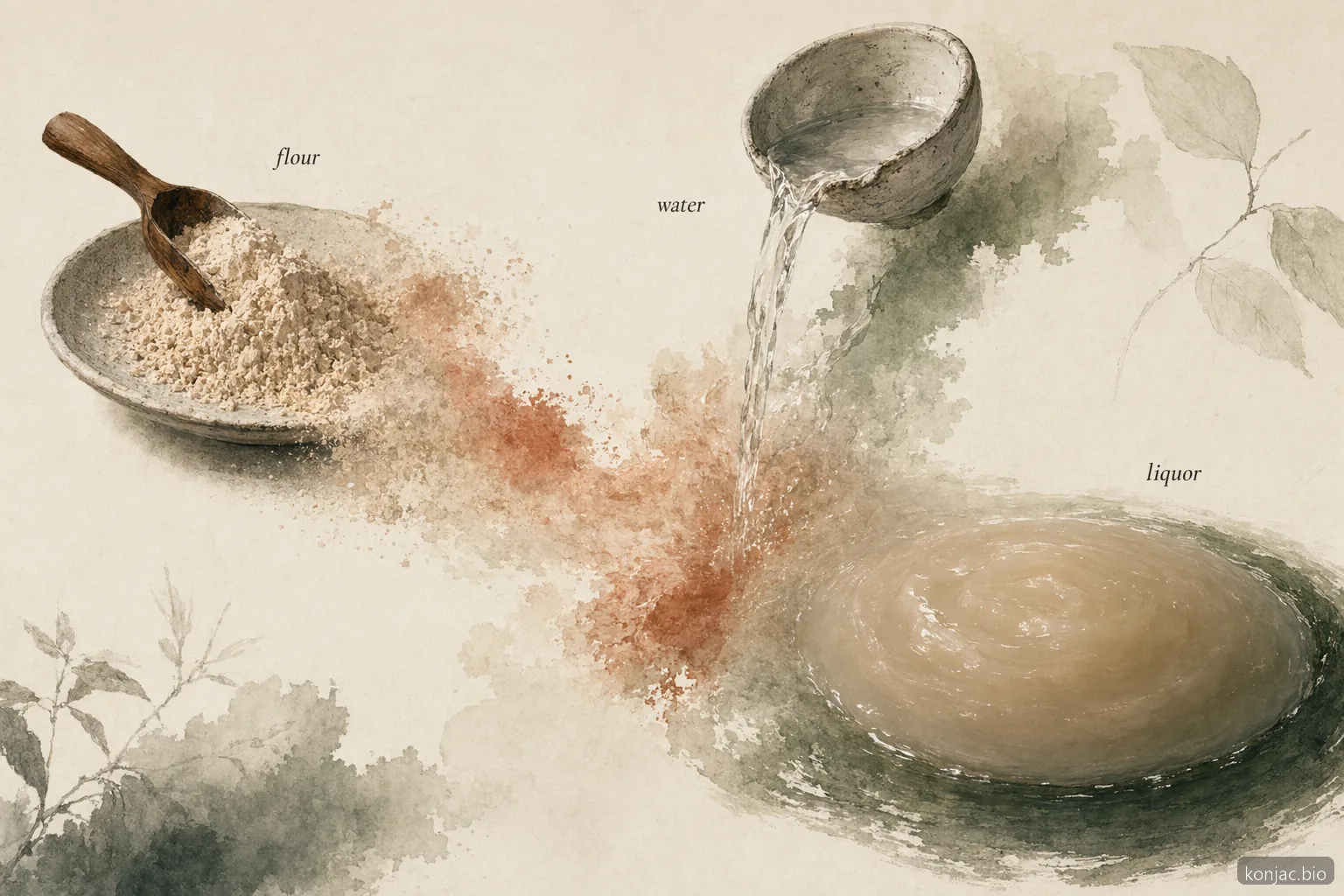
Konjac liquor is made by dispersing konjac flour or konjac gum into water under controlled mixing until the glucomannan hydrates and thickens.
A typical process starts with deionized or potable water at room temperature or warm-processing temperature. Powder is added slowly under agitation to limit fisheyes, which are dry clumps with hydrated surfaces and unhydrated cores. Hydration time can range from 20 minutes to several hours depending on particle size, grade, temperature, and target viscosity.
- Water charging: Add measured water to a mixing tank.
- Powder addition: Sift konjac flour or gum into the vortex or use a powder induction system.
- Hydration: Mix until viscosity develops uniformly.
- pH control: Adjust with alkaline or acidic systems if the finished product requires gelation or stability.
- Deaeration: Reduce bubbles before filling, extrusion, or gel setting.
Konjac glucomannan has been evaluated by EFSA for specific health claims, including the approved wording, “Glucomannan in the context of an energy restricted diet contributes to weight loss,” with defined use conditions in the EFSA opinion. A separate PubMed review evaluated randomized controlled trials on glucomannan and body weight, which is relevant when brands make label or marketing claims.
B2B aside: konjac.bio sources konjac ingredients at wholesale volumes for brands, distributors, and manufacturers. For grade selection, documentation, and pricing, use the contact form.
Konjac liquor vs konjac gel, paste, gum, and shirataki brine
Konjac liquor sits between dry powder and finished food. It has enough water to move through tanks, pumps, and filling systems, but it may not be fully gelled or ready to eat.
| Term | What it means | Typical state | Main use |
|---|---|---|---|
| Konjac flour | Ground, dried konjac corm material | Dry powder | Base ingredient |
| Konjac gum | Purified glucomannan-rich ingredient | Dry powder | Hydrocolloid and thickener |
| Konjac liquor | Hydrated konjac dispersion | Liquid to viscous slurry | Intermediate manufacturing base |
| Konjac paste | Thicker hydrated mass | Paste | Fillings, batters, extrusion |
| Konjac gel | Set matrix, often alkaline-set | Firm gel | Jelly, vegan seafood, noodle blocks |
| Shirataki brine | Packing liquid around noodles | Watery liquid | Product storage medium |
The distinction matters because specifications change by form. Dry powders are usually judged by mesh size, glucomannan content, sulfur dioxide, ash, moisture, and viscosity. Liquor is judged by solids percentage, hydrated viscosity, odor, pH, color, microbial limits, and pumpability.
Regulatory naming also matters. The Codex General Standard for Food Additives lists konjac gum as INS 425(i) and konjac glucomannan as INS 425(ii) in the Codex GSFA. Finished product labels should use the legal ingredient name required in the sales market, not an internal factory shorthand such as konjac liquor.
Is konjac liquor safe to eat or drink?
Konjac liquor can be safe in food applications when it is properly hydrated, formulated, processed, labeled, and used in an appropriate product format.
The main practical risk is not the word liquor, but texture and hydration. Dry or under-hydrated glucomannan can swell strongly in water, so manufacturers design serving formats that avoid rapid swelling in the throat. Firm, slippery mini-cup gels have drawn regulatory concern because of choking hazards, and FDA published a FDA advisory on mini-cup gel candies containing konjac.
For beverage developers, konjac liquor is usually used at low levels and under high-shear mixing to create body, suspension, or fiber content. A drinkable product should not contain hard gel particles that can separate, lodge, or swell unpredictably. Viscosity should be measured after full hydration, not immediately after powder addition.
Quality systems should include HACCP, supplier approval, certificate of analysis checks, metal detection, allergen review, and microbiological testing. Common checks include total plate count, yeast and mold, coliforms, E. coli, and Salmonella, with limits set by the product type and destination market.
Manufacturing specs that matter for konjac liquor
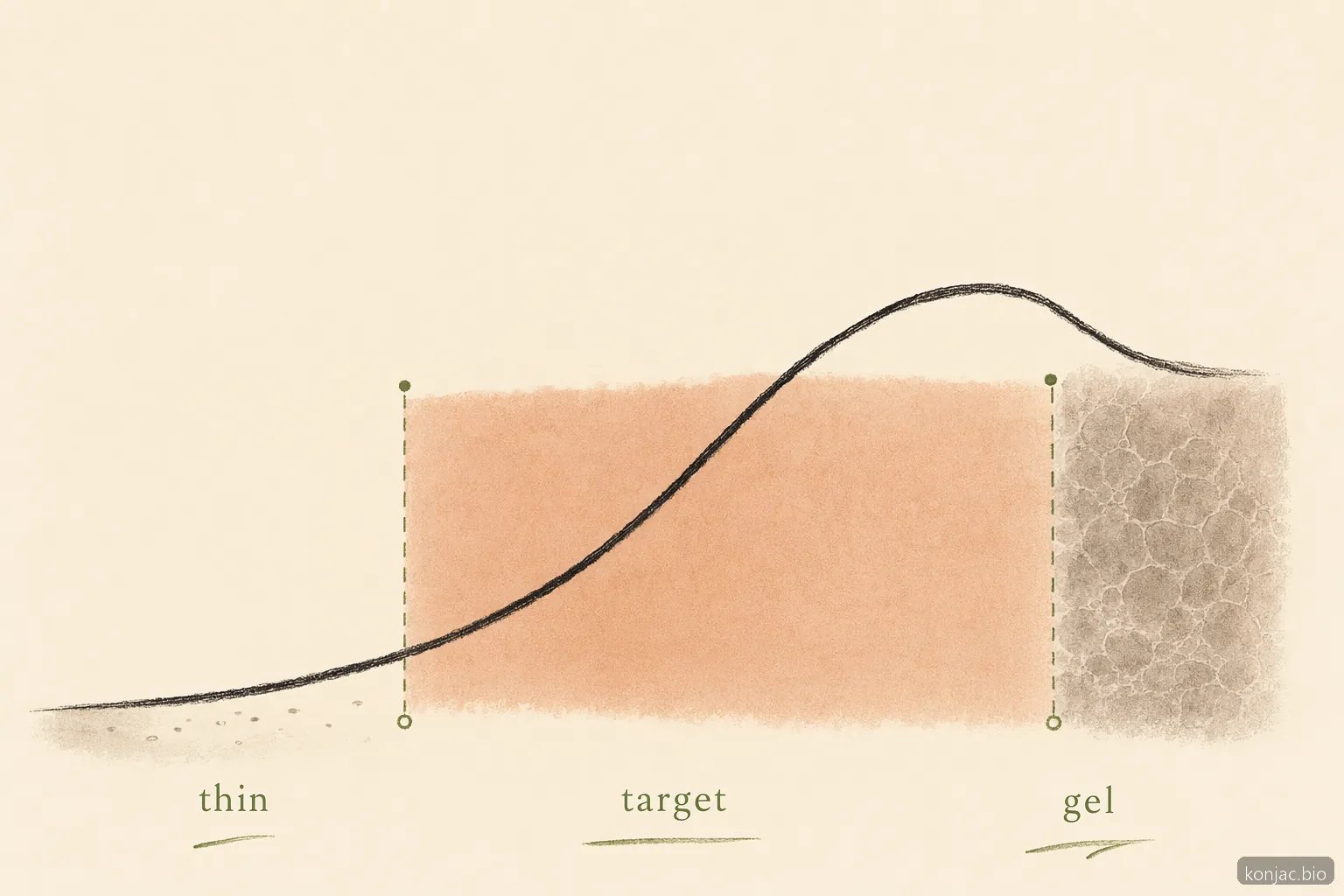
Manufacturers should specify konjac liquor by performance, not by the name alone. The same phrase can describe a thin 0.3 percent dispersion, a pumpable 1 percent slurry, or a thick pre-gel for extrusion.
Useful buying and production specifications include:
- Konjac grade: flour or purified gum, with declared glucomannan content.
- Solids level: percentage of konjac ingredient in the hydrated liquor.
- Viscosity method: spindle, speed, temperature, hydration time, and concentration.
- Particle size: mesh or micron range for hydration speed and mouthfeel.
- Odor: neutral, low-fish, or deodorized grade depending on application.
- pH: target range before and after any alkaline setting step.
- Heat step: pasteurization, hot fill, retort, or chilled processing.
- Microbiology: limits matched to ready-to-eat, beverage, frozen, or further-processing use.
Application testing is the fastest way to avoid purchasing mistakes. A konjac liquor that works in vegan calamari rings may be too elastic for a spoonable dessert. A dispersion that gives excellent suspension in sauce may create haze or stringiness in a low-acid beverage.
For commercial scale-up, request a technical data sheet, certificate of analysis, allergen statement, GMO statement if needed, country-of-origin documentation, and food safety certification such as ISO 22000, FSSC 22000, BRCGS, or SQF. Pilot trials should record water temperature, powder addition rate, hydration time, mixer speed, and final viscosity.
Frequently asked questions
01 Is konjac liquor an alcoholic drink?
02 What is konjac liquor used for in food production?
03 How much konjac powder is used to make konjac liquor?
04 Why does konjac liquor smell fishy sometimes?
05 Can konjac liquor be used in beverages?
06 What documents should a konjac liquor supplier provide?
- Scientific Opinion on health claims related to konjac mannan, glucomannan · European Food Safety Authority · 2010
- A systematic review of the effect of glucomannan on body weight · PubMed · 2008
- Consumer Advisory: Mini-Cup Gel Candy Products Containing Konjac · U.S. Food and Drug Administration · 2001
- Codex General Standard for Food Additives: Konjac gum · FAO Codex GSFA · 2024
- Amorphophallus konjac plant record · Plants of the World Online, Kew · 2024