What is konjac pasta?
Konjac pasta is a noodle-style food made from konjac glucomannan, water, and a food-grade alkaline setting agent.
The fiber comes from the corm of Amorphophallus konjac, a plant in the Araceae family listed by Kew as a recognized species [Kew record](https://powo.science.kew.org/taxon/urn:lsid:ipni.org:names:84487-1). The corm is dried, milled, and refined into konjac flour or purified glucomannan, then hydrated into a firm gel.
Most konjac pasta sold in pouches is already cooked and packed in water. The common shapes include spaghetti, fettuccine, angel hair, and rice-shaped pieces. These products overlap with shirataki, the Japanese term often used for translucent konjac noodles.
Konjac pasta is part of the wider konjac ingredient family, which includes flour, powder, jelly, vegan seafood analogs, and noodle products. For shape-by-shape comparisons, see konjac noodles and shirataki noodles.
How does konjac pasta compare with wheat pasta?
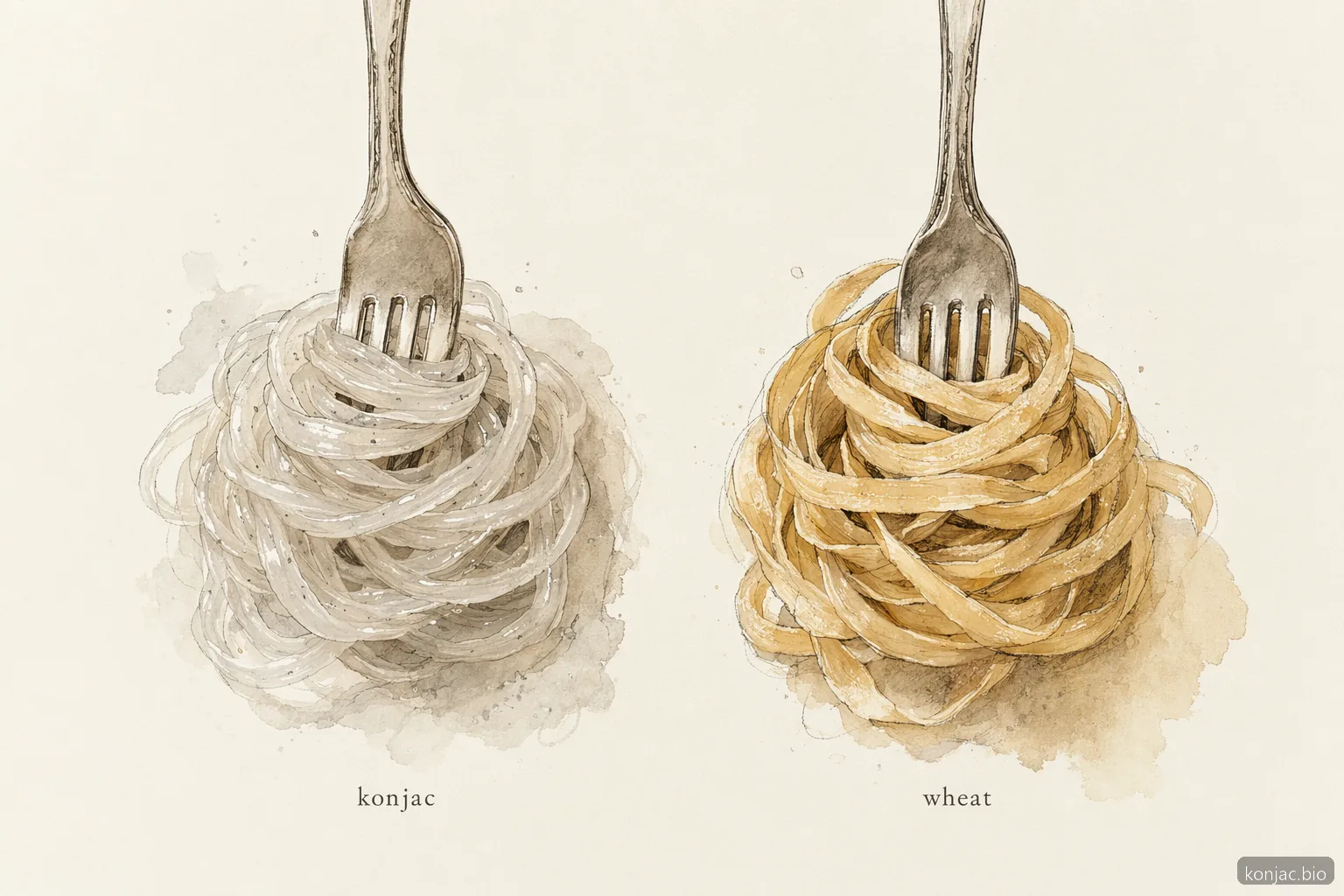
Konjac pasta has far fewer calories and digestible carbohydrates than wheat pasta, but it also has less protein and a more elastic, gel-like bite.
The difference is mainly water content. Pouched konjac pasta is often more than 90% water by weight, while cooked wheat pasta contains starch, gluten-forming proteins, and absorbed cooking water. Cooked enriched spaghetti has about 158 calories per 100 grams in USDA FoodData Central [USDA data](https://fdc.nal.usda.gov/fdc-app.html#/food-details/168930/nutrients), while many konjac pasta labels list 5 to 20 calories per 100 grams.
| Factor | Konjac pasta | Cooked wheat pasta |
|---|---|---|
| Main structure | Glucomannan gel | Wheat starch and gluten |
| Typical calories | 5 to 20 kcal per 100 g | About 158 kcal per 100 g |
| Digestible carbs | Usually very low | Mostly starch |
| Protein | Usually minimal | About 5 to 6 g per 100 g |
| Texture | Springy and slippery | Soft, starchy, and chewy |
| Best use | Brothy, saucy, stir-fried dishes | Traditional pasta dishes and baked casseroles |
Konjac pasta works well when the goal is volume with fewer calories. It is not a one-for-one replacement for wheat pasta in dishes that need starch to thicken a sauce or gluten to hold a baked structure.
How do you cook konjac pasta so it tastes good?
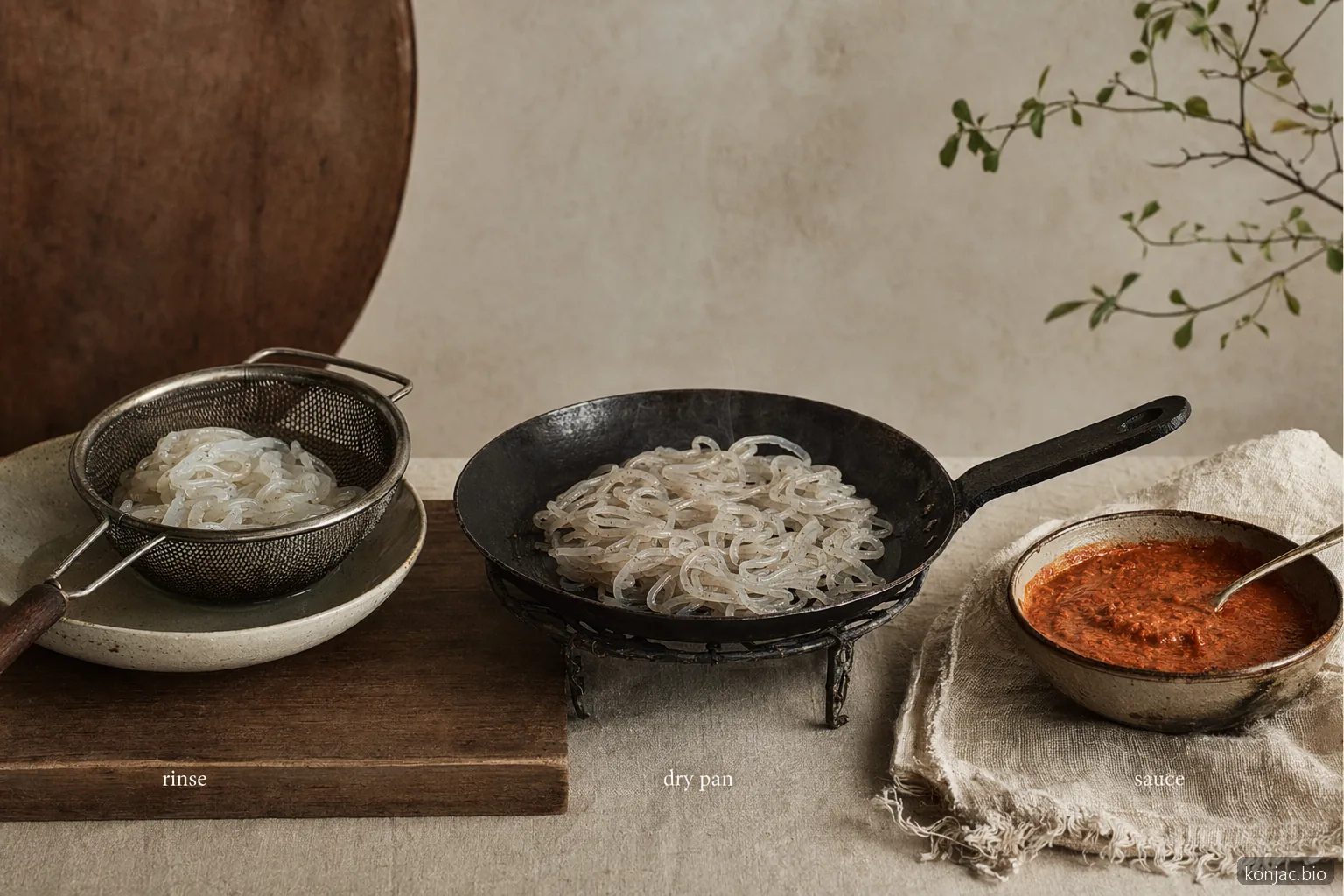
You cook konjac pasta best by rinsing it well, heating it briefly, then drying it in a pan before adding sauce.
The pouch liquid can smell mildly briny because of the alkaline setting process. The aroma is normal for many konjac products and usually disappears after rinsing and heating. Do not judge the finished dish from the smell in the unopened pouch.
- Drain: Pour the pasta into a sieve and discard the packing water.
- Rinse: Rinse under cool water for 30 to 60 seconds.
- Boil: Simmer for 1 to 2 minutes to warm and refresh the noodles.
- Dry-pan heat: Add to a nonstick pan with no oil for 2 to 4 minutes, tossing until surface water evaporates.
- Sauce: Add a bold sauce, then simmer for 1 to 3 minutes so the noodles pick up flavor.
Good pairings include tomato sauce with olives, miso broth, sesame ginger dressing, peanut sauce, curry, garlic chili oil, and mushroom ragù. Thin sauces cling less well because konjac pasta has little surface starch, so emulsified or reduced sauces usually perform better.
For meal balance, add protein and vegetables. Examples include tofu with bok choy, eggs with spinach, shrimp with zucchini, or white beans with tomato sauce.
Konjac pasta nutrition and glucomannan evidence
Konjac pasta nutrition is defined by three facts: high water content, very low energy density, and soluble glucomannan fiber.
Glucomannan has been reviewed for satiety, body weight, and cholesterol-related outcomes, but the evidence depends on dose, format, and total diet. The European Food Safety Authority approved this wording for weight management: "Glucomannan in the context of an energy restricted diet contributes to weight loss" [EFSA opinion](https://www.efsa.europa.eu/en/efsajournal/pub/1798). EFSA conditions specify 3 grams of glucomannan daily in three 1 gram doses, each taken with 1 to 2 glasses of water before meals.
That EFSA wording applies to glucomannan, not automatically to every serving of konjac pasta. A pouch may contain less glucomannan than a measured supplement dose because most of the pouch weight is water. Labels vary, so the fiber grams per serving matter more than the product name.
A PubMed-indexed critical review described glucomannan as a soluble, fermentable fiber with studied effects on appetite and lipid markers [PubMed review](https://pubmed.ncbi.nlm.nih.gov/18842808/). The NIH Office of Dietary Supplements also lists glucomannan among ingredients used in weight-management supplements and notes that evidence quality varies by trial design and product form [NIH ODS](https://ods.od.nih.gov/factsheets/WeightLoss-HealthProfessional/).
For everyday meals, konjac pasta is best viewed as a low calorie base rather than a complete food. It supplies volume, but most meals still need protein, fat, micronutrients, and flavor from other ingredients.
Is konjac pasta safe, and who should be careful?
Konjac pasta is generally used as a food, but dry glucomannan powders and firm konjac gels require careful handling because they absorb water and can be slippery or bulky.
Pouched konjac pasta is hydrated, soft, and eaten like noodles after rinsing and heating. The bigger safety concern is dry glucomannan taken without enough liquid, because it can swell before reaching the stomach. EFSA’s conditions for the authorized weight-management claim require taking glucomannan with 1 to 2 glasses of water per 1 gram dose [EFSA opinion](https://www.efsa.europa.eu/en/efsajournal/pub/1798).
Konjac mini-cup gel candies are a separate product category and have raised choking concerns, especially for children and older adults. The FDA has issued import actions for certain gel candies containing konjac because of choking risk [FDA import](https://www.accessdata.fda.gov/cms_ia/importalert_116.html).
Practical safety steps are simple:
- Chew konjac pasta well and eat it seated, not while walking or driving.
- Serve cut pieces to children only when texture and size are appropriate.
- Drink fluids with high-fiber meals.
- Start with a small serving if you are not used to soluble fiber.
- Check labels for sodium, allergens, and mixed ingredients such as soy, oat, or seaweed fiber.
Buying and formulation notes for konjac pasta
Good konjac pasta should have a clean ingredient list, consistent strand strength, neutral aroma after rinsing, and packaging that protects the hydrated gel.
Common ingredient panels include purified water, konjac flour or konjac powder, and calcium hydroxide. Some products add oat fiber, soybean fiber, seaweed powder, tapioca starch, or rice flour to change color, bite, and label positioning. These additions can raise calories or carbohydrates, so a low calorie claim should always be checked against the nutrition panel.
Buyers should compare four specifications before choosing a product:
- Net drained weight: The usable noodle weight after pouch liquid is removed.
- Fiber grams: The actual glucomannan or dietary fiber contribution per serving.
- Texture target: Spaghetti, fettuccine, rice, and ramen cuts behave differently in sauces.
- Process standard: Supplier controls such as HACCP, ISO 22000, or GFSI-benchmarked systems.
For food brands, restaurants, and distributors, konjac.bio sources konjac ingredients and finished konjac formats at wholesale scale. Use /contact/ to discuss specifications, volumes, and private-label needs.
Retail shoppers can keep quality high by choosing intact pouches, checking best-by dates, and storing unopened products as directed on the label. Once opened, leftover konjac pasta should be refrigerated in fresh water and used quickly according to the manufacturer’s instructions.
Frequently asked questions
01 Is konjac pasta the same as shirataki noodles?
02 Does konjac pasta taste like regular pasta?
03 Is konjac pasta low carb?
04 Can konjac pasta help with weight management?
05 Why does konjac pasta smell odd when opened?
06 How much konjac pasta should I eat at once?
- Scientific Opinion on the substantiation of health claims related to konjac mannan (glucomannan) · European Food Safety Authority · 2010
- Glucomannan and obesity: a critical review · PubMed · 2005
- Dietary Supplements for Weight Loss: Fact Sheet for Health Professionals · NIH Office of Dietary Supplements · 2024
- Import Alert 33-15: Detention Without Physical Examination of Konjac Gel Candy · U.S. Food and Drug Administration · 2024
- Amorphophallus konjac K.Koch · Plants of the World Online, Kew · 2024