What are konjac plants?
Konjac plants are perennial aroids, mainly Amorphophallus konjac, cultivated for a large underground corm that stores glucomannan-rich starch and fiber.
The species belongs to the Araceae family, the same botanical family as taro and philodendron. Taxonomic databases list Amorphophallus konjac as an accepted species, with native range and cultivation centered in East and Southeast Asia, including China and Japan, according to Kew POWO.
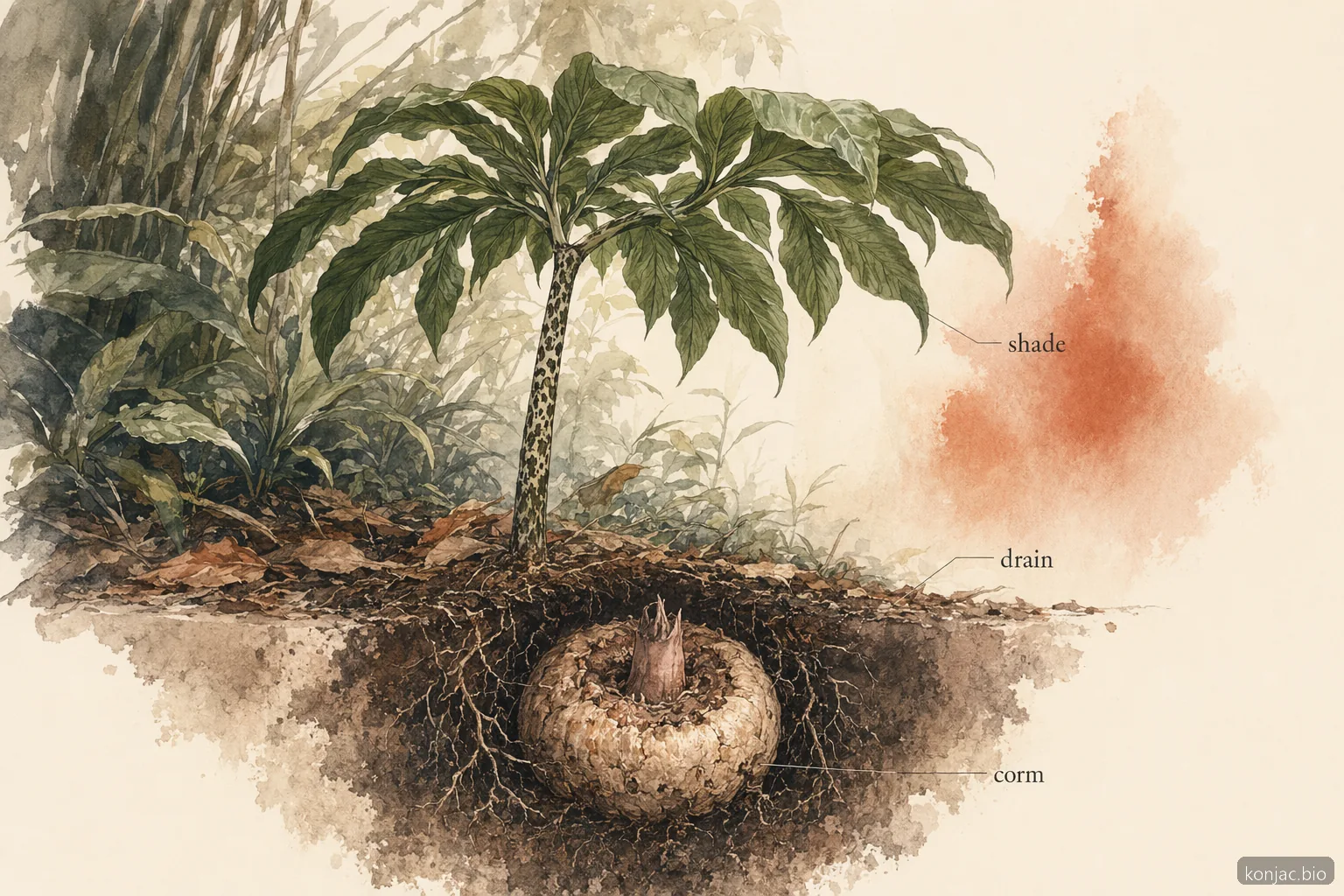
A mature plant sends up one umbrella-like leaf from the corm, not a conventional leafy stem. Under suitable conditions, older corms can also produce a striking inflorescence with a spathe and spadix, a structure typical of many aroids.
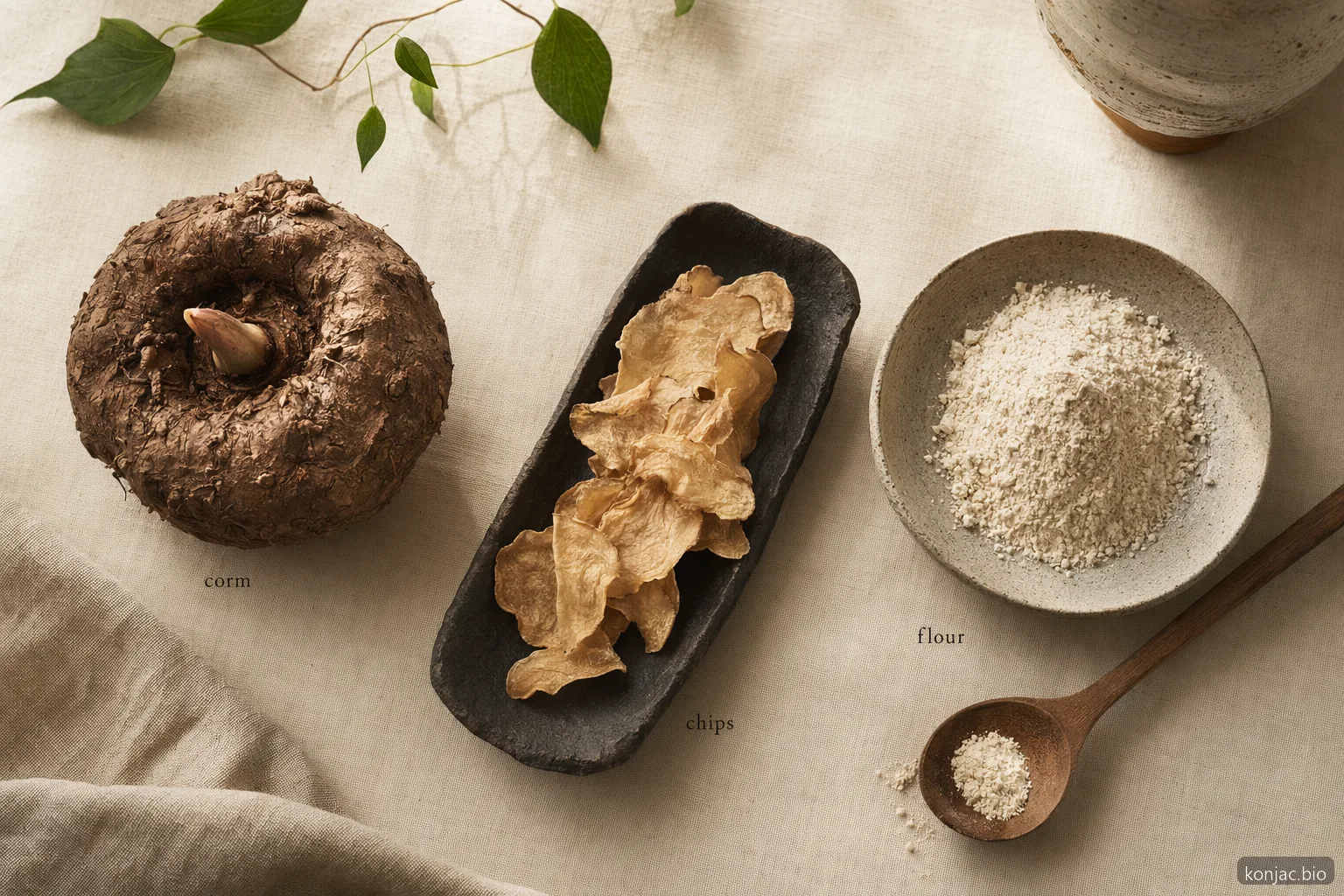
The edible and industrial value is concentrated below ground. The corm is sliced, dried, milled, and refined into konjac flour or purified glucomannan. For the broader ingredient family, see the parent guide to konjac.
Where do konjac plants grow best?
Konjac plants grow best in warm, humid, partially shaded areas with loose, well-drained soil and a long frost-free season.
The crop is associated with hilly subtropical regions where summer warmth supports leaf growth and winter dormancy allows corm storage. Flora of China records Amorphophallus konjac across forest margins, thickets, and cultivated areas in several Chinese provinces, with botanical details in Flora China.
Good drainage is essential because the corm is a storage organ that can rot in waterlogged soil. In field production, growers often use raised beds, organic matter, and spacing that gives each corm room to expand.
| Growing factor | Practical target | Why it matters |
|---|---|---|
| Light | Partial shade | Reduces leaf scorch in hot areas |
| Soil | Loose, fertile, well-drained | Supports corm expansion and lowers rot risk |
| Temperature | Warm growing season | Drives leaf photosynthesis and corm gain |
| Water | Even moisture, no standing water | Keeps growth steady without saturating corms |
Small growers sometimes compare konjac to taro because both are aroids with underground storage organs. The practical difference is end use: taro is commonly cooked as a starchy vegetable, while konjac is mainly processed to isolate functional glucomannan.
How are konjac plants cultivated and harvested?
Konjac plants are usually propagated from seed corms or cormels, grown for two to three seasons, then harvested when the corm reaches processing size.
The growth cycle starts when a dormant corm sprouts a single large leaf. That leaf captures energy during the warm season, then collapses naturally as the plant enters dormancy. Each cycle adds mass to the underground corm if moisture, soil, and nutrition are balanced.
- Select planting material: growers use healthy seed corms or side cormels with no visible rot.
- Plant after frost risk: corms are set into loose soil when temperatures are warm enough for emergence.
- Manage canopy: partial shade and weed control protect the single leaf that feeds the corm.
- Lift during dormancy: corms are harvested after the leaf dies back and skins firm.
- Sort and clean: small corms are saved for replanting, while larger corms move to processing.
Harvest timing affects yield and quality. Immature corms have less dry matter, while over-wet harvest conditions can increase handling losses. Commercial buyers usually focus on dry basis glucomannan content, viscosity, ash, sulfur dioxide residue if bleaching is used, and microbiological specifications.
From corm to ingredient: what konjac plants become
The commercial pathway from konjac corm to ingredient is a drying and milling sequence designed to concentrate glucomannan and reduce moisture, starch, and insoluble residues.
Fresh corms are highly perishable, so processors typically wash, peel or trim, slice, and dry them soon after harvest. Dried chips are milled into crude flour, then air-classified, washed with alcohol, or otherwise purified depending on the target specification.
Purified konjac glucomannan is valued because it hydrates into a very viscous solution at low inclusion rates. EFSA evaluated glucomannan and authorized the claim: “Glucomannan in the context of an energy restricted diet contributes to weight loss,” with conditions described in the EFSA opinion. Product labels still need to follow local rules, serving conditions, and consumer warning language.
| Output | Typical use | Key quality signal |
|---|---|---|
| Konjac chips | Intermediate raw material | Low moisture, clean slicing |
| Konjac flour | Gels, thickening, fiber blends | Viscosity and glucomannan content |
| Purified glucomannan | Capsules, powders, food systems | Particle size, purity, hydration rate |
| Shirataki | Ready-to-eat noodles | Texture, odor control, water pack stability |
For formulators, konjac.bio sources konjac flour and glucomannan at wholesale volumes, with documentation available through contact.
Konjac plants, safety, and product standards
Konjac plants are food-source crops, but finished products need correct hydration, sizing, labeling, and quality controls because concentrated glucomannan forms dense, elastic gels.
The main safety concern is physical form, not the living plant in a field. The U.S. FDA has warned about mini-cup gel candies containing konjac gum because small, firm gels may pose a choking hazard, especially when consumed by children, as described by FDA jelly.
Powdered glucomannan also needs clear preparation directions because it swells rapidly in water. A practical label directs consumers to mix with enough liquid and avoid dry swallowing. Industrial buyers often request COA data for viscosity, mesh size, moisture, ash, heavy metals, microbial counts, and residual processing aids.
For B2B procurement, production standards matter as much as botanical identity. Common documentation includes HACCP plans, allergen statements, pesticide screening, ISO 22000 or FSSC 22000 certification where available, and traceability from corm lot to finished powder lot.
Frequently asked questions
01 Are konjac plants edible?
02 How long do konjac plants take to grow?
03 Can konjac plants grow indoors?
04 What is the difference between konjac plants and konjac flour?
05 Why are konjac plants important to food manufacturers?
- Amorphophallus konjac taxon record · Plants of the World Online, Royal Botanic Gardens, Kew · 2025
- Amorphophallus konjac in Flora of China · eFloras, Missouri Botanical Garden and Harvard University Herbaria · 2010
- Scientific Opinion on the substantiation of health claims related to glucomannan · European Food Safety Authority · 2010
- Mini-Cup Gel Candy Products Containing Konjac Gum · U.S. Food and Drug Administration · 2001