What is konjac root?
Konjac root is the edible underground corm of Amorphophallus konjac, an Asian aroid processed mainly for glucomannan fiber. Botanically, it is closer to a swollen storage stem than a true root, but “konjac root” is the common food and supplement term used by consumers and suppliers.
The plant belongs to the Araceae family and is listed by Kew under the accepted species name Amorphophallus konjac [Kew profile](https://powo.science.kew.org/taxon/urn:lsid:ipni.org:names:84323-1). The usable corm is peeled, sliced, dried, milled, and purified to concentrate glucomannan, the soluble fiber responsible for konjac’s water-binding texture.
Konjac has a long food history in East Asia, especially in Japan and China. Traditional forms include konnyaku blocks, shirataki noodles, and jelly-like foods made by combining konjac flour with water and a food-grade alkaline coagulant.
For a broader ingredient overview, see the parent guide: Konjac: The Complete Guide to the Plant, Powder, and Products.
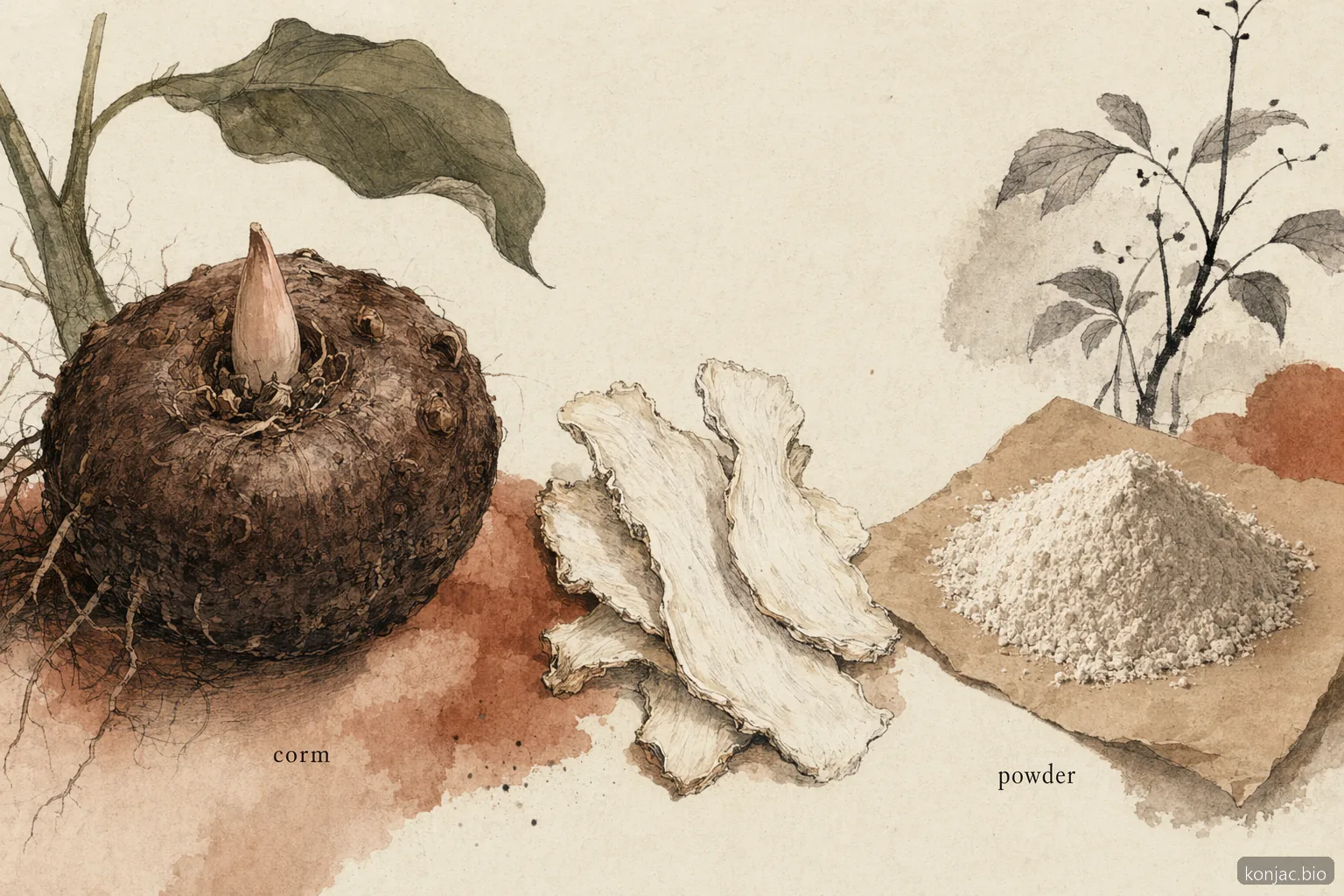
How is konjac root turned into glucomannan powder?
Konjac root is turned into glucomannan powder by drying the corm, milling it, and separating starch, fiber, and impurities until a high-viscosity soluble fiber powder remains. The exact process depends on whether the final product is food-grade flour, refined gum, or a supplement ingredient.
A typical konjac powder process follows 5 steps:
- Harvesting: Mature corms are collected when the plant has stored enough carbohydrate and fiber.
- Cleaning and peeling: Soil, outer skin, and damaged tissue are removed before slicing.
- Drying: Slices or chips are dried to reduce moisture and improve shelf stability.
- Milling: Dried chips are ground into flour with controlled particle size.
- Purification: Air classification, sieving, washing, or alcohol-based purification can raise glucomannan content and reduce odor.
Crude konjac flour usually has more color, aroma, minerals, and residual starch than purified konjac gum. Refined glucomannan is selected when manufacturers need clearer gels, higher viscosity, and more predictable hydration.
B2B aside: konjac.bio sources food-grade konjac root derivatives at wholesale volumes, and purchasing teams can request specifications through /contact/.
What is konjac root used for?
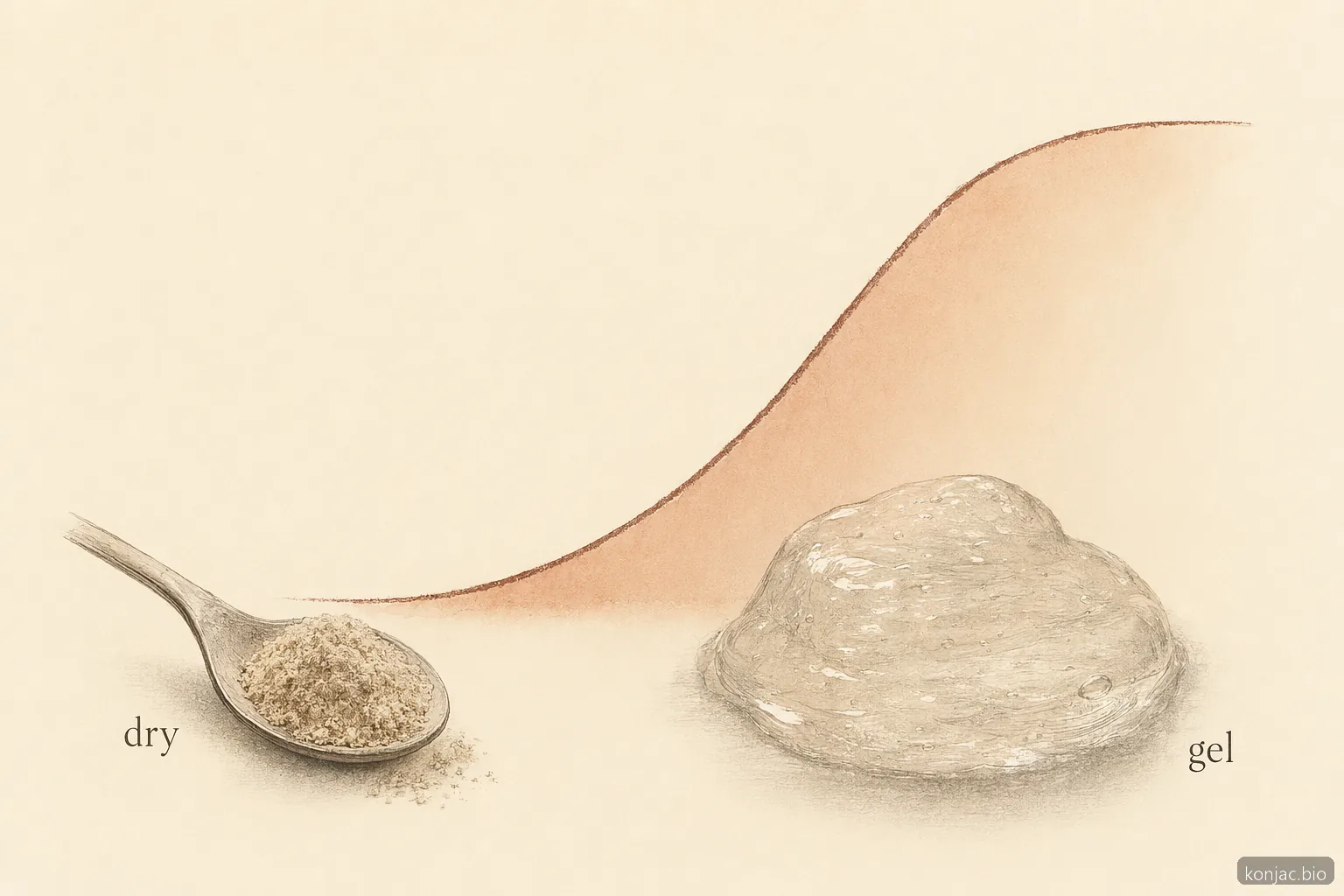
Konjac root is used for low-calorie noodles, konnyaku gels, thickening systems, vegan textures, and glucomannan fiber supplements. Its value comes from one technical property: glucomannan can absorb many times its weight in water and create a firm or elastic gel depending on formula conditions.
| Use | Common form | Why konjac works |
|---|---|---|
| Shirataki noodles | Hydrated noodle | Very low digestible carbohydrate and springy texture |
| Konnyaku blocks | Set gel | Firm bite after alkaline setting |
| Thickened sauces | Powder | High water binding at low dosage |
| Vegan seafood or meat analogs | Gel matrix | Elastic structure and neutral flavor after rinsing |
| Fiber supplements | Capsules or powder | Concentrated glucomannan intake |
In retail foods, konjac is often recognized through shirataki noodles, which are usually packed in water and rinsed before cooking. In ingredient manufacturing, it is more often specified as konjac flour, konjac gum, or glucomannan powder.
Food labels may list konjac flour, konjac gum, glucomannan, or E425 in regions where that additive numbering system is used. Product performance depends on viscosity grade, particle size, hydration time, pH, mineral content, and heat process.
Konjac root nutrition and glucomannan benefits
Konjac root nutrition is defined less by vitamins or minerals and more by glucomannan, a soluble fiber that forms a viscous gel in water. Because purified products vary, buyers should compare glucomannan percentage, viscosity, moisture, ash, sulfur dioxide status, microbiology, and heavy metal specifications.
EFSA’s authorized wording for weight management is specific: 'Glucomannan in the context of an energy restricted diet contributes to weight loss' [EFSA claim](https://www.efsa.europa.eu/en/efsajournal/pub/1798). EFSA conditions describe 3 grams of glucomannan daily, taken in 3 doses of 1 gram each with 1 to 2 glasses of water before meals, and within an energy-restricted diet.
EFSA also assessed glucomannan and normal blood cholesterol, with a beneficial effect stated at a daily intake of 4 grams of glucomannan [EFSA opinion](https://www.efsa.europa.eu/en/efsajournal/pub/1258). These claims apply to glucomannan under defined intake conditions, not to every konjac snack, noodle bowl, or dessert.
A systematic review and meta-analysis found glucomannan was associated with changes in body weight, lipids, glucose, and blood pressure markers, but the authors also noted variation across trials [PubMed review](https://pubmed.ncbi.nlm.nih.gov/18842808/). For consumer products, responsible wording should stay within approved claim language or use cautious phrases such as “may support fullness” or “is associated with soluble fiber intake.”
Konjac root safety: hydration, choking risk, and labeling
Konjac root foods and glucomannan products are generally handled as food ingredients, but dry powders, capsules, and small firm gels need practical safety controls. The main issue is rapid swelling: glucomannan expands when it contacts water, so dry forms should be consumed with enough liquid and according to label directions.
The FDA has warned consumers about mini-cup gel candies containing konjac because their size, shape, and firmness can create a choking hazard [FDA warning](https://www.fda.gov/food/alerts-advisories-safety-information/fda-warns-consumers-not-eat-mini-cup-gel-candies-containing-konjac). This concern is about a specific candy format, not every konjac food.
For capsules and powders, practical label controls include:
- Take with a full glass of water.
- Do not consume dry powder directly.
- Keep away from young children unless the product is designed for them.
- Follow serving sizes, especially for concentrated glucomannan.
- Stop use if swallowing discomfort occurs.
Manufacturers should evaluate particle size, viscosity, hydration speed, allergen controls, microbiology, and contaminant testing. For wholesale specifications, stronger documentation often includes COA, HACCP plan, ISO 22000 or FSSC 22000 certification, pesticide screening, and country-of-origin traceability.
Frequently asked questions
01 Is konjac root actually a root?
02 What does konjac root taste like?
03 Is konjac root the same as glucomannan?
04 Does konjac root help with weight management?
05 Are konjac root noodles the same as shirataki noodles?
06 Who should be careful with konjac root products?
- Amorphophallus konjac K. Koch · Plants of the World Online, Royal Botanic Gardens, Kew · 2024
- Scientific Opinion on the substantiation of health claims related to glucomannan and weight loss · European Food Safety Authority · 2010
- Scientific Opinion on the substantiation of health claims related to konjac mannan and maintenance of normal blood cholesterol concentrations · European Food Safety Authority · 2009
- The effect of glucomannan on plasma lipid and glucose concentrations, body weight, and blood pressure: systematic review and meta-analysis · PubMed · 2008
- FDA Warns Consumers Not To Eat Mini-Cup Gel Candies Containing Konjac · U.S. Food and Drug Administration · 2001