What is the root of konjac?
The root of konjac is the edible underground corm of Amorphophallus konjac, a plant in the aroid family used to make glucomannan-rich foods and ingredients. The accepted botanical name is Amorphophallus konjac K.Koch in the Royal Botanic Gardens, Kew database [Kew taxon](https://powo.science.kew.org/taxon/urn:lsid:ipni.org:names:84462-1).
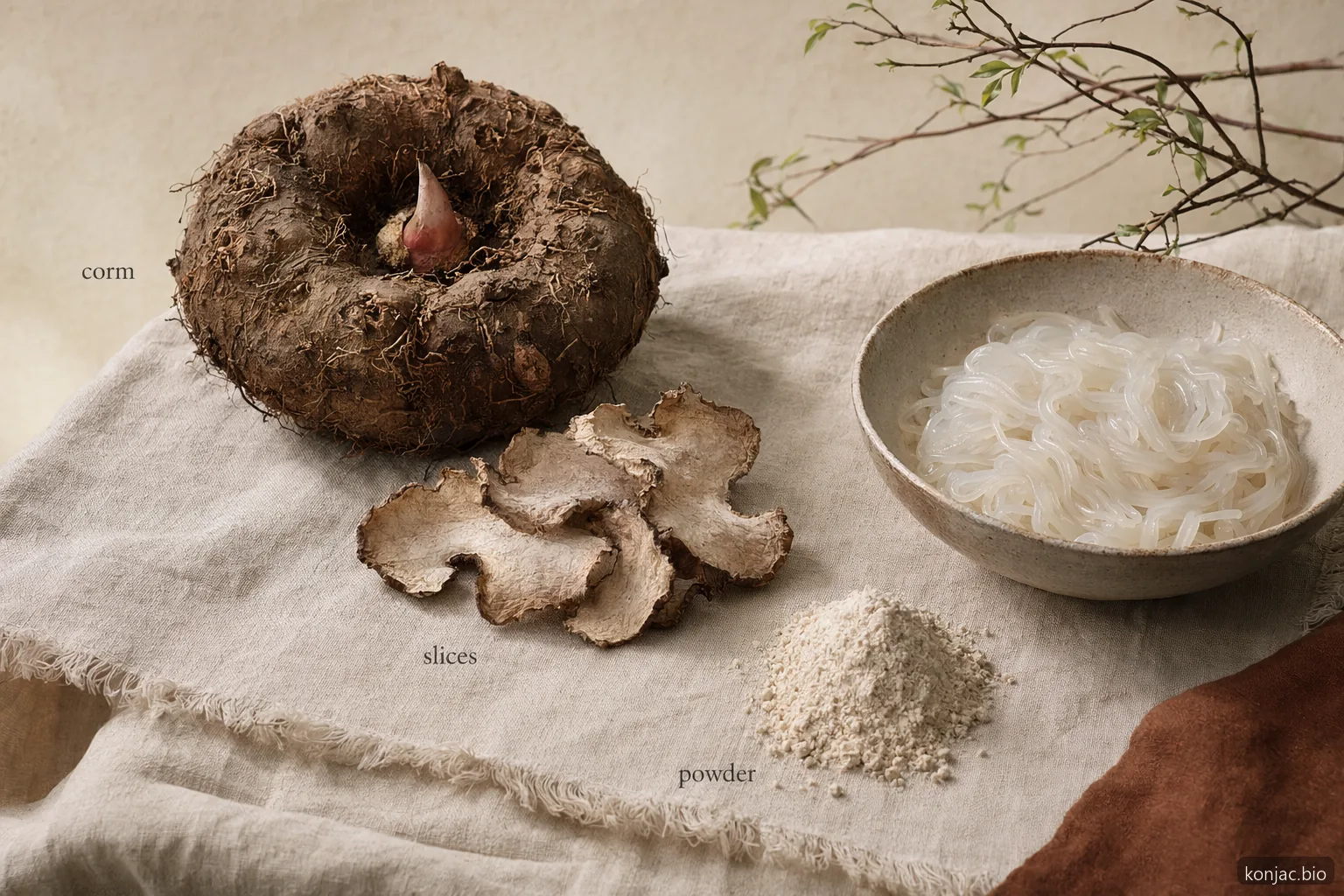
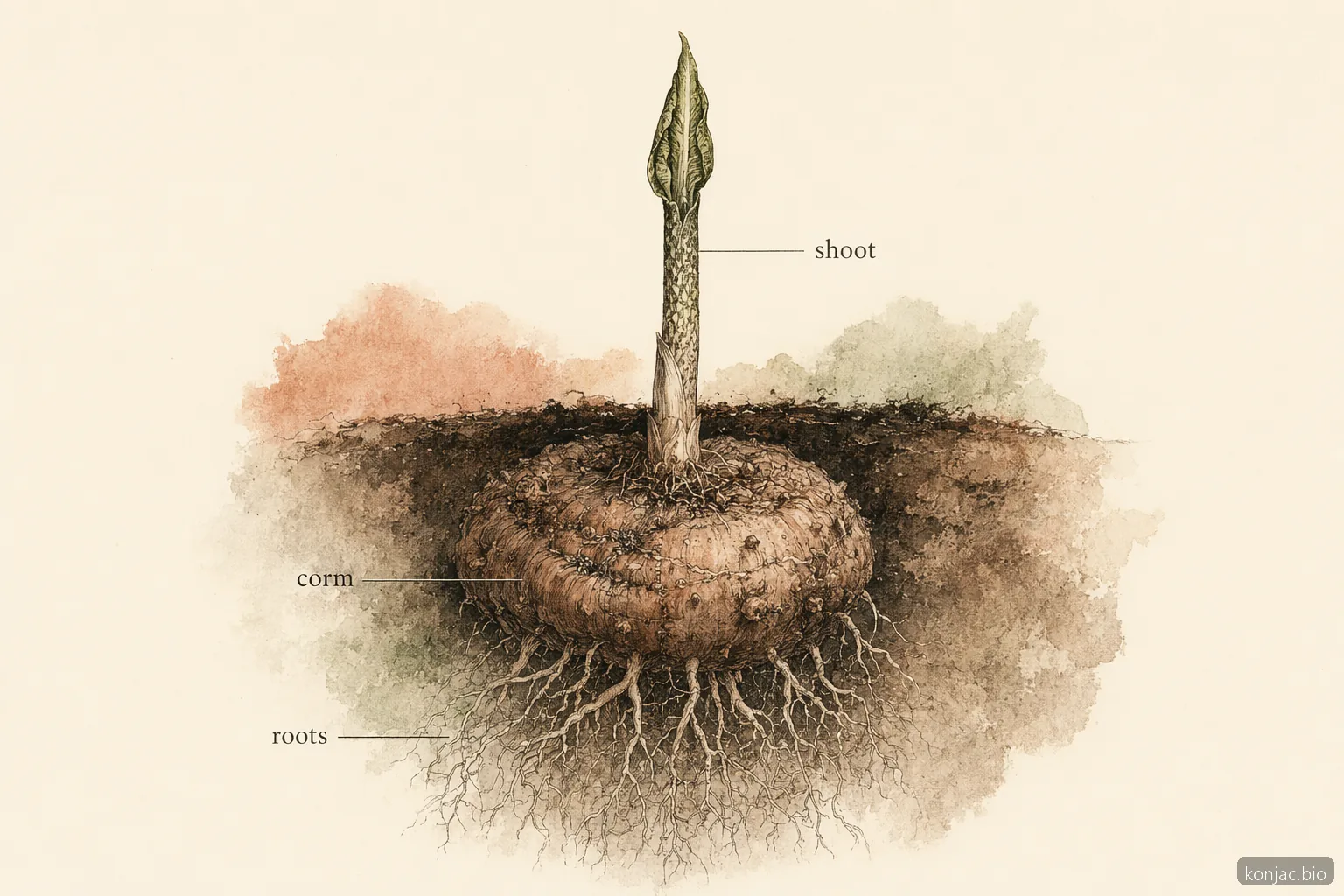
In food commerce, people say konjac root because the harvested part grows underground and looks like a rough, brown tuber. Botanically, it is better described as a corm, a swollen stem base that stores carbohydrate and supports regrowth.
The corm is valued because it contains glucomannan, a polysaccharide made from glucose and mannose units [PubChem](https://pubchem.ncbi.nlm.nih.gov/compound/Glucomannan). When hydrated, glucomannan forms a viscous gel that helps explain why konjac powder is used in shirataki noodles, plant-based gels, sauces, and calorie-reduced foods.
For a broader overview of the plant, powder, and product formats, see the parent guide: Konjac: The Complete Guide to the Plant, Powder, and Products.
Is the root of konjac actually a root?
No, the root of konjac is not a true root, it is a corm, which is a swollen underground stem used by the plant for storage. A corm differs from a root because it has stem tissue, buds, and a compact storage structure, while true roots mainly anchor the plant and absorb water and minerals [corm anatomy](https://www.britannica.com/science/corm).
This distinction matters for accuracy, but it does not change how buyers and consumers find the ingredient. Search terms such as konjac root, konjac tuber, konjac corm, and elephant yam often point to the same edible underground storage organ.
Konjac is also sometimes confused with yam, taro, or cassava because all are starchy-looking underground crops. The difference is that konjac is processed primarily for glucomannan fiber, not for eating as a cooked staple in the way potatoes or yams are commonly eaten.
- Common name: konjac root
- Botanical structure: corm
- Plant name: Amorphophallus konjac
- Main ingredient of interest: glucomannan
- Main food outputs: powder, shirataki noodles, jelly, thickening systems
How is the root of konjac processed into powder and noodles?
The root of konjac is processed by cleaning the corm, slicing it, drying it, milling it, and refining the flour into glucomannan-rich powder or hydrated food gels. The goal is to separate useful soluble fiber from peel, starch, odor compounds, and coarse plant material.
A typical konjac ingredient workflow includes five steps:
- Harvest and sorting: mature corms are selected by size, age, and condition.
- Washing and peeling: soil and outer skin are removed to reduce grit and off-notes.
- Slicing and drying: thin pieces are dried to lower moisture and stabilize the crop.
- Milling: dried chips are ground into crude konjac flour.
- Purification: air classification, washing, or alcohol-assisted refining can increase glucomannan concentration.
Konjac powder becomes noodles or gels when it is hydrated and combined with an alkaline coagulant such as calcium hydroxide. Heat and pH help the hydrated glucomannan network set into a firm, elastic texture used in shirataki noodles and konjac jelly.
For formulators, powder grade matters. Particle size, viscosity, odor, color, hydration speed, and microbiological limits can change performance in noodles, gummies, sauces, and meat alternatives. If your team is comparing konjac powder grades, see konjac powder for ingredient-specific guidance.
B2B aside: konjac.bio sources konjac powder and related konjac inputs at wholesale scale for manufacturers. For specifications, samples, and pricing, contact the team at /contact/.
Konjac corm versus potato, cassava, and yam
Konjac corm looks similar to several underground staple crops, but it is used very differently in food manufacturing. Potato, cassava, and yam are usually valued for starch and calories, while konjac is valued for glucomannan viscosity, gel formation, and high water-binding capacity.
The practical difference appears in the finished plate. A potato becomes a dense, calorie-containing staple. Konjac becomes a low-energy gel or noodle because the ingredient is used at low solids and holds a large amount of water.
| Crop | Plant part | Main food role | Typical output |
|---|---|---|---|
| Konjac | Corm | Soluble fiber and gel texture | Konjac powder, shirataki, gels |
| Potato | Tuber | Starch and calories | Fresh potato, flakes, starch |
| Cassava | Storage root | Starch and flour | Tapioca starch, cassava flour |
| Yam | Tuber | Staple carbohydrate | Boiled, roasted, flour |
Konjac is not eaten raw as a crunchy root vegetable. In most commercial foods, it is milled, purified, hydrated, and set into a controlled texture. That processing is why konjac appears in products such as shirataki noodles, vegan seafood analogues, and fiber-enriched foods.
Benefits, uses, and safety basics
Konjac’s main functional benefit is texture: glucomannan hydrates into a thick, elastic gel that gives foods body with very few calories. That property makes it useful in noodles, gels, sauces, bakery systems, and satiety-focused food designs.
Health-related language should be precise. EFSA authorized the claim, “Glucomannan in the context of an energy restricted diet contributes to weight loss,” under specified conditions of use [EFSA opinion](https://www.efsa.europa.eu/en/efsajournal/pub/1798). EFSA also evaluated the claim that glucomannan contributes to the maintenance of normal blood cholesterol concentrations [EFSA opinion](https://www.efsa.europa.eu/en/efsajournal/pub/1798).
Dry glucomannan expands quickly when it contacts water. Capsules, powders, or tablets should be taken with adequate fluid and used according to label directions, especially because thick gels can become difficult to swallow if not fully hydrated.
Konjac gel candies have a separate safety history. The U.S. FDA has maintained an import alert for certain konjac-containing mini-cup gel candies because their shape and texture can create choking risk [FDA alert](https://www.accessdata.fda.gov/cms_ia/importalert_115.html). That concern is about small gel candies, not about all konjac foods.
For home cooks, the easiest format is rinsed shirataki noodles. For manufacturers, the most flexible format is konjac powder because viscosity, purity, and particle size can be matched to the target product.
Frequently asked questions
01 What is the root of konjac used for?
02 Can you eat konjac root raw?
03 Why is konjac root called a corm?
04 Is glucomannan the same as konjac root?
05 Does konjac root support weight management?
06 Are konjac noodles made from the root of konjac?
- Amorphophallus konjac K.Koch · Royal Botanic Gardens, Kew · 2024
- Glucomannan · National Center for Biotechnology Information · 2024
- Scientific Opinion on the substantiation of health claims related to konjac mannan · European Food Safety Authority · 2010
- Import Alert 45-06: Konjac-containing mini-cup gel candies · U.S. Food and Drug Administration · 2024
- Corm · Encyclopaedia Britannica · 2024