What are the benefits of a konjac sponge?
The main benefits of a konjac sponge are mild exfoliation, cushioned cleansing, easy daily use, and a plant-based format. A konjac sponge is typically made from glucomannan-rich fiber from Amorphophallus konjac, a plant whose corm contains konjac glucomannan, a water-soluble polysaccharide described in food and biomaterial literature [konjac review](https://pubmed.ncbi.nlm.nih.gov/26966417/).
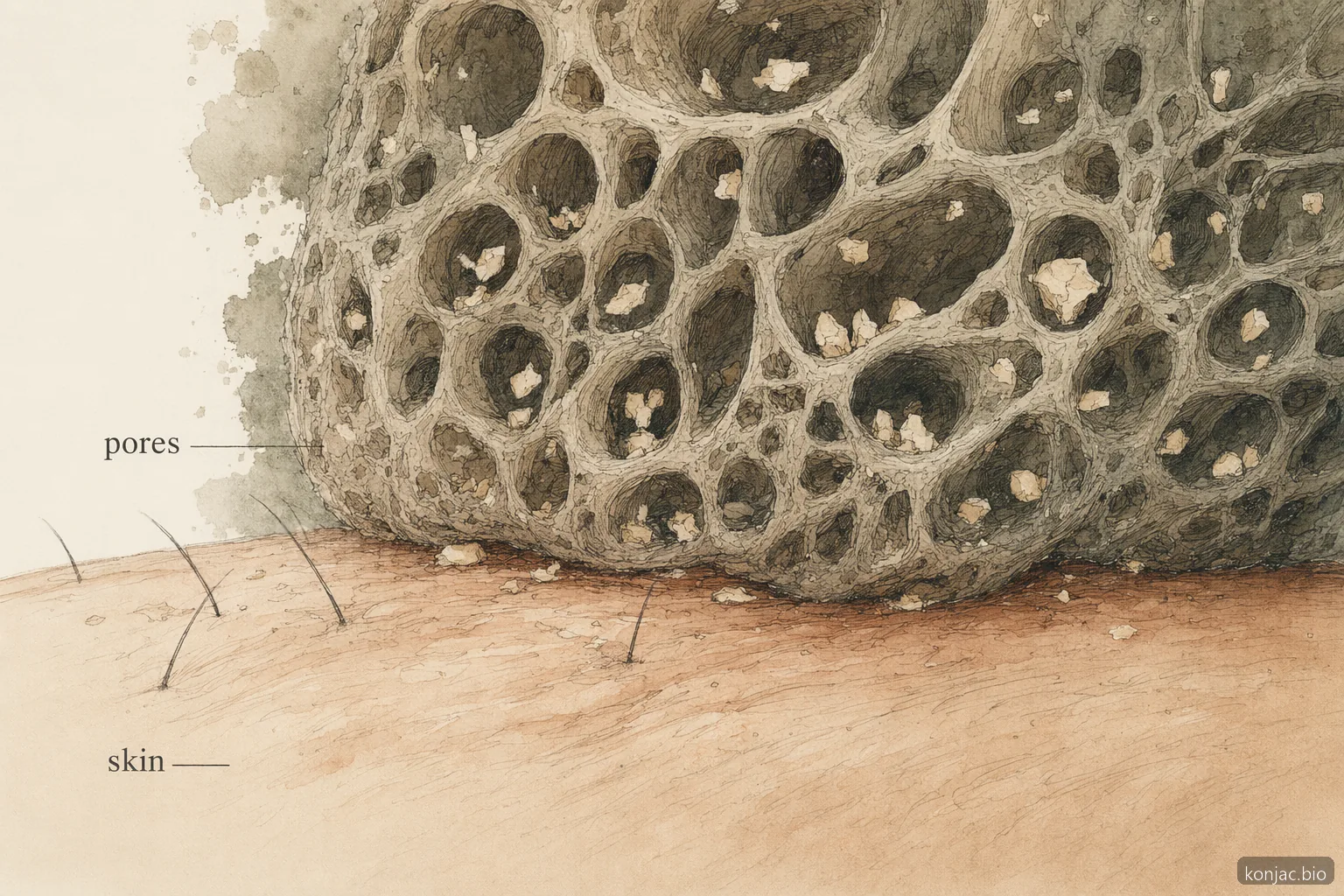
For skincare, the value is mechanical rather than biochemical. The sponge softens in water, swells, and creates a springy surface that helps move cleanser and water across the skin. That physical action can lift loose flakes, sunscreen residue, and makeup residue from the surface without needing crushed shells, plastic microbeads, or high-pressure scrubbing.
- Gentle exfoliation: removes loose surface cells through soft friction.
- Cleaner rinse: helps distribute cleanser evenly across curved areas of the face.
- Light massage: encourages a slow, circular cleansing habit instead of fast rubbing.
- Simple routine fit: works with water alone or a mild cleanser.
- Lower-waste option: pure konjac fiber sponges are plant-derived and replace disposable wipes in many routines.
The best results come from using the sponge fully hydrated. A dry konjac sponge is firm and not meant for direct facial use. Soak it until it becomes soft, squeeze out extra water, then glide it over the skin with minimal pressure.
How does a konjac sponge exfoliate without harsh scrubbing?
A konjac sponge exfoliates by using soft, hydrated fiber to loosen surface debris through low-pressure circular movement. The sponge does not need sharp particles or aggressive texture because the water-swollen network creates a cushioned contact surface.
This matters because skin comfort depends partly on barrier condition. Human skin has an acidic surface, and a pH below 5 is associated with barrier function and resident skin flora [skin pH](https://pubmed.ncbi.nlm.nih.gov/18489300/). Harsh cleansing habits, strong detergents, and repeated abrasion can increase dryness or tightness, while mild cleansing is designed to reduce barrier disruption [mild cleansing](https://pubmed.ncbi.nlm.nih.gov/27084122/).
A konjac sponge supports a gentler technique when used correctly:
- Soak for 3 to 5 minutes: the center should feel soft, not hard.
- Add cleanser only if needed: a pea-sized amount is enough for most face routines.
- Use 20 to 30 seconds per zone: cheeks, forehead, nose, and chin.
- Let the sponge glide: pressure should feel lighter than fingertip massage.
- Rinse thoroughly: cleanser left in the sponge can dry stiff and shorten its life.
The goal is not to polish skin until it feels squeaky. A comfortable cleanse leaves skin fresh, not tight, stinging, or shiny from over-rubbing.
Which benefits of a konjac sponge matter most for sensitive skin?
The benefits of a konjac sponge that matter most for sensitive skin are softness, pressure control, and the option to cleanse with very little product. A fully hydrated sponge can be less scratchy than dry washcloth texture, stiff brushes, or gritty exfoliating particles.
The American Academy of Dermatology advises washing the face with a gentle, non-abrasive cleanser, using fingertips, lukewarm water, and avoiding scrubbing [face washing](https://www.aad.org/public/everyday-care/skin-care-basics/care/face-washing-101). A konjac sponge can fit that style when it is used as a soft delivery tool rather than a scrub pad.
People with reactive skin should start slowly. Use the sponge 2 or 3 times per week, with water or a mild cleanser, and watch for tightness, burning, or lasting redness. If the skin feels uncomfortable after use, reduce frequency or return to fingertip cleansing.
| Skin goal | Best konjac sponge habit | What to avoid |
|---|---|---|
| Less friction | Use a fully soaked sponge | Using it semi-dry |
| Less dryness | Pair with a mild cleanser | High-foam stripping cleansers |
| Less irritation risk | Cleanse for under 60 seconds | Repeated passes over one area |
| Better hygiene | Rinse, squeeze, and air-dry | Leaving it wet in a closed container |
A konjac sponge is still a physical exfoliating tool. The gentleness comes from the hydrated texture and light technique, not from unlimited use.
A simple routine for getting the benefits safely
A safe konjac sponge routine starts with full hydration, light contact, and careful drying after every use. The sponge should feel bouncy before it touches the face. If the center is still hard, keep soaking.
Use this routine for face cleansing:
- Soak: place the sponge in warm water for 3 to 5 minutes.
- Squeeze gently: press between palms instead of twisting hard.
- Cleanse: glide in small circles for 30 to 60 seconds.
- Rinse skin: use lukewarm water, not hot water.
- Clean sponge: rinse until water runs clear.
- Dry: hang in airflow outside the shower spray zone.
Frequency depends on skin tolerance. Oily or resilient skin may prefer once daily use. Dry, reactive, or post-exfoliation skin often does better with 2 to 4 uses per week. Do not use it over open cuts, fresh sunburn, or active irritation.
Replacement timing is practical rather than exact. Many users replace a konjac sponge every 4 to 8 weeks because repeated wetting, cleanser exposure, and bathroom humidity weaken the fiber structure. Replace it sooner if it smells musty, develops dark spots, or stops drying fully between uses.
For a complete overview of sponge types, materials, and use cases, visit the parent guide: [Konjac Sponge](/konjac-sponge/). For step-by-step care habits, see [how to use a konjac sponge](/konjac-sponge-how-to-use/) and [konjac sponge care](/konjac-sponge-care/).
Konjac sponge benefits compared with washcloths and loofahs
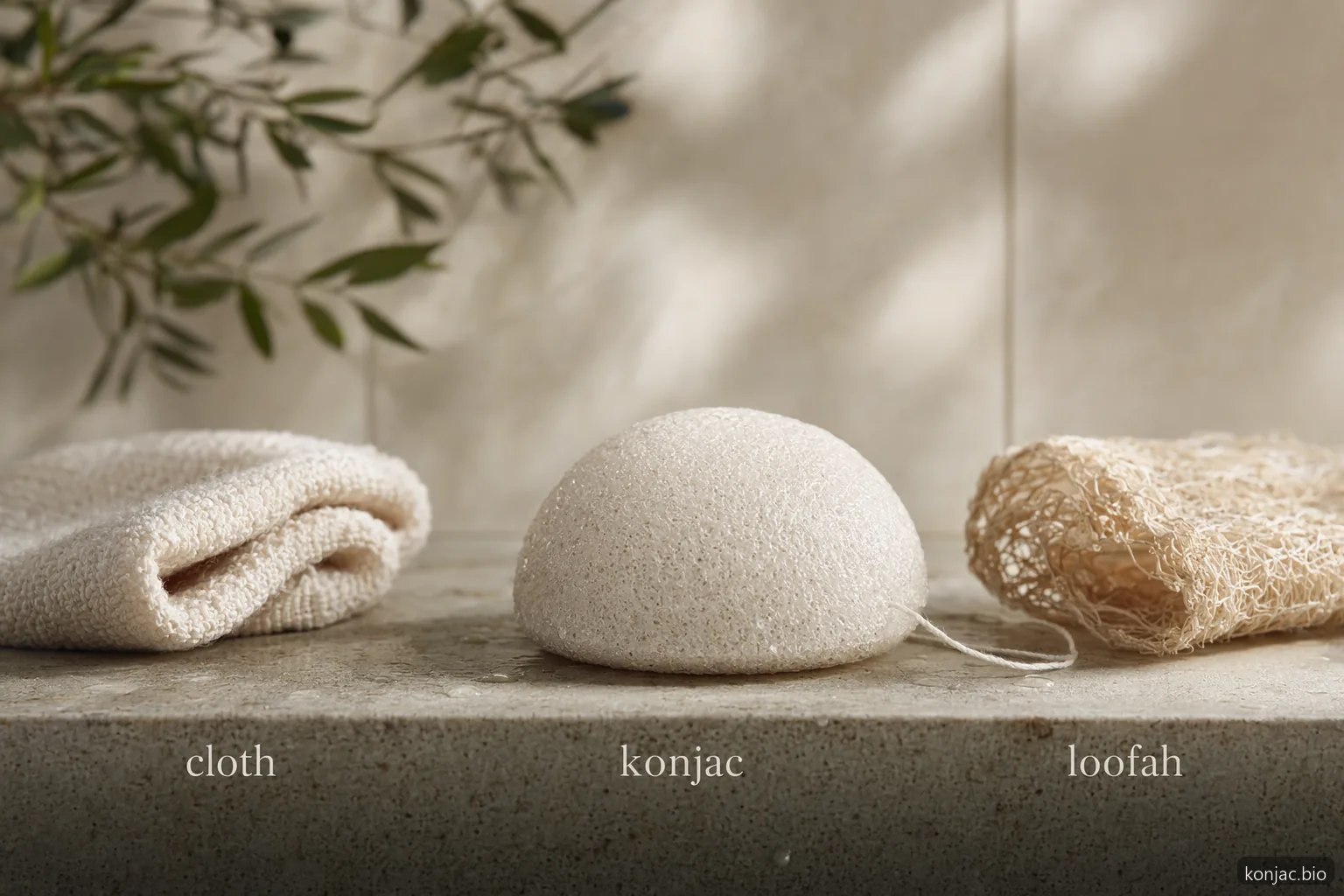
Konjac sponge benefits are easiest to understand when compared with common cleansing tools. A washcloth can be effective, but cotton loops can feel rough when used with pressure. A loofah can be too textured for facial skin. A konjac sponge sits in the middle: soft enough for daily facial routines, but more structured than fingertips alone.
| Tool | Texture | Best use | Main caution |
|---|---|---|---|
| Konjac sponge | Soft, bouncy when wet | Face cleansing and mild exfoliation | Must dry fully between uses |
| Washcloth | Variable cotton texture | Makeup removal and body cleansing | Can abrade if rubbed hard |
| Loofah | Coarse, fibrous texture | Body exfoliation | Often too rough for facial skin |
| Fingertips | Very gentle | Minimalist cleansing | Less surface lifting action |
The konjac sponge is not automatically better for every person. Fingertips remain the simplest option for very reactive skin. A washcloth may be better for removing heavy makeup, provided it is clean and soft. A konjac sponge is most useful when someone wants a small amount of daily texture without the harshness of a scrub.
For brands developing facial sponges, konjac.bio sources wholesale konjac materials and can discuss sponge formats, documentation, and packaging needs at [/contact/](/contact/). This keeps product development focused on consistent fiber quality and clear buyer specifications.
Frequently asked questions
01 Can I use a konjac sponge every day?
02 Is a konjac sponge good for acne-prone skin?
03 Do I need cleanser with a konjac sponge?
04 How long does a konjac sponge last?
05 Is a konjac sponge better than a face scrub?
06 What is a konjac sponge made from?
- Konjac glucomannan: A promising polysaccharide for OCDDS · PubMed · 2016
- The skin pH and its impact on the barrier function · PubMed · 2008
- Cleansing without compromise: the impact of cleansers on the skin barrier and technology of mild cleansing · PubMed · 2016
- Face washing 101 · American Academy of Dermatology · 2024