What are the benefits of konjac sponge for daily cleansing?
The benefits of konjac sponge for daily cleansing are softer-feeling cleansing, mild surface exfoliation, and less friction than many grainy scrubs.
A konjac sponge is made from konjac glucomannan, a soluble fiber obtained from the corm of Amorphophallus konjac, a plant evaluated in the EFSA-2010 glucomannan opinion for oral uses, not topical sponge claims EFSA opinion. When dried, the sponge is hard. After soaking for 3 to 5 minutes, it becomes soft, cushiony, and flexible.
The daily skincare value is mechanical. The sponge gives fingers a larger, textured cleansing surface, which can help spread cleanser evenly across the forehead, nose, cheeks, and chin. The outer skin layer, the stratum corneum, is the top part of the epidermis and contains flattened surface cells skin anatomy. A soft sponge can loosen some surface flakes while cleansing, without the sharp feel of crushed shells, sugar, salt, or rough washcloths.
Common daily uses include:
- Morning cleanse with water or a low-foam gel cleanser.
- Evening cleanse after sunscreen removal.
- Light exfoliation around the nose and chin.
- Gentle cleanser distribution for people who rub too hard with fingertips.
For a broader overview of materials, storage, and selection, see the parent guide: Konjac Sponge.
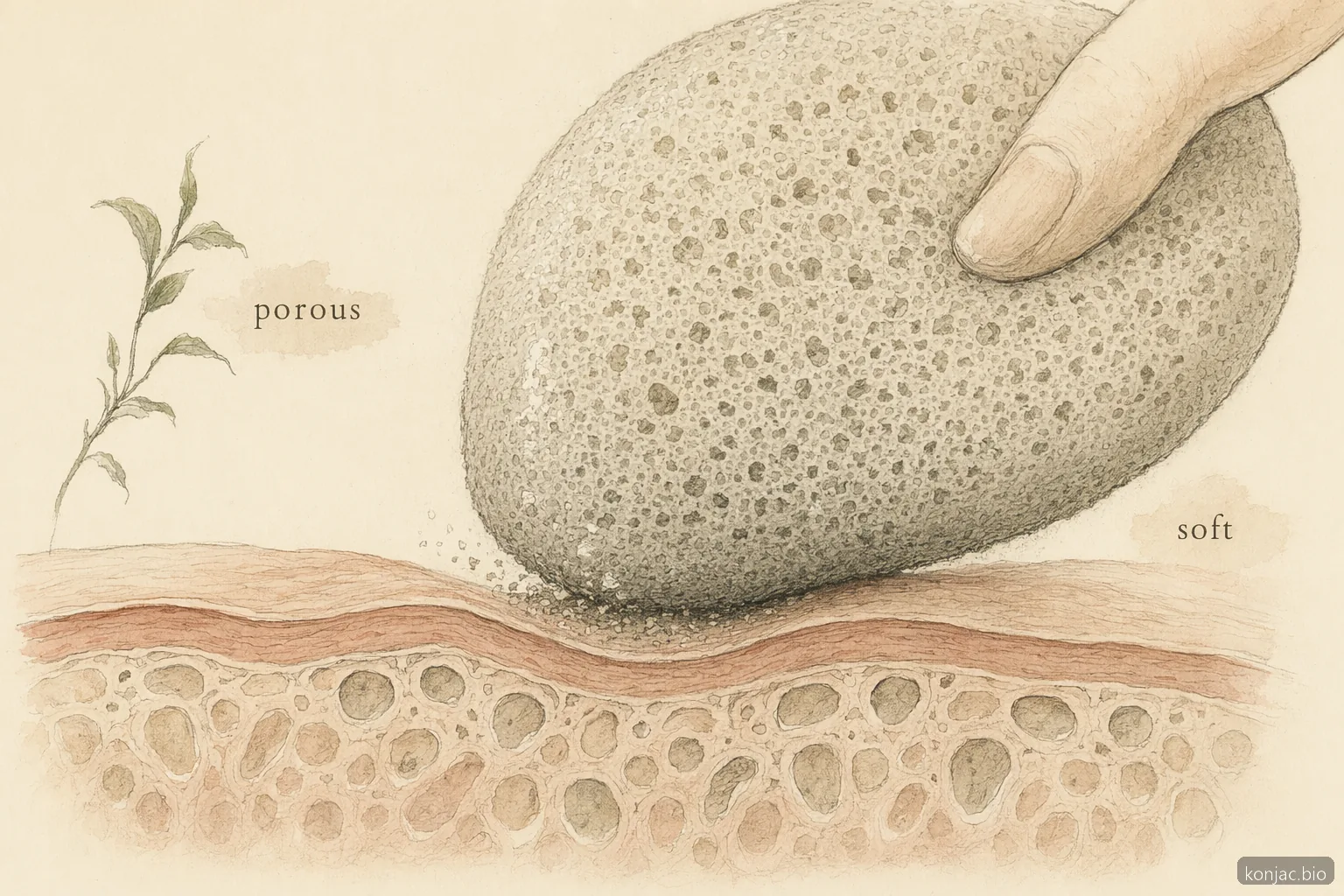
How do the benefits of konjac sponge compare with facial scrubs?
The benefits of konjac sponge are gentler and more rinse-clean focused than abrasive scrubs because the hydrated sponge is soft, porous, and reusable for several weeks.
Facial scrubs depend on loose particles. Those particles can vary in size, edge shape, and pressure during massage. A konjac sponge works as one hydrated surface, so pressure is easier to control. This matters because over-rubbing can leave skin feeling tight, shiny, or uncomfortable, especially on cheeks and around the nose.
Here is the practical comparison:
| Feature | Konjac sponge | Grainy scrub |
|---|---|---|
| Texture after wetting | Soft, bouncy, porous | Depends on particle type |
| Exfoliation style | Light physical buffing | Particle-based abrasion |
| Pressure control | Easy to adjust by hand | Can become uneven |
| Best frequency | Often daily or several times weekly | Usually less frequent |
| Cleanup | Rinse, squeeze, air-dry | Rinse product from face and sink |
The sponge is not a substitute for all exfoliating products. Leave-on acids, cleanser formulations, and professional skincare services work through different mechanisms. A konjac sponge is best for people who want a low-tech tool that supports cleansing without adding another leave-on active.
If choosing between bath tools, a konjac sponge usually feels softer on the face than a body loofah. For a deeper comparison, see konjac sponge vs loofah.
Why can a konjac sponge feel gentle on sensitive skin?
A konjac sponge can feel gentle on sensitive skin because it becomes very soft when saturated and does not need hard scrubbing to move across the face.
The key is hydration. A dry konjac sponge should never be rubbed on skin. After full soaking, its structure swells with water and forms a springy surface that bends against facial contours. That softer contact can reduce the temptation to press hard around the nose, jaw, and hairline.
Skin surface pH is mildly acidic, and pH balance is part of normal barrier function skin pH. A sponge does not set skin pH by itself, so the paired cleanser matters. For sensitive routines, choose a fragrance-free, low-foam cleanser and rinse thoroughly after 30 to 60 seconds of circular massage.
People with reactive skin should start slowly:
- Use the sponge 2 to 3 times per week at first.
- Apply almost no pressure, especially on cheeks.
- Stop if stinging, roughness, or lasting redness appears.
- Do not use on cuts, sunburn, or freshly shaved areas.
Konjac.bio sources konjac materials and finished-product inputs for wholesale skincare and personal-care brands. For specifications, pack formats, and volume pricing, contact the team at konjac.bio contact.
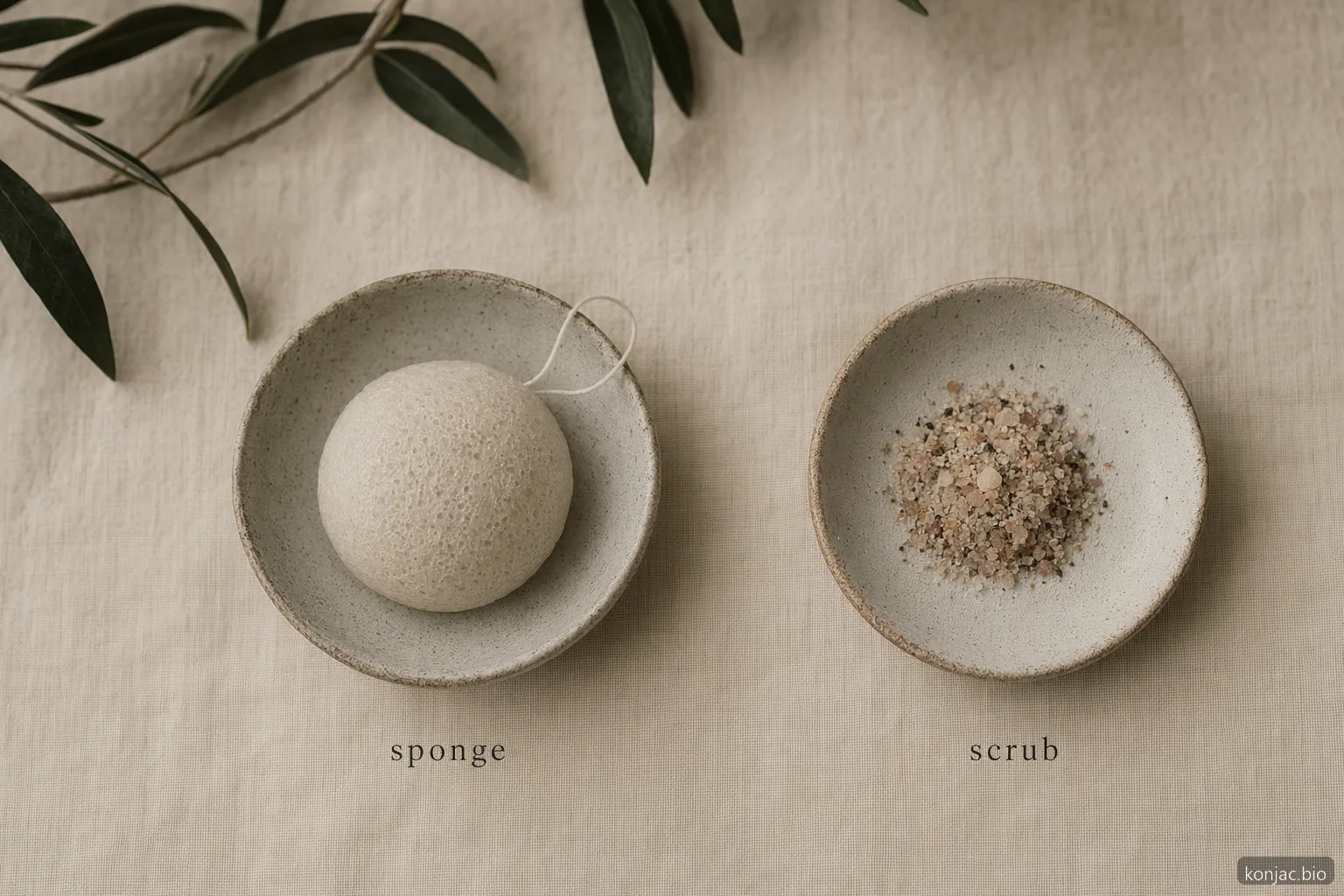
The benefits of konjac sponge in a simple skincare routine
The simplest routine uses a konjac sponge as the cleansing step, not as a replacement for moisturizer, sunscreen, or targeted leave-on products. Its value is consistency: a soft sponge can make cleansing feel more even and controlled.
A practical face routine looks like this:
- Soak: Place the dry sponge in warm water for 3 to 5 minutes until fully soft.
- Squeeze: Press out excess water with clean hands. Do not twist aggressively.
- Cleanse: Add cleanser to the sponge or directly to damp skin.
- Massage: Use light circular movements for 30 to 60 seconds.
- Rinse: Rinse face and sponge until no cleanser remains.
- Dry: Press the sponge between palms, then hang it in open air.
Use frequency depends on skin response. Oily or sunscreen-heavy routines may prefer once daily. Dry or reactive routines may prefer 2 to 4 uses per week. The goal is a clean, comfortable finish, not a squeaky or tight feeling.
A konjac sponge also helps people use less cleanser because the wet sponge distributes foam or gel across a larger surface. That does not mean the sponge improves the cleanser formula. It simply spreads product efficiently and adds light physical movement.
For step-by-step handling, storage, and replacement guidance, see how to use konjac sponge.
Safety limits and care standards for konjac sponges
Konjac sponges are simple cosmetic tools, so hygiene matters as much as material choice. In U.S. cosmetic regulation, products intended for cleansing or beautifying the body fall within the cosmetic category FDA cosmetics.
The main risk with any wet sponge is poor drying. A sponge left in a closed shower corner can stay damp for hours. Rinse it thoroughly after use, press out water, and hang it where air can circulate. Do not store it in a sealed travel case while wet.
Replacement timing is usually 4 to 8 weeks, depending on usage, drying conditions, and product quality. Replace sooner if the sponge develops odor, dark spots, slimy texture, cracking, or a surface that no longer softens evenly. Boiling is sometimes suggested by sellers, but repeated heat can weaken the sponge structure.
Do not share one facial sponge between people. Do not use the same sponge for face and body if the body area includes feet, underarms, or intimate areas. Use separate tools and label them if multiple people share one bathroom.
A konjac sponge should not be used to manage acne, eczema, rosacea, infection, burns, or any medical concern. If skin is painful, bleeding, swollen, or persistently irritated, skip exfoliating tools and ask a licensed clinician for personal guidance.
Frequently asked questions
01 What are the main benefits of konjac sponge?
02 Can I use a konjac sponge every day?
03 Is a konjac sponge good for sensitive skin?
04 Does a konjac sponge remove makeup?
05 How often should I replace a konjac sponge?
- Scientific Opinion on health claims related to konjac mannan (glucomannan) · European Food Safety Authority · 2010
- Anatomy, Skin (Integument), Epidermis · NCBI Bookshelf · 2023
- The pH of the skin surface and its impact on the barrier function · PubMed · 2006
- Cosmetics & U.S. Law · U.S. Food and Drug Administration · 2024