What is a facial konjac sponge?
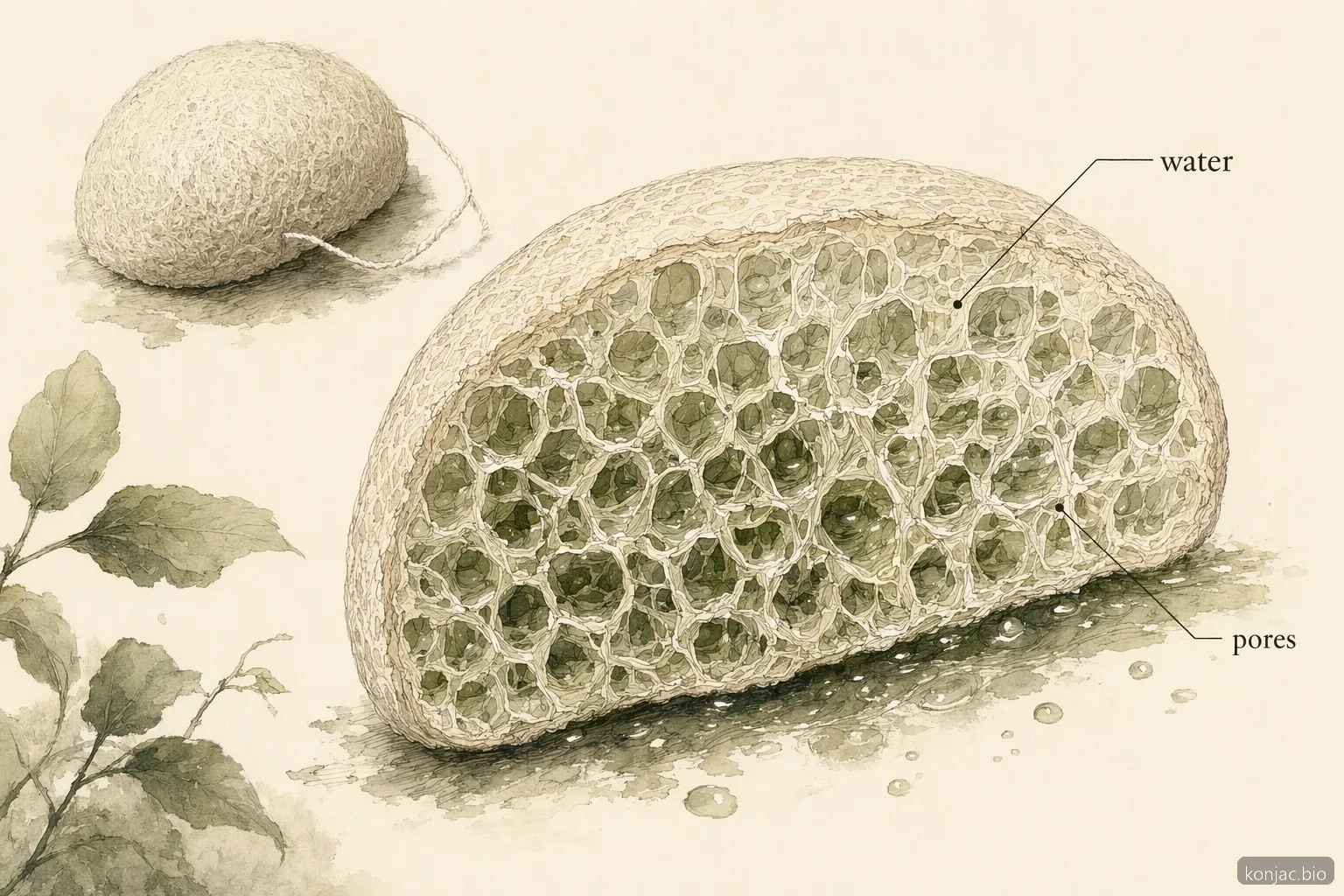
A facial konjac sponge is a water-activated cleansing sponge made from konjac plant fiber, usually the dried, porous matrix of Amorphophallus konjac glucomannan.
In its dry state, it feels hard and lightweight. After 3 to 5 minutes in water, it expands into a cushiony sponge that can glide across the face with cleanser or plain water.
The material comes from the corm of Amorphophallus konjac, a plant used as a source of glucomannan fiber. EFSA identifies konjac mannan, also called glucomannan, as a soluble dietary fiber from konjac, but skincare sponges are topical tools and should not be confused with ingestible fiber products [EFSA](https://www.efsa.europa.eu/en/efsajournal/pub/1798).
A facial format is smaller and softer than body exfoliating tools. For a broader category overview, see the parent guide: Konjac Sponge: The Natural Skincare Tool.
How does a facial konjac sponge clean skin?
A facial konjac sponge cleans by holding water in a soft fiber network that loosens residue while its surface gives mild physical exfoliation.
The sponge does not need grit to feel effective. Its hydrated structure gives slip, so the cleansing action comes from water, gentle movement, and contact with the skin surface.
The American Academy of Dermatology recommends using lukewarm water, a gentle cleanser, and avoiding aggressive scrubbing when washing the face [AAD](https://www.aad.org/public/everyday-care/skin-care-basics/care/face-washing-101). A konjac sponge fits that style when it is fully softened and moved with light pressure.
The outer skin barrier includes the stratum corneum, the top layer of the epidermis described in NCBI Bookshelf anatomy resources [epidermis](https://www.ncbi.nlm.nih.gov/books/NBK470464/). A facial tool should respect that layer, which means no hard rubbing, no use on broken skin, and no sharing between users.
Facial konjac sponge comparison: washcloth, silicone brush, and scrub
A facial konjac sponge sits between a soft washcloth and a more textured exfoliating tool. It gives more cushion than a cotton cloth, less mechanical intensity than many brushes, and less scratch than granulated scrubs.
| Tool | Texture | Best fit | Watch-out |
|---|---|---|---|
| Facial konjac sponge | Soft, porous, water-swollen | Daily or occasional gentle cleansing | Must dry between uses |
| Washcloth | Fabric loops or weave | Reusable cleansing with easy laundering | Can feel rough if used hard |
| Silicone brush | Flexible bristles | People who prefer a non-plant tool | Pressure can increase quickly |
| Granular scrub | Particles in a cream or gel | Occasional texture-focused routines | Particles may feel too abrasive |
For most face routines, the difference is pressure control. The same sponge can feel gentle with fingertip pressure or irritating with fast circular rubbing for several minutes.
If you are comparing claimed skincare outcomes, separate tool feel from ingredient claims. A plain konjac sponge is mainly a cleansing accessory, while additives such as charcoal, clay, or green tea powder change color and positioning more than the core sponge structure.
How do you use a facial konjac sponge?
You use a facial konjac sponge by soaking it until fully soft, gliding it over wet skin for 30 to 60 seconds, rinsing it well, and hanging it to dry.
- Soak: Place the dry sponge in warm water for 3 to 5 minutes until it becomes fully flexible.
- Check softness: Squeeze it gently. Do not use it while the center still feels hard.
- Cleanse: Use alone or with a small amount of mild cleanser.
- Move lightly: Glide over the face with small circles for 30 to 60 seconds.
- Rinse skin: Use lukewarm water, matching dermatologist guidance for face washing [AAD](https://www.aad.org/public/everyday-care/skin-care-basics/care/face-washing-101).
- Rinse sponge: Flush out cleanser, then press between palms. Do not wring aggressively.
- Dry: Hang in an airy place, not in a sealed shower corner.
Frequency depends on skin comfort. Many users start 2 to 3 times weekly, then adjust based on dryness, tightness, or redness.
For a step-by-step routine focused only on technique, see how to use a konjac sponge.

What should you look for when buying a facial konjac sponge?
You should look for a facial konjac sponge with a simple ingredient list, even pore structure, clear drying instructions, and packaging that protects it before first use.
A plain sponge usually lists konjac fiber or konjac glucomannan. Colored versions may include charcoal powder, clay, turmeric, green tea powder, or mineral pigments. The shorter the ingredient list, the easier it is to understand what is touching the skin.
- Shape: Round pads suit cheeks and forehead. Teardrop shapes help around the nose.
- Texture: A good facial sponge should become uniformly soft after soaking.
- String: A hanging loop helps drying and reduces counter contact.
- Packaging: Sealed packaging keeps the dry sponge clean before opening.
- Instructions: Look for soak time, rinse directions, and replacement guidance.
For B2B product teams, konjac.bio sources konjac materials at wholesale scale for skincare, sponge, and adjacent personal-care lines. Contact konjac.bio wholesale for specifications, formats, and pricing.
Replacement timing and skin-comfort signals
Most facial konjac sponges should be replaced every 4 to 8 weeks, with faster replacement if the sponge smells, cracks, changes texture, or never dries fully.
The FDA notes that cosmetic products can change over time, especially after opening and exposure to air, moisture, and users’ hands [FDA shelf life](https://www.fda.gov/cosmetics/resources-consumers-cosmetics/cosmetics-safety-qa-shelf-life). A wet cleansing sponge has the same practical challenge: moisture management matters.
Replace immediately if you see black, green, orange, or fuzzy spots. Replace if the sponge becomes slimy after rinsing, sheds pieces, or develops a persistent odor after drying.
Skin feedback matters too. If your face feels tight, looks unusually red, or stings after use, reduce frequency, shorten contact time, or stop using the sponge. A cleansing tool should make washing easier, not more aggressive.
For a broader look at expected advantages and limitations, read konjac sponge benefits.
Frequently asked questions
01 Can I use a facial konjac sponge every day?
02 Do I need cleanser with a facial konjac sponge?
03 Is a facial konjac sponge good for sensitive skin?
04 How long should I soak a facial konjac sponge?
05 How should I store a facial konjac sponge between uses?
- Scientific Opinion on the substantiation of health claims related to konjac mannan (glucomannan) · European Food Safety Authority · 2010
- Face washing 101 · American Academy of Dermatology · 2024
- Cosmetics Safety Q&A: Shelf Life · U.S. Food and Drug Administration · 2022
- Anatomy, Skin (Integument), Epidermis · NCBI Bookshelf · 2023