What is a konjac body sponge?
A konjac body sponge is a larger shower sponge made from hydrated konjac glucomannan, designed for gentle body cleansing and light exfoliation. Konjac glucomannan comes from Amorphophallus konjac, a plant whose corm contains a water-absorbing polysaccharide fiber documented in food and materials literature [Amorphophallus konjac](https://pubmed.ncbi.nlm.nih.gov/29923504/).
For skincare, the material is processed into a porous sponge that becomes soft and springy after soaking. A dry konjac sponge feels firm, but after 1 to 3 minutes in warm water, it swells and becomes flexible enough for shower use.
A body sponge differs from a facial konjac sponge mainly by size, surface area, and grip. Face sponges are usually smaller and rounded for cheeks, nose, and chin. Body sponges are wider or teardrop-shaped, so they cover arms, legs, back, and torso faster.
For a full material overview, see the parent guide: Konjac Sponge: The Natural Skincare Tool. For adjacent skincare positioning, the konjac sponge benefits guide covers face, body, and product-claim boundaries.
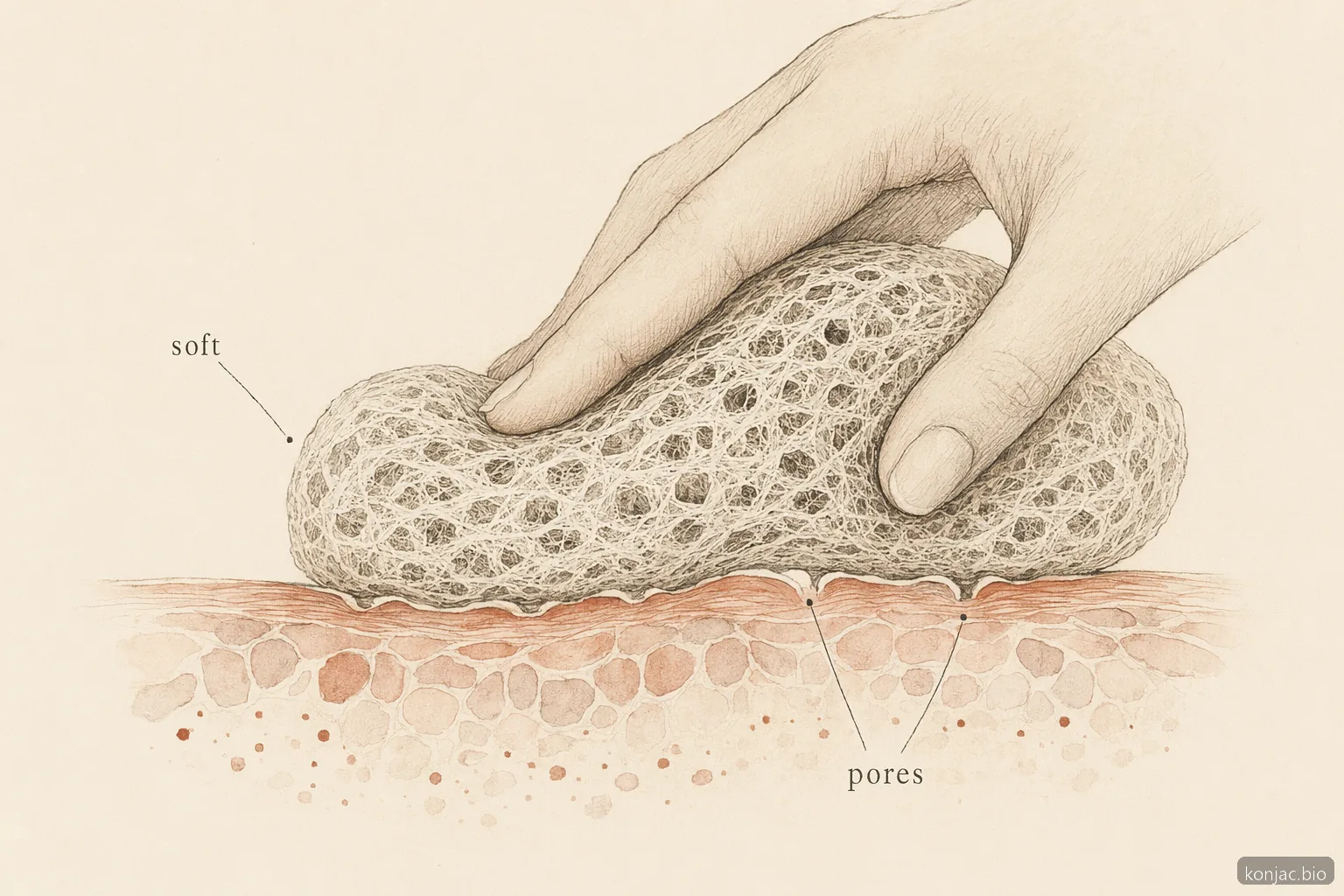
How does a konjac body sponge exfoliate skin?
A konjac body sponge exfoliates by using a soft, water-swollen fiber network to lift loose surface cells and body-wash residue with low friction. It is a physical exfoliator, but it is not a gritty scrub, brush, pumice stone, or acid peel.
The sponge’s pores hold water and cleanser, which helps spread body wash evenly over broad areas. That cushioning matters because the body has zones with different tolerance levels: elbows and knees usually tolerate more friction, while chest, shoulders, and inner arms often prefer lighter pressure.
Use the sponge in small circles or long strokes for 30 to 90 seconds per body area. More pressure does not make the sponge work better. Pressing too hard can make any exfoliating tool feel rough, especially after shaving, sun exposure, or vigorous exercise.
Konjac’s food fiber reputation should not be confused with topical skincare outcomes. The EFSA-authorized food claim is: “Glucomannan in the context of an energy-restricted diet contributes to weight loss” [EFSA claim](https://www.efsa.europa.eu/en/efsajournal/pub/1798). That oral-intake claim does not apply to a shower sponge, which works mechanically on the skin surface.
Konjac body sponge vs. loofah, washcloth, and scrub
A konjac body sponge sits between a soft washcloth and a traditional loofah: more textured than cloth, but usually gentler than fibrous loofah or coarse scrub particles. The best choice depends on skin feel, drying habits, and how much exfoliation a user wants.
| Tool | Typical feel | Best fit | Watch-outs |
|---|---|---|---|
| Konjac body sponge | Soft, cushiony, porous | Daily or near-daily gentle body cleansing | Needs thorough drying between showers |
| Loofah | Fibrous, scratchier | People who prefer stronger friction | Wet loofahs can hold microbes if poorly dried |
| Washcloth | Flat, familiar, adjustable | Frequent laundering and simple routines | Can feel less exfoliating than porous tools |
| Body scrub | Variable, often gritty | Occasional polishing on rough zones | Particles and pressure can be too intense for some users |
Hygiene is not only about the material. A classic microbiology paper found loofah sponges could act as reservoirs for potentially pathogenic bacterial species when kept damp [loofah study](https://pubmed.ncbi.nlm.nih.gov/2130905/). The practical lesson applies to any shower sponge: rinse, squeeze, and dry in open air.
Compared with a washcloth, a konjac body sponge needs less rubbing to create a lather because its pores hold water and cleanser. Compared with a scrub, it does not rely on salt, sugar, shell powder, or plastic particles for exfoliation.

How should you use and care for a konjac body sponge?
Use a konjac body sponge by soaking it fully, massaging with light pressure, rinsing thoroughly, and hanging it where air can circulate. A dry sponge should never be dragged across skin because the fibers are firm before hydration.
- Soak: Place the sponge under warm water for 1 to 3 minutes, until it feels fully soft.
- Add cleanser: Use a pea-sized to coin-sized amount of body wash, or use the sponge with water only.
- Massage: Move in circles or long strokes, using light pressure on chest, shoulders, and recently shaved areas.
- Rinse: Flush out lather until the water runs clear.
- Squeeze: Press between palms. Do not twist aggressively, which can tear the fiber network.
- Dry: Hang in a ventilated place, not in a puddle, sealed box, or constantly wet shower corner.
Most users should replace a konjac body sponge every 4 to 8 weeks. Replace sooner if it develops an odor, visible dark spots, slimy texture, cracks, or a persistent flattened shape.
For step-by-step face and body routines, see how to use a konjac sponge. The same soaking and drying principles apply, but body sponges usually need longer rinsing because they hold more cleanser.
Quality checklist for konjac body sponge sourcing
A good konjac body sponge should be clearly identified, evenly porous, easy to rehydrate, and packaged so it reaches the user clean and intact. Product teams should evaluate the sponge before thinking about scent, color, or retail presentation.
- Material identity: Look for konjac glucomannan or konjac root fiber as the core material.
- Texture: After soaking, the sponge should feel springy, not brittle, slimy, or crumbly.
- Shape control: Body formats should be large enough for shower use without tearing at the hanging string.
- Colorant choice: Undyed sponges are simplest. Charcoal, clay, or botanical colorants need clear ingredient disclosure.
- Drying performance: The sponge should drain and air-dry between uses when hung properly.
- Labeling: Avoid unsupported skincare promises. Usage, care, and replacement guidance should be visible.
Brands selling a bundled cleanser, cosmetic kit, or skin-facing product in the United States should review cosmetic labeling expectations before final packaging [FDA labeling](https://www.fda.gov/cosmetics/cosmetics-labeling-regulations/cosmetics-labeling-guide). A bath sponge should also not be confused with konjac mini-cup gel candy, an ingestible product category that has separate FDA import controls because of choking risk [FDA jelly](https://www.accessdata.fda.gov/cms_ia/importalert_113.html).
For brands and distributors, konjac.bio sources konjac sponge materials and finished sponge formats at wholesale scale. Contact konjac.bio for specifications, MOQ, and pricing.
Frequently asked questions
01 Is a konjac body sponge good for sensitive skin?
02 Can I use a konjac body sponge with body wash?
03 How long does a konjac body sponge last?
04 What is the difference between a face sponge and a konjac body sponge?
05 Is a konjac body sponge biodegradable?
06 Should I disinfect or boil a konjac body sponge?
- Scientific Opinion on the substantiation of health claims related to konjac mannan (glucomannan) · EFSA Journal · 2010
- Cosmetics Labeling Guide · U.S. Food and Drug Administration · 2024
- Loofah sponges as reservoirs and vehicles in transmission of potentially pathogenic bacterial species to human skin · PubMed · 1994
- Import Alert 33-15 · U.S. Food and Drug Administration · 2024