What does konjac sponge japan mean?
konjac sponge japan means a cleansing sponge connected to Japan through manufacturing origin, Japanese konnyaku culture, or Japanese-style skincare positioning.
The plant behind the sponge is Amorphophallus konjac, a corm-forming species recorded by Kew Plants. In Japan, konjac is widely known as konnyaku, a traditional food material documented by Japan’s Ministry of Agriculture, Forestry and Fisheries in its regional cuisine archive for Gunma konnyaku.
For skincare, the corm’s glucomannan-rich fiber is processed into a porous sponge. Glucomannan is a water-binding polysaccharide associated with the konjac corm, and its food and material properties are described in scientific literature indexed by PubMed. The sponge works mechanically: it softens with water, glides over skin, and helps lift sunscreen residue, light makeup, oil, and dead surface cells without needing a scrub grain.
Three labels often appear in the market:
- Made in Japan: the sponge is manufactured in Japan.
- Japanese konjac sponge: the product may be Japan-made or Japan-inspired.
- Japanese-style konjac sponge: the sponge follows Japan’s soft, minimal, water-activated cleansing format.
For a broader product overview, see Konjac Sponge: The Natural Skincare Tool.
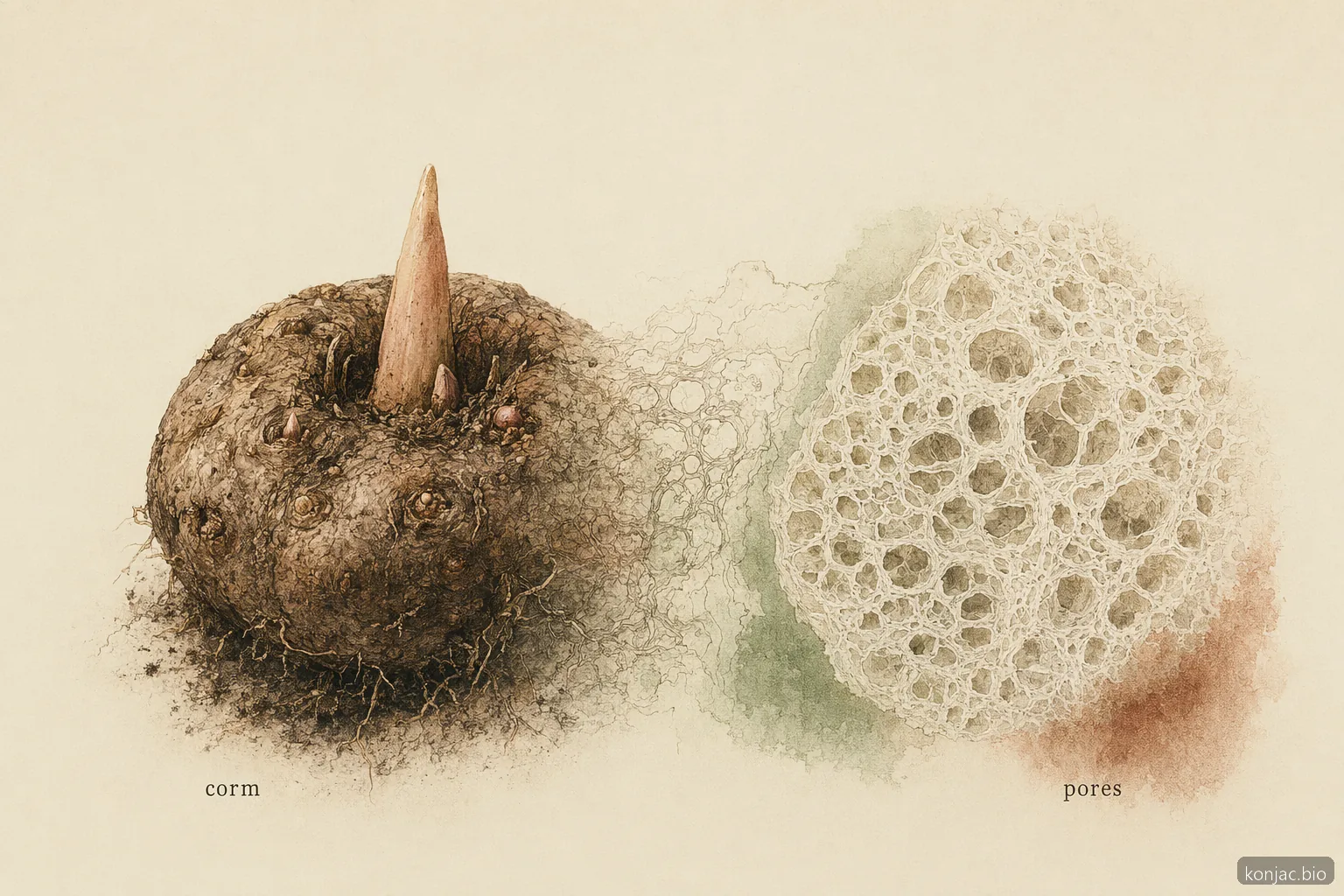
Why did konjac sponge japan become a skincare reference?
konjac sponge japan became a skincare reference because Japan connected konjac’s long food history with a gentle, water-first cleansing culture.
Japanese konnyaku is closely associated with Gunma Prefecture, where MAFF documents konnyaku as a regional food made from konjac potato, also called konnyaku imo in Japanese food culture MAFF cuisine. That food heritage helped consumers understand konjac as a familiar plant material rather than a synthetic scrub.
In skincare, the appeal is tactile. A dry konjac sponge is hard and lightweight. After 10 to 15 minutes in warm water, it becomes springy, gelatinous, and cushion-soft. That texture made it attractive for people who wanted cleansing with less friction than loofah, walnut shell powders, or stiff facial brushes.
The Japanese-style routine is also simple:
- Soak the sponge until fully soft.
- Press out excess water without twisting hard.
- Massage in small circles for 30 to 60 seconds.
- Rinse thoroughly after use.
- Hang in airflow until fully dry.
The term can be confusing because not every sponge sold with Japanese language, cherry blossom imagery, or minimalist packaging is made in Japan. A serious buyer should read the origin statement, ingredient list, and factory documentation rather than relying on visual branding.
Japanese konjac sponge quality signals
A quality Japanese-style konjac sponge should be ingredient-simple, evenly porous, quick to soften, and comfortable on damp skin.
The ingredient list is the fastest filter. The plainest version contains konjac fiber and water during processing, with no fragrance, plastic beads, or abrasive shells. Variants may include bamboo charcoal, green tea powder, pink clay, red clay, or turmeric for color and marketing position, but the sponge’s core performance still depends on konjac structure.
Use this comparison when reviewing a Japan-made or Japanese-style sponge:
| Quality signal | What to look for | Red flag |
|---|---|---|
| Dry texture | Light, firm, not dusty | Crumbles in the hand |
| Soak time | Fully soft in 10 to 15 minutes | Hard center after soaking |
| Wet feel | Gel-soft and cushiony | Scratchy or gritty |
| Pore structure | Even, sponge-like pores | Dense lumps or cracks |
| Odor | Neutral plant smell | Sour or musty smell |
Packaging should also explain how to soak, rinse, dry, and replace the sponge. If a seller claims the sponge lasts 6 months with daily bathroom use, ask for test data. In most consumer routines, 4 to 8 weeks is a more practical replacement window because wet cellulose-like materials can degrade with repeated soaking and drying.
For product teams, konjac.bio sources konjac materials at wholesale for skincare, bath, and personal-care manufacturers. Contact the team at /contact/ for specifications, volumes, and pricing.
How do you use a Japanese-style konjac sponge?
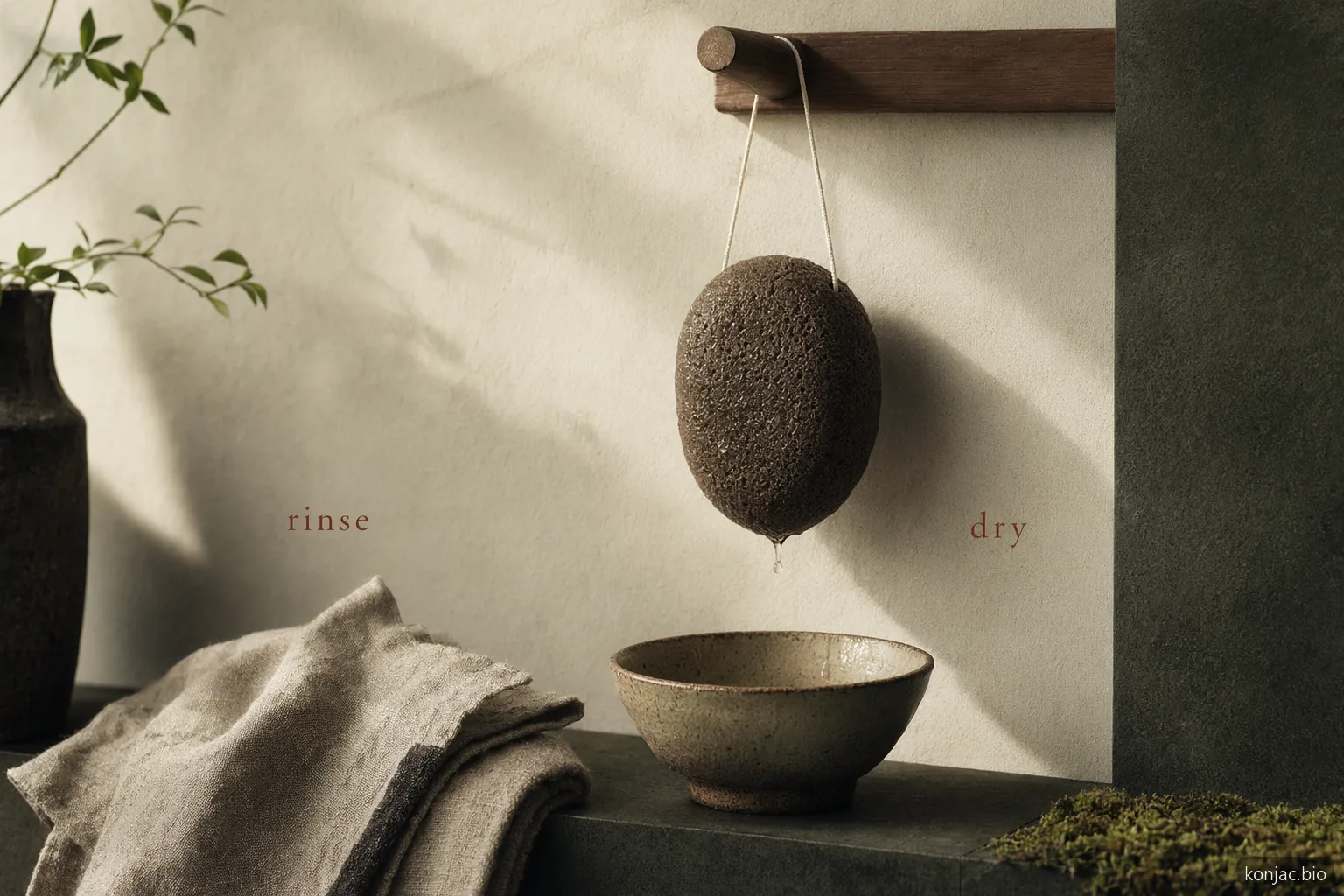
You use a Japanese-style konjac sponge by soaking it fully, massaging gently on wet skin, rinsing it clean, and drying it in open airflow.
Never use the sponge while hard. A dry konjac sponge can feel like a pumice stone because its porous network has not absorbed water. Warm water usually softens the sponge faster than cold water, and a bowl soak gives a more even result than holding it under a tap for a few seconds.
A simple face routine takes under 3 minutes:
- Soak: place the sponge in warm water for 10 to 15 minutes before first use.
- Check softness: squeeze lightly; the center should feel fully flexible.
- Cleanse: use alone or with a pea-sized amount of mild cleanser.
- Massage: glide in small circles for 30 to 60 seconds.
- Rinse skin: remove cleanser and loosened residue with clean water.
- Rinse sponge: wash out foam, makeup, and debris.
- Dry: press between palms and hang from its string.
The sponge is usually soft enough for cheeks, forehead, chin, neck, elbows, and knees. Avoid pressing hard around the eyes, active irritation, fresh shaving discomfort, or broken skin. The benefit comes from slip and water, not force.
For step-by-step timing, cleanser pairing, and storage habits, read how to use a konjac sponge. For product positioning and routine fit, see konjac sponge benefits.
Buying checklist for Japan-made and Japan-style konjac sponges
The best konjac sponge japan purchase is the one with clear origin, simple composition, realistic care instructions, and a texture that matches the intended skin area.
For personal use, a small dome or teardrop sponge works well for the face because it fits the nose, chin, and jawline. Larger half-spheres and rectangles suit body cleansing because they cover elbows, shoulders, and knees faster. Charcoal versions are often marketed for oily-feeling skin, while clay versions are often positioned for spa or mask-adjacent routines. The sponge’s physical softness matters more than the additive name.
For wholesale or private-label buying, ask suppliers for:
- Country-of-origin statement for finished goods.
- Full ingredient declaration with additive percentages where relevant.
- Microbiological testing approach for wet-process goods.
- Drying method, moisture target, and packaging barrier details.
- Carton quantity, compression method, and rehydration test results.
- Replacement guidance printed on consumer packaging.
Safety language should stay precise. The U.S. FDA has issued an import alert concerning konjac-containing mini-cup jelly because of choking risk in ingestible jelly products FDA alert. That alert is not about facial sponges, but it shows why konjac product format and intended use must be clear on labels.
A good retail page should say “external cleansing sponge” and should not imply edible use. It should also avoid unsupported performance claims. A konjac sponge is a physical cleansing tool, not a clinical skincare product.
Frequently asked questions
01 Is a konjac sponge from Japan better than one made elsewhere?
02 What is a konjac sponge made from?
03 How long should a Japanese-style konjac sponge last?
04 Can I use a konjac sponge every day?
05 How do I know if a konjac sponge is truly Japanese?
06 Should I use cleanser with a konjac sponge?
- Amorphophallus konjac K.Koch · Plants of the World Online, Royal Botanic Gardens, Kew · 2024
- Konnyaku, Gunma Prefecture · Ministry of Agriculture, Forestry and Fisheries of Japan · 2024
- Konjac glucomannan and related material properties · PubMed · 2019
- Import Alert 33-15: Detention Without Physical Examination of Gel Candy Containing Konjac · U.S. Food and Drug Administration · 2024