What is konjac jelly made of?
Konjac jelly is made from water, konjac glucomannan, sweetener, acid, flavor, and often a supporting gelling agent such as carrageenan or agar.
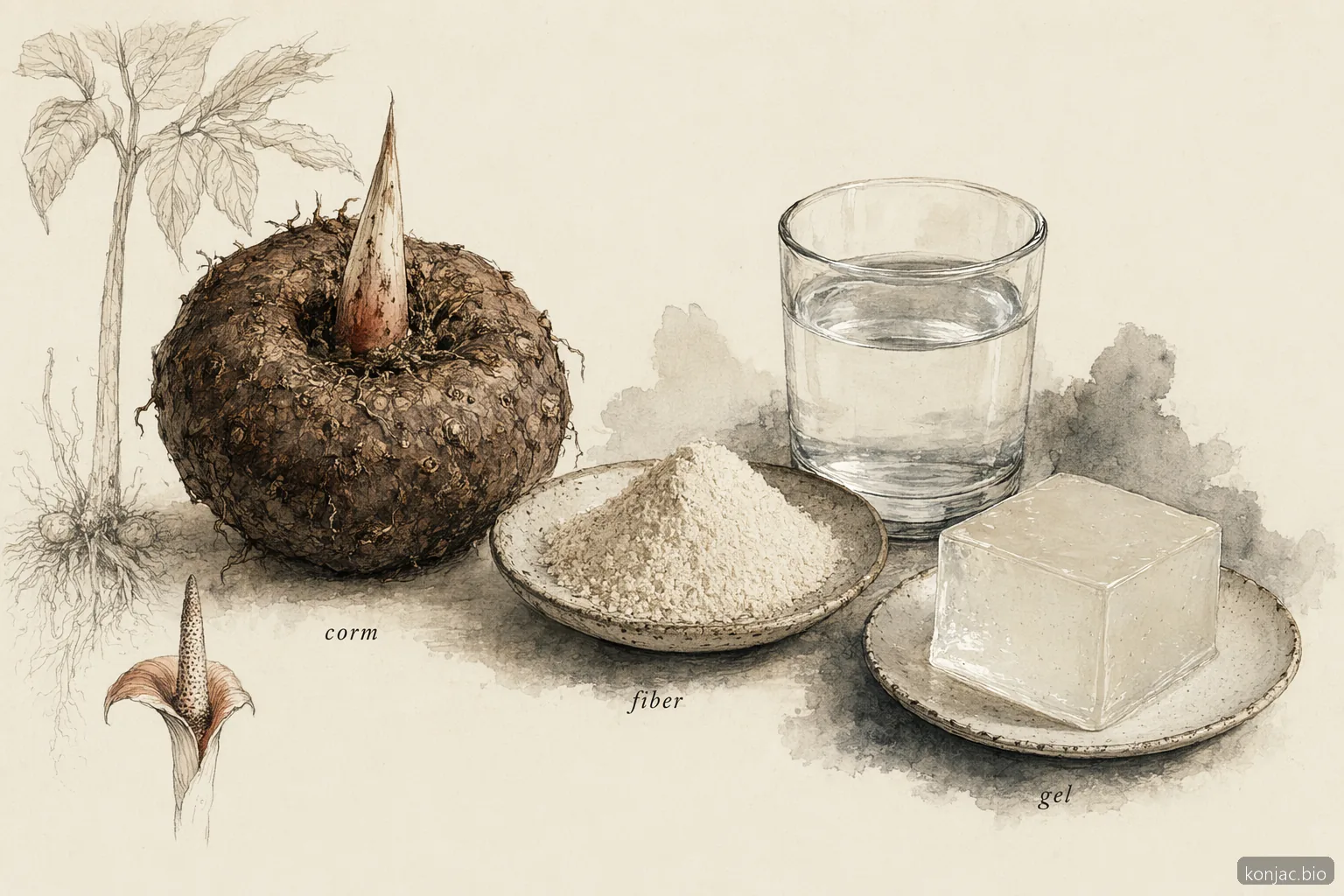
The key ingredient is glucomannan, a highly water-binding polysaccharide from the corm of Amorphophallus konjac, a plant listed by [Kew](https://powo.science.kew.org/taxon/urn:lsid:ipni.org:names:77149985-1). Glucomannan forms a firm, elastic network because it hydrates strongly, then thickens or gels when combined with the right pH, heat, salts, or co-gelling ingredients.
A typical fruit konjac jelly formula contains 85% to 95% water, 0.3% to 1.5% konjac gum or powder, fruit flavor, citric acid, and a sweetener system. Sugar, erythritol, allulose, stevia, or sucralose may be used depending on the label target.
Konjac jelly is part of the wider konjac product family, which also includes konjac powder, shirataki noodles, and plant-based gel applications. For ingredient selection, particle size, viscosity grade, and microbial limits matter more than the word “konjac” on its own.
How is konjac jelly made?
Konjac jelly is made by hydrating konjac powder in water, blending it with flavors and acids, heating or processing it, then filling it into cups, pouches, or molds.
The process begins with dispersion. Konjac powder clumps quickly if added too fast, so manufacturers usually pre-blend it with sugar or another dry carrier before adding it to agitated water. Full hydration can take 20 to 60 minutes depending on viscosity grade, temperature, and shear.
- Disperse: Mix konjac powder with dry ingredients to reduce clumping.
- Hydrate: Add to water under agitation until viscosity develops.
- Adjust: Add sweetener, acid, flavor, color, and co-gelling agents.
- Process: Heat, pasteurize, or use validated processing controls.
- Fill: Pack into cups, squeeze pouches, trays, or cuttable slabs.
- Set: Cool until the gel reaches target bite and elasticity.
Food-grade konjac specifications often focus on viscosity, purity, moisture, ash, sulfur dioxide residues, and microbiology. The [NIH](https://www.ncbi.nlm.nih.gov/books/NBK548592/) describes glucomannan as a dietary fiber from konjac root, which aligns with its main technical function in jelly: water binding and gel texture.
What is konjac jelly used for?
Konjac jelly is used for chewy snacks, fruit gels, squeeze pouches, dessert cubes, topping inclusions, and low-calorie jelly formats.
Its main advantage is texture. Konjac jelly can be bouncy, slippery, firm, or spoonable depending on the amount of glucomannan and the co-gelling system. This makes it useful in products where gelatin is not desired or where a more elastic bite is needed.
| Use case | Common format | Why konjac helps |
|---|---|---|
| Snack jelly | Cups or pouches | Chewy texture with high water content |
| Dessert topping | Cubes or pearls | Holds shape in syrup or tea |
| Reduced-sugar gel | Pouches | Texture without relying on high sugar |
| Plant-based dessert | Cups or trays | No animal gelatin required |
Konjac glucomannan has also been reviewed for health-related claims. EFSA’s approved wording is: “Glucomannan in the context of an energy restricted diet contributes to weight loss” [EFSA](https://www.efsa.europa.eu/en/efsajournal/pub/1798). A snack jelly should not copy supplement claims unless the finished product, serving size, labeling, and market rules support that positioning.
Konjac jelly vs gelatin jelly and fruit snacks
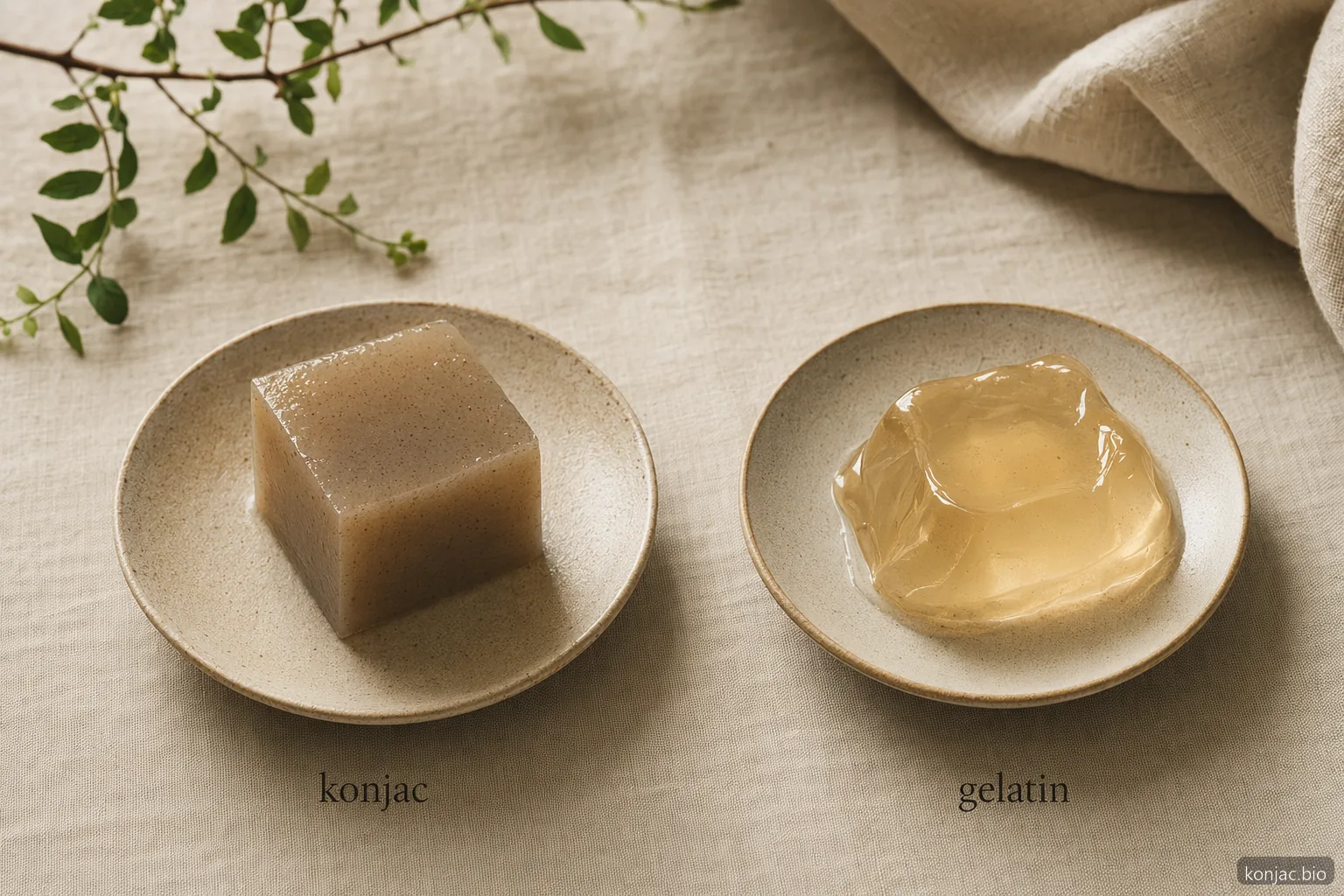
Konjac jelly is firmer and more elastic than many gelatin desserts, while gelatin jelly is softer, meltier, and derived from animal collagen. Fruit snacks often use pectin, starch, gelatin, or blends, so their chew depends on the gelling system rather than the fruit flavor.
The biggest sensory difference is melt. Gelatin softens near body temperature, giving it a smooth, melting bite. Konjac gels do not melt the same way in the mouth, so they feel more springy and resistant.
| Feature | Konjac jelly | Gelatin jelly |
|---|---|---|
| Primary gel source | Konjac glucomannan | Animal collagen gelatin |
| Diet fit | Plant-based formulas possible | Not vegetarian |
| Texture | Elastic, bouncy, chewy | Soft, smooth, meltier |
| Heat response | More stable in many systems | Melts more readily |
| Typical formats | Pouches, cups, cubes | Dessert cups, molded gels |
Konjac jelly is not automatically better than gelatin jelly. It is better when the product brief calls for plant-based labeling, high water binding, a resilient chew, or reduced-sugar texture. Gelatin remains useful when the goal is a delicate melt, clear gel, or classic dessert profile.
Is konjac jelly safe to eat?
Konjac jelly can be safe when it is formulated, portioned, labeled, and eaten in a way that reduces choking risk.
The main concern is not ordinary konjac powder or every jelly dessert. The concern is small, firm, slippery mini-cup gel candies that can lodge in the throat if swallowed whole. FDA import controls have targeted certain gel candies containing konjac because of choking hazards, especially when the gel is packed in small cups and does not dissolve quickly [FDA alert](https://www.accessdata.fda.gov/cms_ia/importalert_108.html).
Safer product design usually focuses on size, squeeze format, gel strength, bite behavior, and instructions. Pouches that dispense a strand or spoonable gel can reduce the chance of swallowing a firm plug whole. Products for young children, older adults, or people with swallowing difficulty need extra caution.
Home consumers should chew konjac jelly thoroughly and avoid giving firm mini-cup gels to small children. Food brands should validate texture, serving geometry, label warnings, and market-specific rules before launch.
Buying and formulation notes for konjac jelly
Good konjac jelly starts with a controlled konjac ingredient, not just a generic powder. Buyers should ask for viscosity grade, mesh size, microbiological limits, heavy metal results, allergen status, country of origin, and processing certifications such as ISO 22000 or FSSC 22000 where relevant.
For formulation, the most common failure points are clumping, weak gel, rubbery bite, syneresis, and flavor dulling. Clumping usually comes from poor dispersion. Rubbery bite often means the konjac level or alkali interaction is too high. Water release can point to an unstable hydrocolloid blend, low solids, pH mismatch, or inadequate processing.
Konjac jelly also needs a clear product identity. A snack pouch, dessert cube, and mini-cup candy should not share the same texture target. The safest and best-tasting product is built around its eating moment, serving size, and consumer group.
B2B aside: konjac.bio sources konjac ingredients at wholesale scale for food brands developing jelly, noodle, powder, and gel applications. For specifications and pricing, contact the team at /contact/.
Frequently asked questions
01 Is konjac jelly the same as shirataki noodles?
02 Does konjac jelly contain gelatin?
03 Why is konjac jelly so chewy?
04 Can children eat konjac jelly?
05 Is konjac jelly low calorie?
06 What does konjac jelly taste like?
- Scientific Opinion on the substantiation of health claims related to konjac mannan · European Food Safety Authority · 2010
- Import Alert 33-15 · U.S. Food and Drug Administration · 2024
- Glucomannan · National Center for Biotechnology Information · 2020
- Amorphophallus konjac K.Koch · Plants of the World Online, Kew · 2024