what is konjac?
Konjac is the common name for Amorphophallus konjac, a tuber-forming plant used to make glucomannan fiber, konjac flour, shirataki noodles, and firm alkaline gels. Botanically, it belongs to the Araceae family, the same broad plant family as taro and calla lily, with its accepted species record listed in the NCBI taxonomy.
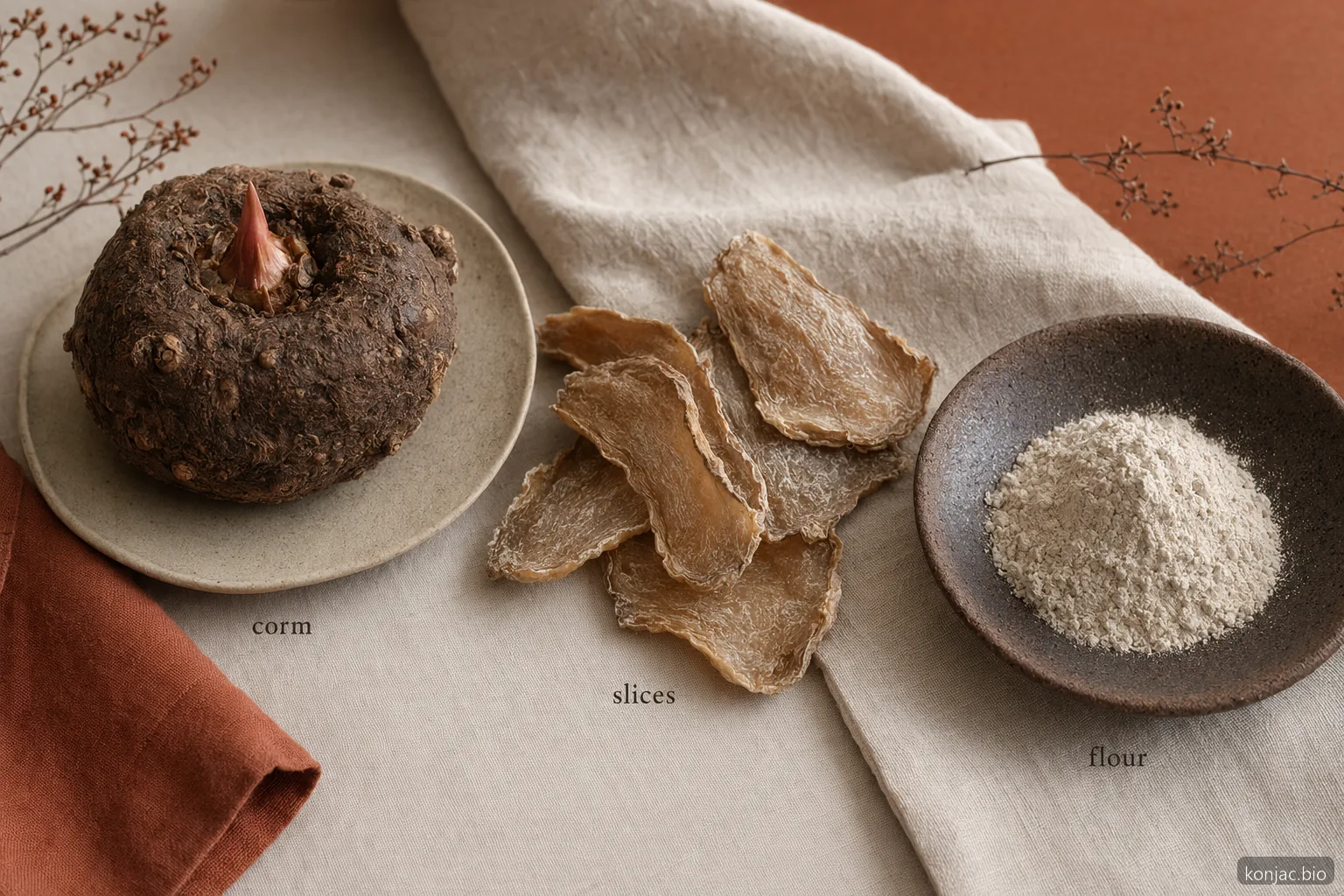
The edible and industrial value comes from the corm, a swollen underground stem. After harvesting, the corm is sliced, dried, milled, and purified into flour with high water-binding capacity. Food makers use that flour because it thickens, gels, and adds soluble fiber at low inclusion rates.
Konjac is not one single finished food. It is a plant source that can appear as translucent noodles, blocks, powders, capsules, jelly-style snacks, vegan seafood-style products, or texture systems in sauces and desserts. For a wider map of the plant, powder, and product categories, see the parent konjac hub.
what is konjac made of?
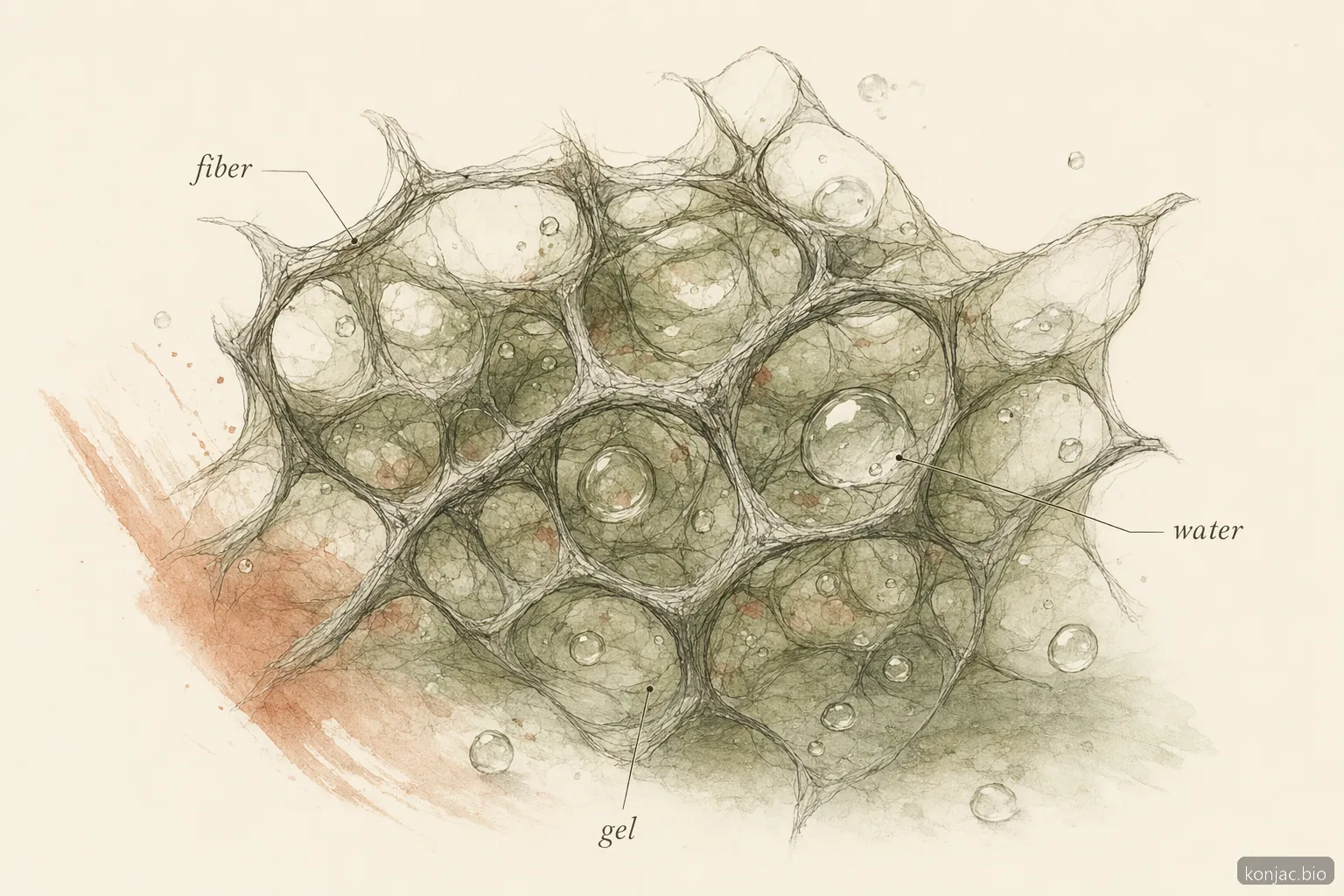
Konjac is mainly valued for glucomannan, a soluble polysaccharide concentrated in the dried corm and widely used as a food hydrocolloid. Konjac glucomannan is built from glucose and mannose units, and reviews describe it as a high-molecular-weight, water-soluble dietary fiber with strong thickening and gelling behavior konjac review.
In plain terms, glucomannan absorbs water and forms a viscous network. That is why a small amount of konjac powder can change the mouthfeel of a sauce, help a noodle hold shape, or form a bouncy gel when combined with alkaline processing.
| Component or property | Why it matters |
|---|---|
| Glucomannan | Main soluble fiber responsible for viscosity and gel structure |
| Water binding | Helps create fullness, thick textures, and low-calorie bulk |
| Alkaline gelation | Turns konjac flour into firm noodles, cakes, and gel blocks |
| Neutral flavor | Allows use in savory, sweet, and functional food systems |
The exact composition depends on cultivar, harvest timing, drying method, and purification level. Food-grade konjac powder is usually specified by glucomannan content, viscosity, particle size, moisture, ash, microbiology, and sulfur dioxide residue when relevant.
From corm to food ingredient
The konjac supply chain starts with the corm, not the leaf or flower. Farmers harvest mature corms, then processors clean, slice, dry, and mill them into crude powder before air classification or alcohol washing improves color, odor, and glucomannan concentration.
A simplified production flow looks like this:
- Harvest mature Amorphophallus konjac corms.
- Wash and trim soil, skin, and damaged tissue.
- Slice or chip the corm for faster drying.
- Dry to a stable moisture level for storage.
- Mill into powder, then separate starch, fiber, and impurities.
- Standardize viscosity, mesh size, and microbial specifications.
Konjac flour becomes a food ingredient when processors control purity and hydration behavior. Coarse flour may work in traditional gel foods, while refined powder is preferred in beverages, sauces, capsules, and clean-label texture systems.
For formulators, konjac.bio sources wholesale konjac powder and related formats for product teams that need specification review, sample matching, and scale planning through contact.
what is konjac used for in food?
Konjac is used in food as a fiber source, thickener, gelling agent, noodle base, and low-calorie texture builder. The best-known consumer format is shirataki, a translucent noodle made from hydrated konjac flour and alkaline water, covered further in our shirataki noodles guide.
Because konjac has little flavor on its own, it usually carries sauces, broths, seasonings, or sweeteners. Its value is functional texture: it can be slippery, springy, firm, elastic, or viscous depending on hydration, pH, heat, and calcium or alkaline conditions.
| Food format | Konjac function | Typical result |
|---|---|---|
| Shirataki noodles | Gel matrix and water binding | Low-calorie, chewy noodle texture |
| Konjac powder | Soluble fiber and thickener | Viscosity in drinks, sauces, and mixes |
| Vegan seafood-style foods | Elastic gel structure | Firm bite and sliceable shape |
| Jelly desserts | Gel strength and bounce | Clear, resilient gel texture |
| Bakery and meat alternatives | Moisture retention | Improved juiciness and structure |
Dry konjac powder behaves differently from ready-to-eat noodles. Powder needs controlled dispersion to avoid clumping, rapid swelling, or overly thick textures. Product developers usually pre-blend it with sugar, salt, starch, or other dry ingredients before adding water under shear.
Benefits, limits, and safety of konjac
Konjac is most often discussed for its fiber content, low calorie density, and ability to form filling, hydrated foods. The European Food Safety Authority approved the claim: 'Glucomannan in the context of an energy restricted diet contributes to weight loss,' with conditions including 3 g daily in three 1 g doses with water before meals EFSA opinion.
Konjac glucomannan also has an EFSA-authorized cholesterol claim in the European Union when the food provides the required amount, using the wording that glucomannan 'contributes to the maintenance of normal blood cholesterol concentrations' EU register. These are regulated wording frameworks, not blanket promises for every konjac food.
Safety depends on format. Ready-to-eat noodles and properly hydrated gels are different from dry powder, tablets, or small gel candies. Dry glucomannan can swell quickly, so it should be consumed with enough liquid and used according to label directions.
Mini-cup jelly products have a specific choking-risk history. The U.S. FDA has maintained an import alert for gel candies containing konjac because small, firm gels can lodge in the throat, especially when sucked from mini cups FDA alert.
For everyday food use, the practical rule is simple: match the konjac format to the eater and the application. Hydrated noodles, powders dispersed into recipes, and commercial foods made under food-safety systems behave differently from concentrated dry forms or small resilient gel cups.
Frequently asked questions
01 Is konjac the same as glucomannan?
02 What does konjac taste like?
03 Is konjac low in calories?
04 How is konjac powder used in recipes?
05 Can children eat konjac foods?
06 What is the EFSA claim for konjac glucomannan?
- Scientific Opinion on konjac mannan and weight loss · European Food Safety Authority · 2010
- Commission Regulation (EU) No 432/2012 on authorised health claims · European Union · 2012
- Konjac glucomannan: A promising polysaccharide for food and biomedical applications · National Library of Medicine · 2020
- Import Alert 33-15: Gel candies containing konjac · U.S. Food and Drug Administration · 2024
- NCBI Taxonomy Browser: Amorphophallus konjac · National Center for Biotechnology Information · 2024