What is konjac noodle bulk buying?
Konjac noodle bulk buying is the wholesale purchase of konjac-based noodles for retail packs, foodservice cases, meal kits, or private-label products. The noodles are usually made from purified konjac glucomannan, water, and a food-grade alkaline setting agent, then packed in liquid and sealed for distribution.
Konjac glucomannan is a soluble dietary fiber derived from the corm of Amorphophallus konjac, a plant used in Asian gel foods and shirataki-style noodles. Scientific literature describes konjac glucomannan as a high-molecular-weight polysaccharide with strong water-binding and viscosity-forming properties [PubMed review](https://pubmed.ncbi.nlm.nih.gov/6096282/).
For commercial buyers, the word bulk can mean three different order types:
- Private-label retail: 200 g to 400 g pouches, cartons, and branded labels.
- Foodservice packs: larger pouches or tubs for restaurants, catering, and institutional kitchens.
- Industrial ingredients: drained noodles supplied for ready meals, soups, and chilled prepared foods.
The main buying risk is not the noodle itself, but an unclear specification. Two suppliers may both quote konjac noodle bulk, yet differ on drained weight, liquid fill, odor control, pasteurization process, carton count, and shelf-life validation.
Which konjac noodle bulk specs should buyers confirm?
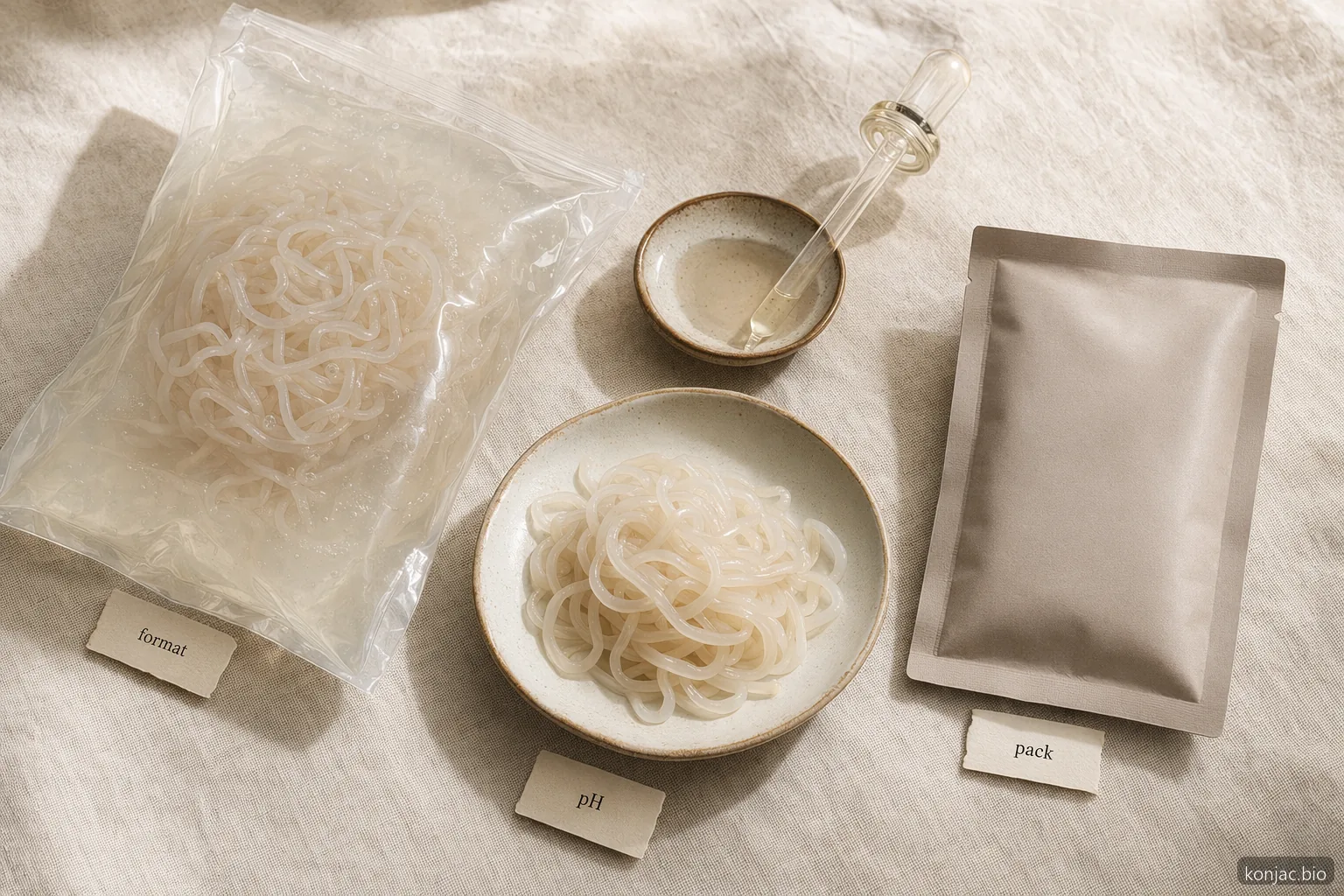
Buyers should confirm format, ingredients, drained weight, pH, shelf life, packaging, labeling, and quality documents before approving a konjac noodle bulk supplier. These items affect cost, consumer experience, customs clearance, and regulatory review.
A clear specification sheet should name the exact noodle shape and pack format. Common shapes include spaghetti, fettuccine, angel hair, rice-shaped grains, knots, and mixed vegetable blends. Shape affects texture, cooking use, filling speed, and breakage during transport.
| Spec item | Why it matters | Buyer check |
|---|---|---|
| Net weight | Defines labeled pack size | Confirm gross, net, and drained weight |
| pH | Supports product stability and taste profile | Ask for target range and release limits |
| Liquid fill | Affects odor, texture, and carton weight | Review water ratio and seasoning options |
| Ingredients | Controls label claims and allergen review | Check konjac flour, water, calcium hydroxide, and blends |
| Shelf life | Impacts import planning and retail dating | Request validation data by pack format |
| Packaging | Controls leakage, pallet load, and display | Approve pouch thickness, carton, and pallet plan |
United States buyers should align nutrition panels, serving sizes, ingredient statements, and claims with FDA food labeling rules [FDA label](https://www.fda.gov/food/food-labeling-nutrition/nutrition-facts-label). EU buyers should review nutrition and health claim language separately, because authorized wording and conditions can differ by market.
If the same supplier also sells konjac flour or purified powder, request ingredient traceability back to the same raw material system. Buyers comparing noodle and powder programs can map specifications through our konjac flour wholesale guide.
How are bulk konjac noodles manufactured and packed?
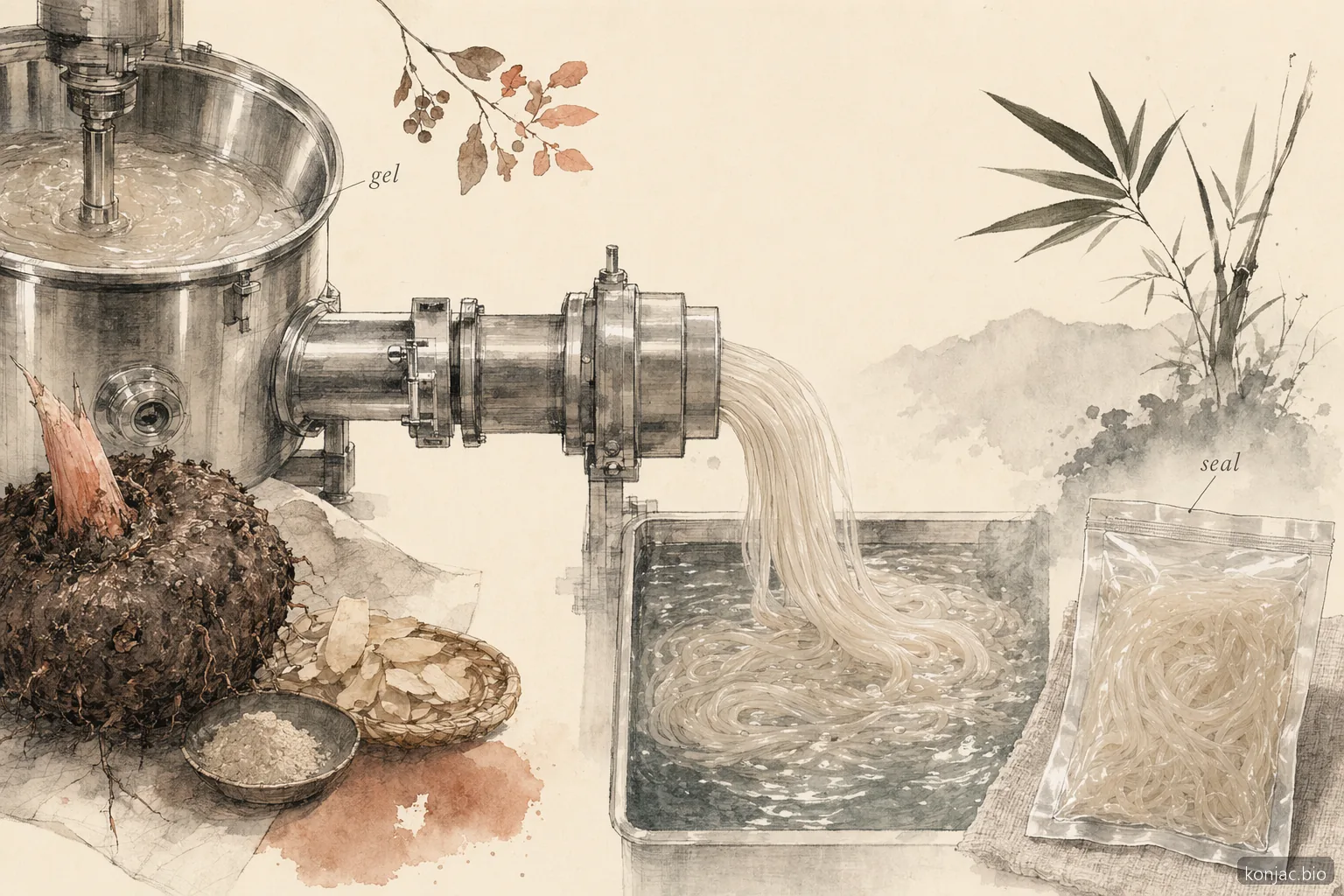
Bulk konjac noodles are manufactured by hydrating konjac glucomannan, forming a gel with an alkaline setting agent, shaping the gel into noodles, rinsing, packing in liquid, sealing, and applying a validated thermal process. The exact process depends on noodle shape, pouch size, and target shelf life.
A typical wholesale production flow has seven steps:
- Raw material approval: konjac flour or glucomannan is checked for viscosity, ash, moisture, color, and microbiology.
- Hydration: powder is dispersed in water until a uniform viscous slurry forms.
- Gel setting: a food-grade alkaline ingredient, often calcium hydroxide, creates the firm konjac gel texture.
- Shaping: the gel is extruded or cut into spaghetti, flat noodle, rice, or specialty formats.
- Rinsing: noodles are washed to manage alkaline notes and surface liquid.
- Packing: noodles and liquid are filled into pouches, cups, or foodservice packs.
- Sealing and thermal processing: packs are sealed, processed, cooled, inspected, and cased.
Food safety systems should cover raw material controls, water quality, foreign material control, sealing integrity, thermal process records, and finished-product testing. Many manufacturers use ISO 22000 as a food safety management framework for documented hazard control, verification, and continuous improvement [ISO 22000](https://www.iso.org/standard/65464.html).
Konjac noodle programs are different from konjac mini-cup gel candies. FDA import controls have focused on certain gel candies containing konjac because of choking risk in that product format [FDA alert](https://www.accessdata.fda.gov/cms_ia/importalert_115.html). Noodles, rice-shaped konjac, and pasta-style products require their own product-specific risk review, not a copy of candy-format assumptions.
Commercial formats, packaging, and use cases
Konjac noodles are sold in formats that match a brand channel: retail grocery, online multipacks, foodservice kitchens, ready-meal factories, and diet-oriented meal plans. The most common commercial format is a liquid-packed pouch because konjac gel holds texture well in water and the pack is easy to rinse before cooking.
Retail packs usually emphasize low calorie positioning, gluten-free formulation when verified, and quick preparation. Foodservice packs focus on drained yield, fast rinse time, consistent strand length, and carton handling. Ready-meal manufacturers often need tighter controls on noodle length, liquid carryover, and compatibility with sauce, soup, or chilled meal assembly.
| Channel | Common pack | Typical buyer priority |
|---|---|---|
| Retail | 200 g to 400 g pouch | Label appearance, shelf life, consumer texture |
| E-commerce | Multi-pouch carton | Leak resistance and parcel durability |
| Foodservice | Large pouch or tub | Drained yield and prep speed |
| Ready meals | Ingredient pack | Process compatibility and consistent cut size |
Packaging choices affect landed cost more than many first-time buyers expect. Liquid-packed noodles carry water weight, so carton count, pallet height, container utilization, and leakage tolerance should be reviewed before confirming a quote.
B2B aside: konjac.bio sources konjac ingredients and finished konjac formats at wholesale scale for food brands. For pricing, formats, and production planning, contact the team at /contact/.
Supplier due diligence for wholesale noodle programs
Supplier due diligence should verify that the manufacturer can produce the chosen noodle format consistently, document food safety controls, and support the buyer's target market. A low unit price is useful only when the supplier can pass document review, label review, and arrival inspection.
Ask for a document pack before placing a commercial order. At minimum, request:
- Finished product specification sheet
- Certificate of analysis for recent lots
- Microbiology release standards
- Allergen statement
- Ingredient statement and processing aid disclosure
- Food safety certification, audit summary, or HACCP plan overview
- Shelf-life validation or stability summary
- Pouch, carton, and pallet specifications
- Country of origin and export documents
Health claim review is a separate workstream. EFSA authorized the specific claim, 'Glucomannan in the context of an energy-restricted diet contributes to weight loss,' with conditions of use that include 3 g daily in three 1 g doses with water before meals [EFSA opinion](https://www.efsa.europa.eu/en/efsajournal/pub/1798). Brands should not generalize that language across markets without legal and regulatory review.
For United States distribution, buyers should also check whether the supplier's facility and importer workflow align with the FDA Food Safety Modernization Act framework for human food [FDA rule](https://www.fda.gov/food/food-safety-modernization-act-fsma/fsma-final-rule-preventive-controls-human-food). For adjacent product lines, compare noodle sourcing with konjac rice bulk to simplify supplier qualification across shapes.
Frequently asked questions
01 What is the usual minimum order for konjac noodle bulk?
02 Are bulk konjac noodles the same as shirataki noodles?
03 What documents should a buyer request before ordering?
04 Can konjac noodle labels mention weight management?
05 How long is the shelf life of bulk konjac noodles?
- Scientific Opinion on the substantiation of health claims related to glucomannan · European Food Safety Authority · 2010
- Nutrition Facts Label · U.S. Food and Drug Administration · 2024
- Import Alert 33-15 · U.S. Food and Drug Administration · 2024
- FSMA Final Rule for Human Food · U.S. Food and Drug Administration · 2024
- Konjac glucomannan review · PubMed · 1984
- ISO 22000 Food safety management · International Organization for Standardization · 2018