What are the core konjac noodle ingredients?
The core konjac noodle ingredients are purified water, konjac flour, and calcium hydroxide.
Konjac flour comes from the corm of Amorphophallus konjac, a plant taxon listed by Kew Plants. Its main functional component is glucomannan, a water-binding polysaccharide reviewed by EFSA in its glucomannan opinion.
| Ingredient | Typical role | Brand check |
|---|---|---|
| Purified water | Hydrates the flour and creates noodle mass | Water quality, filtration, local standards |
| Konjac flour or powder | Provides glucomannan for gel structure | Mesh size, viscosity, sulfur dioxide, ash |
| Calcium hydroxide | Raises pH and helps form a stable gel | Food-grade status, dosage, residual alkalinity |
Wet-packed shirataki noodles are often over 95 percent water by weight. The konjac powder level is usually low, but its hydration behavior has a large effect on firmness, strand strength, and cooking stability.
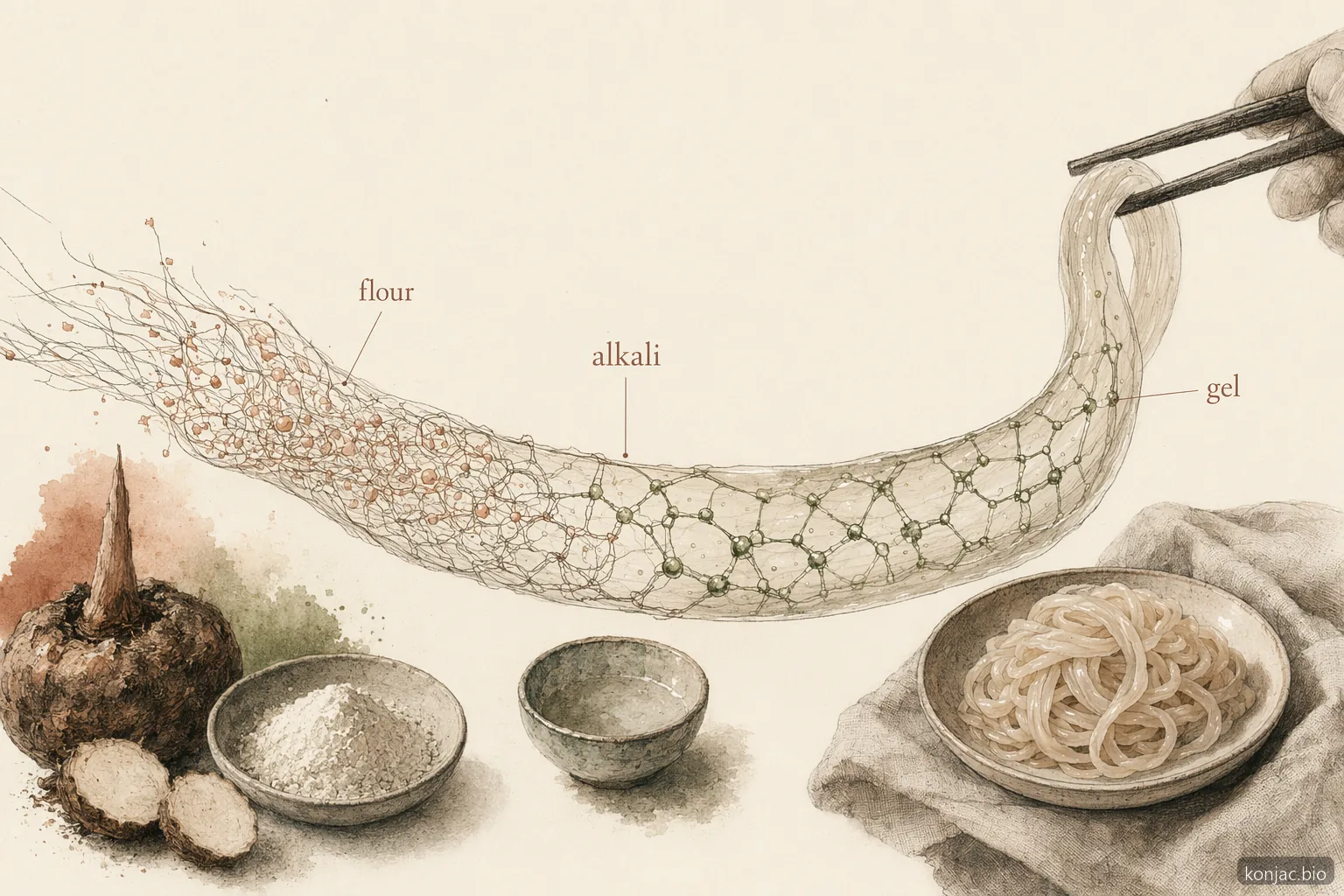
Why do konjac noodle ingredients need calcium hydroxide?
Konjac noodle ingredients need calcium hydroxide because alkaline conditions help hydrated glucomannan set into a firm, elastic gel.
Calcium hydroxide is a recognized food additive in international additive databases, including the FAO GSFA. In noodle production, it is used in controlled amounts to shift the pH and stabilize the hydrated konjac matrix.
Without an alkaline setting step, hydrated konjac can stay too soft, sticky, or fragile for extrusion into noodle strands. With too much alkali, the noodle can taste harsh, smell strongly alkaline, or fail brand sensory targets.
For commercial sourcing, the calcium hydroxide specification should confirm food-grade status, purity, heavy metals limits, dosage range, and finished-product pH target. Brands should also check whether the finished label must declare calcium hydroxide, depending on market rules and formulation role.
Ingredient functions in a commercial konjac noodle formula
A commercial konjac noodle formula is built around hydration, gel formation, strand shaping, and pouch stability. The same short ingredient list can produce very different results when the konjac grade, hydration time, shear, pH, and thermal step change.
- Hydration: Konjac flour is dispersed into water under controlled agitation to limit clumping.
- Swelling: Glucomannan absorbs water and increases viscosity before shaping.
- Setting: Calcium hydroxide creates the alkaline conditions needed for a stronger gel.
- Forming: The gelled mass is extruded or cut into spaghetti, fettuccine, rice, knot, or sheet formats.
- Packing: Noodles are filled with water or brine into pouches, cups, or bulk foodservice packs.
Particle size matters. Fine konjac powder hydrates faster and can build viscosity quickly, while coarser material may hydrate more slowly and create a different bite. Viscosity grade also matters because two powders with the same ingredient name can behave differently in a production kettle.
For ingredient purchasing, connect noodle format to raw material grade. Thin spaghetti-style strands need strand integrity, while rice-style pieces need cut stability and low breakage. See the parent sourcing guide, Konjac Wholesale & Manufacturing, for broader supplier qualification criteria.
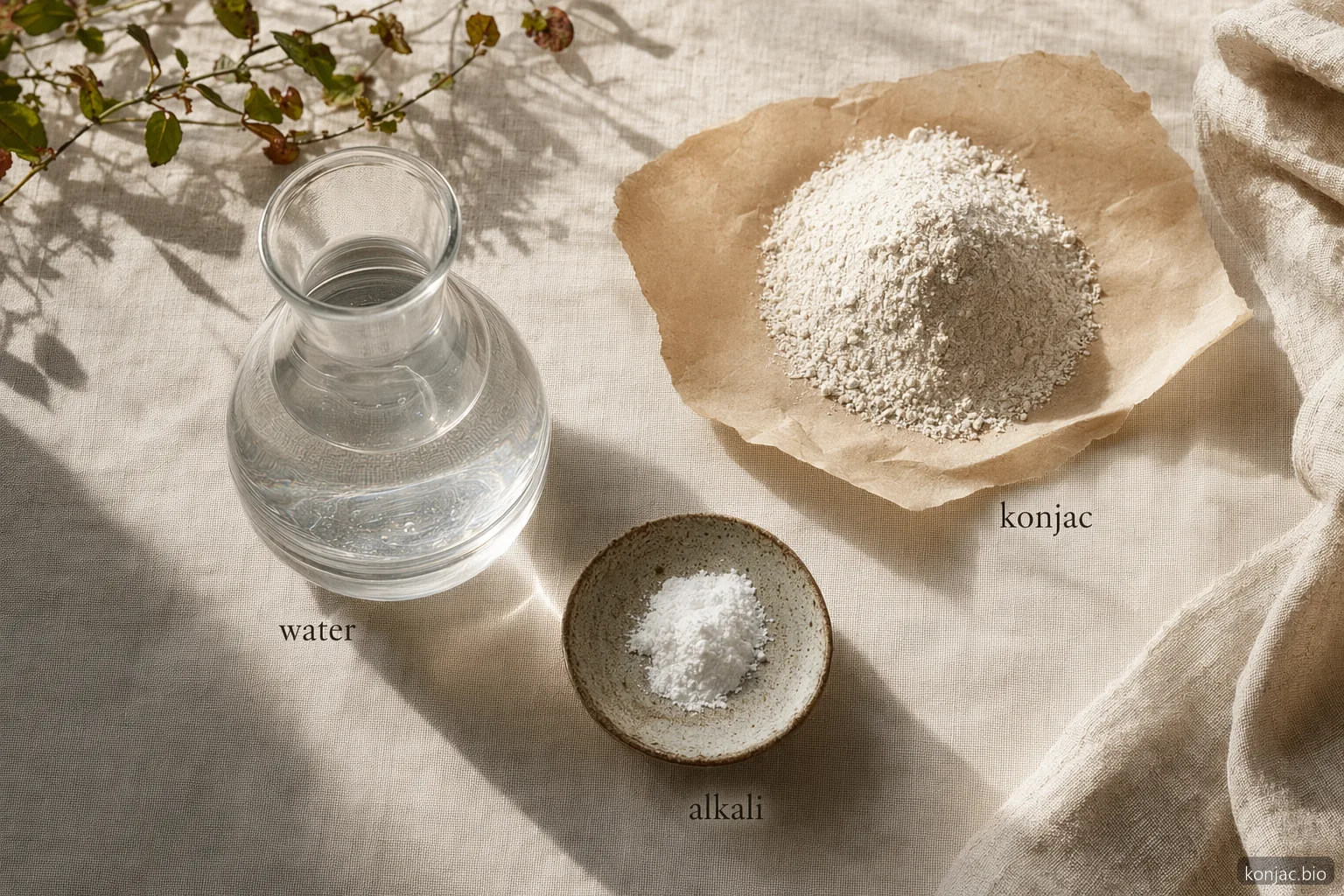
Which konjac noodle ingredients affect texture, odor, and shelf life?
The ingredients most affecting texture, odor, and shelf life are konjac flour grade, calcium hydroxide level, water quality, and optional fiber or starch additions.
Konjac noodles can have a mild alkaline aroma because they are packed in alkaline water. Rinsing and heating can reduce the aroma for consumers, but brands should solve most sensory issues at the formulation and packing-water stage.
| Formula variable | What it changes | Common brand goal |
|---|---|---|
| Higher viscosity konjac | Firmer bite and better strand strength | Premium noodle texture |
| Lower alkali level | Milder aroma but weaker set | Cleaner sensory profile |
| Oat fiber or bamboo fiber | More opacity and grain-like bite | Pasta-style mouthfeel |
| Tapioca or other starch | Softer chew and higher calories | Hybrid noodle positioning |
| Citric acid in pack liquid | pH adjustment and flavor balance | Cleaner pouch aroma |
Physical format also matters. The FDA has warned that mini-cup gel candies containing konjac gel can pose a choking hazard because of firmness and shape, as described in its konjac advisory. Noodles are a different format, but the warning shows why gel strength, size, and intended use should be reviewed during product development.
Wholesale specification checklist for konjac noodle ingredients
Wholesale buying should start with a written specification, not a label name. The phrase konjac flour can cover different mesh sizes, viscosity levels, purification methods, odor profiles, and microbiological limits.
- Botanical source: Amorphophallus konjac corm, country of origin, harvest year.
- Functional grade: viscosity range, gel strength, particle size, hydration curve.
- Purity controls: moisture, ash, protein, starch, sulfur dioxide, heavy metals.
- Food safety: total plate count, yeast and mold, coliforms, Salmonella, allergen controls.
- Processing fit: dispersibility, clump resistance, extrusion behavior, pouch-water compatibility.
- Documentation: COA, specification sheet, allergen statement, country of origin, traceability lot code.
If your product starts from powder rather than finished noodles, compare grades through konjac flour wholesale specifications. If your team is buying finished wet-packed formats, review shirataki noodles wholesale requirements for pouch size, drained weight, and private-label packing.
For B2B teams, konjac.bio sources konjac powder and noodle-grade inputs at wholesale volumes, with specifications matched to finished-format goals. For pricing, samples, and documentation, contact the team at /contact/.
Frequently asked questions
01 Are konjac noodles made only from water and konjac flour?
02 Is calcium hydroxide normal in konjac noodle ingredients?
03 Do konjac noodle ingredients contain gluten?
04 Why do konjac noodles sometimes smell alkaline or fishy?
05 What should brands request before buying konjac noodle ingredients wholesale?
06 Do konjac noodle ingredients support weight-management positioning?
- Scientific Opinion on health claims related to glucomannan · European Food Safety Authority · 2010
- Consumer Advisory: Mini-Cup Gel Candies Containing Konjac Gel Pose Potential Choking Hazard · U.S. Food and Drug Administration · 2002
- The effect of glucomannan on body weight in overweight or obese children and adults · PubMed · 2015
- Calcium hydroxide additive details · FAO GSFA · 2024
- Amorphophallus konjac plant profile · Royal Botanic Gardens, Kew · 2024