What does shirataki noodle bulk include for wholesale buyers?
shirataki noodle bulk includes konjac noodles supplied in wholesale carton quantities for retail, foodservice, meal kits, and private label programs.
The most common format is wet-packed shirataki made from water, konjac flour or konjac glucomannan, and a firming agent such as calcium hydroxide. The noodles are packed in alkaline water or brine-like packing liquid, then sealed in pouches or bags for ambient or chilled distribution depending on the process validation.
| Bulk format | Typical buyer | Common use |
|---|---|---|
| 180 g to 400 g retail pouch | Private label grocery brand | Single-SKU shelf product |
| 1 kg to 5 kg foodservice bag | Restaurant, caterer, institutional kitchen | Portioned bowls, stir-fries, soups |
| Mixed-cut export carton | Distributor | Assorted angel hair, fettuccine, rice, spaghetti |
| Unlabeled or neutral pouch | Brand owner | Domestic relabeling where allowed |
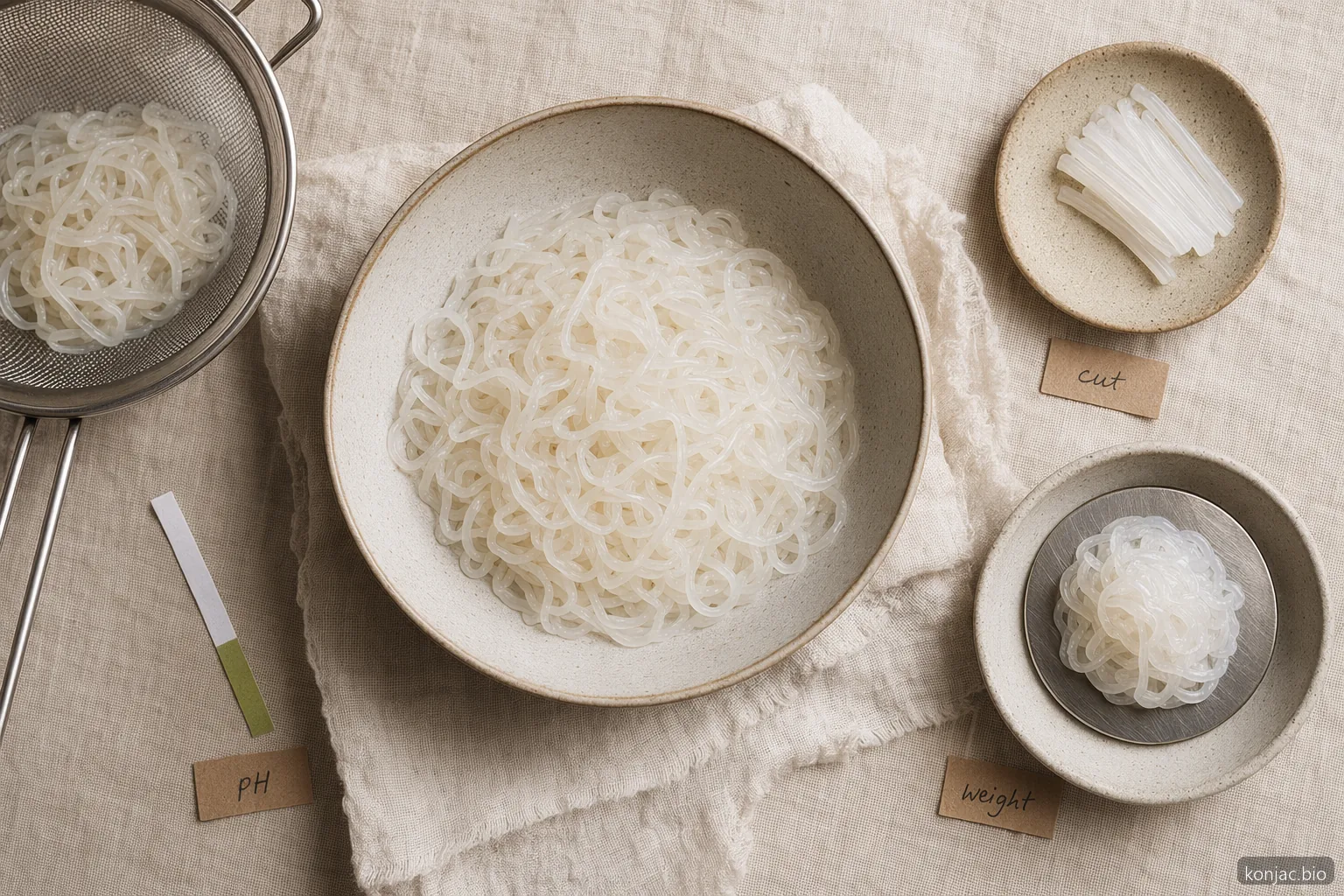
Wholesale buyers should separate product format from commercial format. Product format means noodle shape, moisture, aroma, bite, pH, and drained weight. Commercial format means units per carton, carton dimensions, pallet pattern, Incoterms, and private label artwork control.
How should shirataki noodle bulk specifications be written?
shirataki noodle bulk specifications should define physical, chemical, microbiological, sensory, packaging, and logistics requirements in one buyer-approved document.
A usable specification sheet removes ambiguity before sampling, pilot orders, and repeat production. For wet-packed shirataki, the most important commercial mismatch is often net weight versus drained weight, because consumers eat the drained noodles after rinsing.
- Noodle identity: spaghetti, angel hair, fettuccine, rice shape, knot, sheet, or custom cut.
- Ingredient line: water, konjac flour or glucomannan, calcium hydroxide, and any allowed supporting ingredients.
- Weight control: declared net weight, target drained weight, tolerance, and test method.
- Texture: firmness, elasticity, breakage rate, and acceptable bite after rinsing.
- Chemistry: pH range, moisture level, ash, and any market-specific limits.
- Microbiology: total plate count, yeast and mold, coliforms, and absence criteria where applicable.
- Packaging: pouch film, seal width, leak test, carton strength, and pallet plan.
Food safety systems also belong in the spec pack. ISO 22000 is an international food safety management standard published by the [ISO standard](https://www.iso.org/standard/65464.html), while HACCP-based controls are widely used to identify and manage process hazards. Buyers should ask for the current certificate, issuing body, site address, and scope, not just a logo on a sales deck.
The ingredients behind bulk shirataki noodles
Shirataki noodles are built around konjac, the corm of Amorphophallus konjac, and its main functional polysaccharide, glucomannan. A PubMed-indexed review describes konjac glucomannan as a water-soluble, high-molecular-weight dietary fiber with strong water-binding properties in food systems [konjac review](https://pubmed.ncbi.nlm.nih.gov/25187017/).
In noodle production, konjac powder hydrates in water, then an alkaline coagulant helps form the elastic gel structure associated with shirataki. That gel structure explains why the product has a slippery bite and very high water content compared with wheat pasta.
For brand teams, the ingredient choice affects texture, label wording, cost, and claim strategy. Konjac flour usually contains glucomannan plus natural starches and minerals from the corm, while more refined glucomannan can give stronger viscosity and cleaner gel performance. Buyers comparing upstream raw materials can also review konjac flour bulk specifications for viscosity, mesh size, sulfur dioxide limits, and hydration behavior.
Health-related copy needs careful legal review. The European Food Safety Authority concluded that the authorized wording is: “Glucomannan in the context of an energy restricted diet contributes to weight loss” when the stated conditions of use are met [EFSA opinion](https://www.efsa.europa.eu/en/efsajournal/pub/1798). In the United States, dietary fiber labeling is governed through FDA nutrition labeling rules and recognized fiber definitions [FDA fiber](https://www.fda.gov/food/nutrition-facts-label/dietary-fiber-nutrition-facts-label).
How do packaging and shelf-life decisions affect shirataki noodle bulk?
Packaging and shelf-life decisions affect shirataki noodle bulk by controlling leakage, texture drift, aroma, labeling space, carton efficiency, and retail readiness.
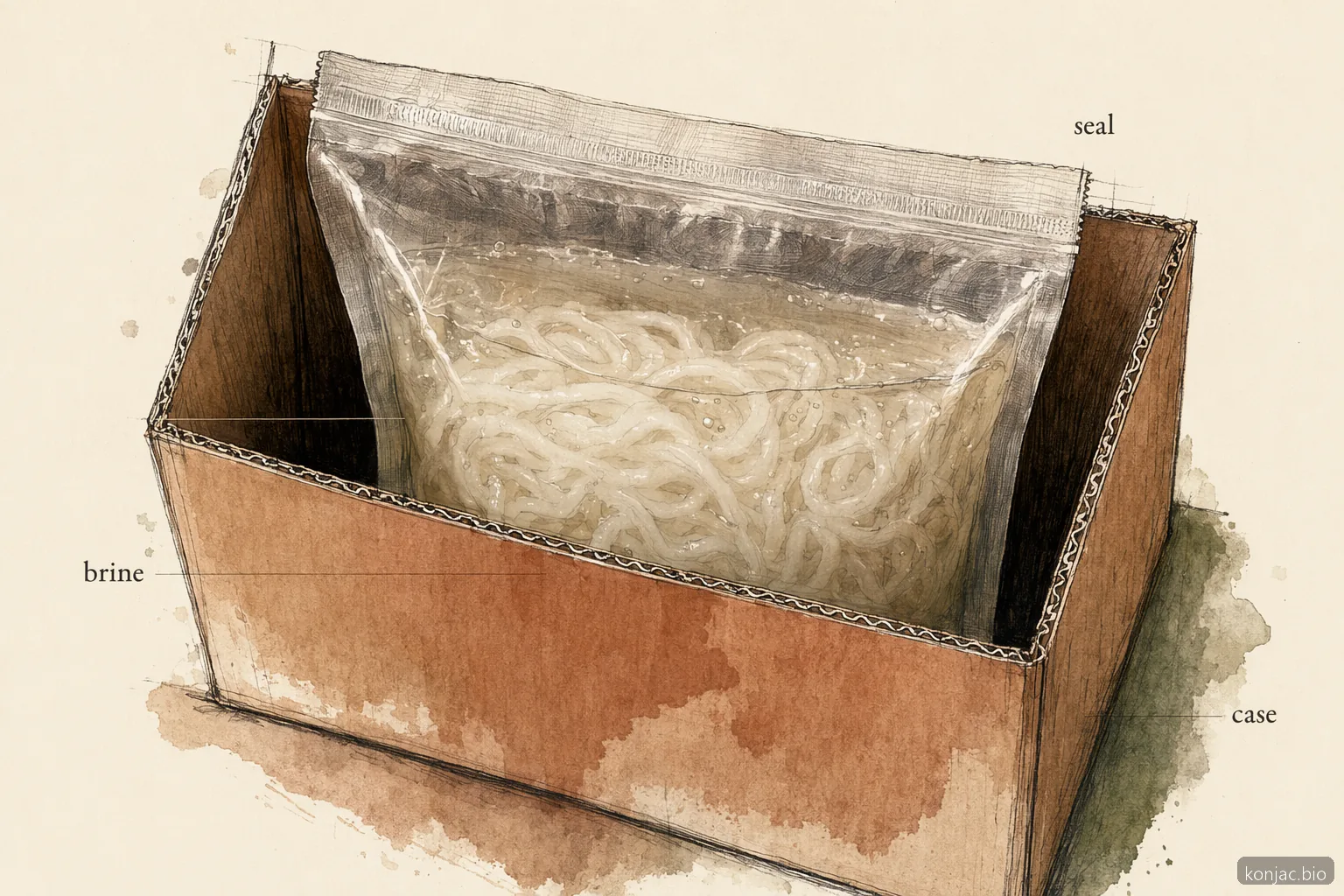
Wet-packed shirataki places unusual stress on packaging because each pouch contains both noodles and liquid. A weak seal can leak during container movement, while an overly rigid pouch can increase carton damage and freight cost. Buyers should approve both primary packaging and shipper cartons before mass production.
| Decision | Why it matters | Buyer check |
|---|---|---|
| Pouch film | Controls oxygen, puncture resistance, and shelf presentation | Request film structure and migration compliance |
| Seal validation | Reduces leakage during export handling | Review burst, vacuum, or compression test records |
| Carton count | Sets case weight and retail replenishment rhythm | Confirm units per case and gross weight |
| Shelf-life basis | Supports date coding and market access | Ask for real-time or accelerated data |
| Barcode and coding | Supports warehouse scans and recalls | Confirm GTIN, lot code, and expiry format |
Shelf life should be tied to the exact formula, pouch, process, and storage condition. A supplier’s 12-month or 18-month claim is only meaningful when supported by microbiology, pH, seal integrity, and sensory records for that product and packaging combination.
What compliance checks reduce risk when importing shirataki noodle bulk?
Compliance checks reduce import risk by confirming that shirataki noodle bulk meets food safety, labeling, packaging, and documentation requirements in the destination market.
Konjac has a strong food safety record in noodle form, but regulators have raised concerns about a different product category: mini-cup gel candies containing konjac. The FDA warned consumers not to eat mini-cup gel candies containing konjac because of choking risk [FDA jelly](https://www.fda.gov/food/alerts-advisories-safety-information/fda-warns-consumers-not-eat-mini-cup-gel-candies-containing-konjac). That warning is not the same as a noodle ban, but it shows why product format, texture, serving instructions, and label review matter.
- COA per lot: confirm microbiology, pH, net weight, drained weight, and any agreed chemical limits.
- Traceability: require lot codes linking konjac raw material, production date, packing date, and export carton.
- Label review: check ingredient names, nutrition panel, allergen statement, claims, country of origin, and importer details.
- Packaging compliance: request food-contact declarations for pouch film, ink, adhesive, and carton liners where relevant.
- Factory documents: review business license, food production license, audit report, and certificate scope.
Some brands buy both noodles and hydrocolloid ingredients for sauces, gels, or plant-based products. If your portfolio uses gum systems, compare specifications with konjac gum wholesale sourcing to align viscosity, gel strength, and labeling across SKUs.
B2B aside: konjac.bio sources konjac ingredients and finished konjac products at wholesale scale for brands, distributors, and manufacturers. Share your target cut, pack size, market, and annual volume through our contact form for a practical sourcing review.
Frequently asked questions
01 What is the usual MOQ for shirataki noodle bulk?
02 Is shirataki noodle bulk shelf-stable or refrigerated?
03 What documents should a supplier provide before shipment?
04 Can shirataki noodles carry weight-management claims?
05 How do buyers compare samples from different shirataki factories?
- Scientific Opinion on the substantiation of health claims related to konjac mannan (glucomannan) · European Food Safety Authority · 2010
- Dietary Fiber on the Nutrition Facts Label · U.S. Food and Drug Administration · 2024
- FDA Warns Consumers Not To Eat Mini-Cup Gel Candies Containing Konjac · U.S. Food and Drug Administration · 2001
- Konjac glucomannan, a promising polysaccharide for food and biomedical applications · PubMed · 2014
- ISO 22000:2018 Food safety management systems · International Organization for Standardization · 2018