What is shirataki rice?
Shirataki rice is rice-shaped konjac gel made primarily from water and konjac glucomannan, not a cereal grain.
The base ingredient comes from Amorphophallus konjac, a plant used to make konjac flour, shirataki noodles, and other gelled konjac foods. EFSA identifies konjac mannan, also called glucomannan, as the fiber fraction used in its evaluated health claims for food products [konjac mannan](https://www.efsa.europa.eu/en/efsajournal/pub/1798).
The finished product is cut into small pieces that look like short rice grains. Its texture is springy and slippery rather than starchy, because it does not contain the same starch structure as white, brown, jasmine, or basmati rice.
Shirataki rice sits in the same food family as shirataki noodles, but the shape changes how it cooks. Noodles work well in broths and pasta swaps, while rice-shaped konjac works better in bowls, skillets, fried rice-style meals, and saucy plates.
How many calories and carbs are in shirataki rice?
Shirataki rice usually has far fewer calories and digestible carbohydrates than cooked white rice because most of its weight is water and glucomannan fiber.
Exact numbers vary by label, serving size, added oat fiber, soybean fiber, or starch blends. The FDA advises shoppers to use the Nutrition Facts label for serving size, calories, carbohydrate, and fiber comparisons [FDA label](https://www.fda.gov/food/nutrition-facts-label/how-understand-and-use-nutrition-facts-label).
| Food | Typical serving | Calories | Total carbohydrate | Best use |
|---|---|---|---|---|
| Plain shirataki rice | 100-200 g, varies by label | Often 5-30 | Often 1-6 g | Low-calorie bowls and stir-fries |
| Cooked white rice | 1 cup, 158 g | About 205 | About 44.5 g | Traditional rice texture and starch |
| Cauliflower rice | 1 cup, about 107 g | About 27 | About 5.3 g | Vegetable-forward rice swap |
USDA FoodData Central lists cooked long-grain white rice at about 130 calories and 28.2 g carbohydrate per 100 g, which equals about 205 calories per cooked cup [USDA rice](https://fdc.nal.usda.gov/fdc-app.html#/food-details/168878/nutrients). Cauliflower is also low in calories, but it brings a vegetable flavor that shirataki rice does not [USDA cauliflower](https://fdc.nal.usda.gov/fdc-app.html#/food-details/169986/nutrients).
For calorie-focused shoppers, the main rule is simple: compare per 100 g and per package, not only per serving. Some packages contain 2 servings, while many people eat the whole pouch in one meal.
How do you cook shirataki rice so it tastes good?
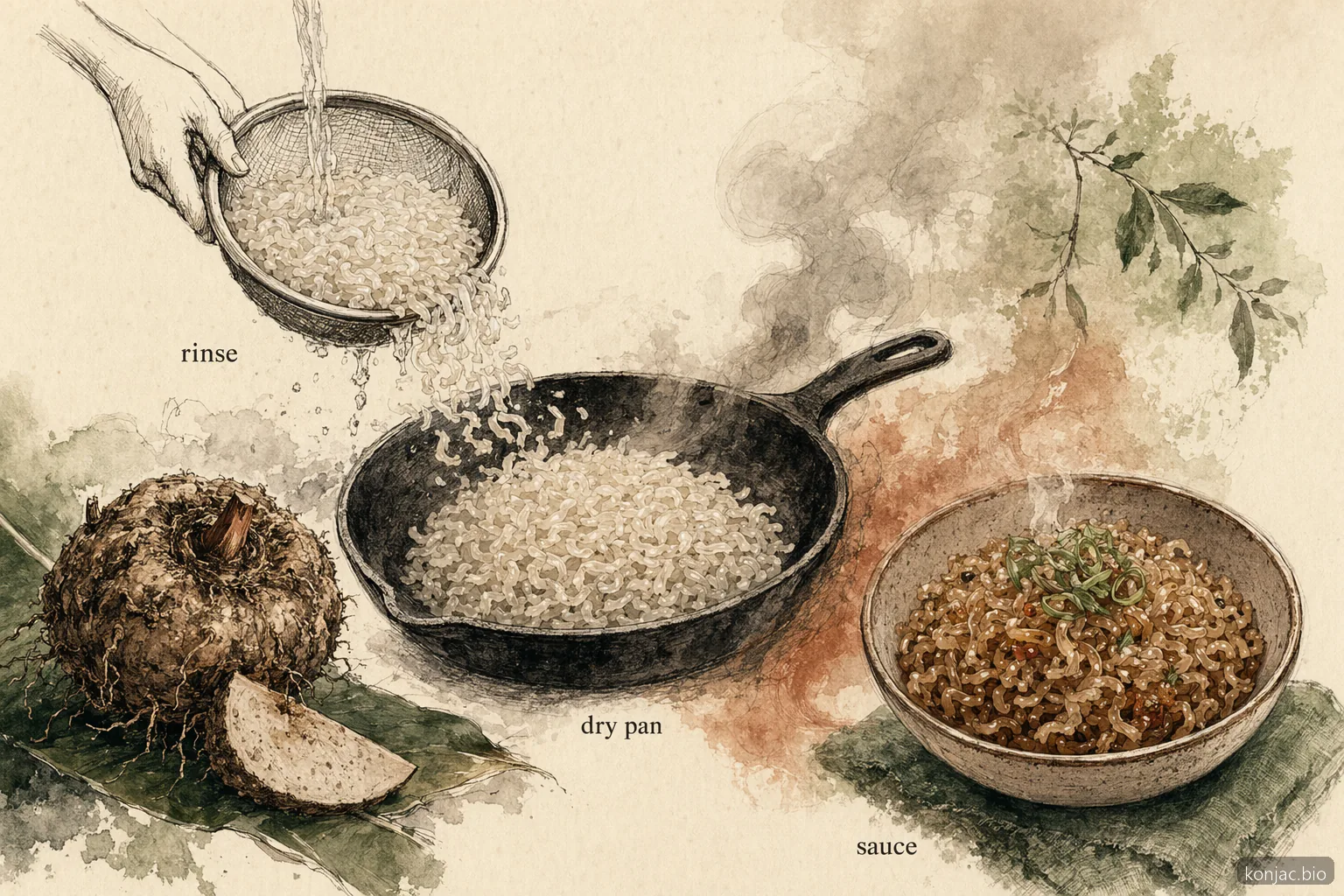
Shirataki rice tastes best when it is rinsed, drained, dry-heated, and then cooked with a strong sauce or aromatic base.
The pouch liquid can smell earthy or alkaline when opened. That aroma is usually reduced by rinsing under cold water for 30-60 seconds, draining well, and heating the rice in a dry skillet until excess moisture evaporates.
- Drain: Empty the pouch into a fine mesh strainer.
- Rinse: Rinse under cold running water for at least 30 seconds.
- Dry-heat: Cook in a dry nonstick skillet for 3-5 minutes.
- Season: Add salt, garlic, ginger, soy sauce, curry paste, salsa, or broth reduction.
- Finish: Add protein, vegetables, herbs, acid, and fat for a complete bowl.
Shirataki rice does not absorb liquid like jasmine rice or arborio rice. It is better to coat it with concentrated flavor than to simmer it in a large amount of broth.
For fried rice-style meals, cook aromatics first, then add eggs, tofu, seafood, poultry, or vegetables. Add shirataki rice near the end so the pan stays hot and the texture remains bouncy rather than watery. For more format ideas, pair this page with shirataki recipes.
Shirataki rice vs cauliflower rice vs white rice
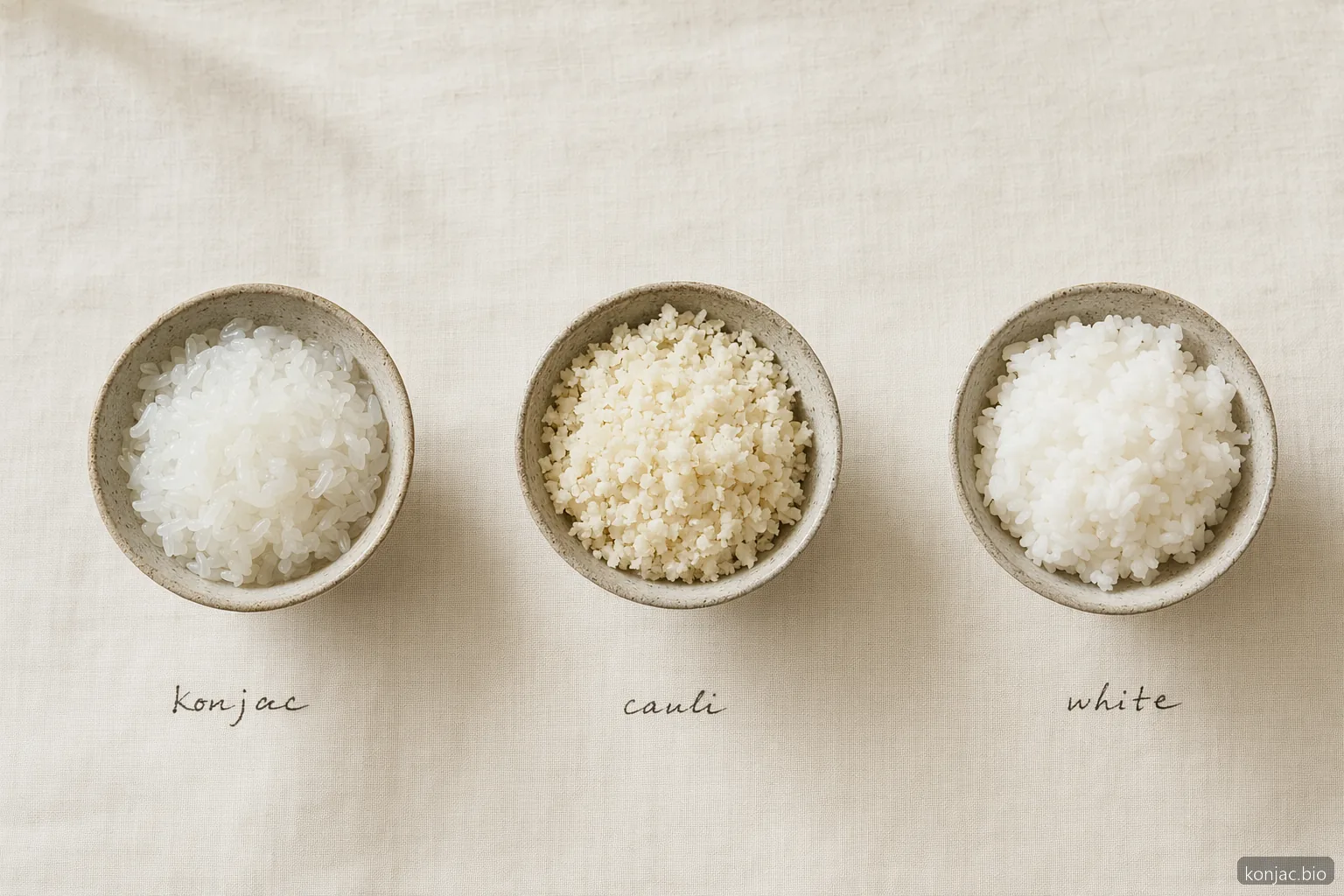
Shirataki rice, cauliflower rice, and white rice solve different problems in the kitchen. The best choice depends on whether the priority is calories, grain-like texture, vegetable intake, or traditional flavor.
| Feature | Shirataki rice | Cauliflower rice | White rice |
|---|---|---|---|
| Main ingredient | Water and konjac glucomannan | Chopped cauliflower | Rice grain |
| Texture | Springy, slick, gel-like | Tender, crumbly, vegetable-like | Soft, starchy, cohesive |
| Flavor | Neutral after rinsing | Mild brassica flavor | Grainy and slightly sweet |
| Meal prep | Good after dry-heating | Can release water | Best for reheated starch texture |
| Best dishes | Curries, bowls, saucy skillets | Vegetable bowls, taco bowls | Sushi bowls, rice plates, pilaf |
White rice gives the most familiar bite because it is a starch-rich grain. USDA data shows cooked white rice is energy-dense compared with water-rich alternatives [USDA rice](https://fdc.nal.usda.gov/fdc-app.html#/food-details/168878/nutrients).
Cauliflower rice brings more vegetable character and can brown lightly in a skillet. Shirataki rice is more neutral, but it needs aggressive draining because water is its dominant component.
For low-carb meal planning, shoppers often compare shirataki rice with shirataki noodles because both are konjac foods. A detailed calorie comparison is covered in shirataki calories.
Shirataki rice safety, benefits, and buying criteria
Shirataki rice is best evaluated as a high-water, fiber-based food with specific texture, labeling, and preparation considerations.
For glucomannan and weight management language, EFSA’s approved claim is: "Glucomannan in the context of an energy restricted diet contributes to weight loss" [EFSA claim](https://www.efsa.europa.eu/en/efsajournal/pub/1798). EFSA specifies the claimed effect for 3 g glucomannan daily in 3 doses of 1 g each, taken with 1-2 glasses of water before meals in an energy-restricted diet.
Food form matters. FDA has addressed konjac-containing mini-cup gel candies as a choking concern because of their size, shape, and gel properties [mini-cup candy](https://www.fda.gov/food/food-additives-petitions/agency-response-petitions-concerning-konjac-containing-mini-cup-gel-candies). Rice-shaped konjac is a different format, but sensible use still means chewing well and serving carefully to young children or anyone who has swallowing difficulty.
Use this buying checklist:
- Ingredient list: Look for water, konjac flour or glucomannan, and a setting agent.
- Serving math: Compare calories and carbs per 100 g and per full pouch.
- Sodium: Plain products are usually easier to season than pre-sauced pouches.
- Texture target: Choose rice-shaped pieces for bowls and small-grain applications.
- Storage: Check whether the package is shelf-stable or refrigerated.
B2B aside: konjac.bio sources konjac ingredients at wholesale for rice-style, noodle, and ready-meal applications. For specifications, volumes, and pricing, contact konjac.bio.
Frequently asked questions
01 Is shirataki rice real rice?
02 Does shirataki rice taste like white rice?
03 Why does shirataki rice smell odd when opened?
04 Is shirataki rice good for low-carb meals?
05 Can shirataki rice help with weight management?
06 What dishes work best with shirataki rice?
- Scientific Opinion on the substantiation of health claims related to konjac mannan (glucomannan) · European Food Safety Authority · 2010
- How to Understand and Use the Nutrition Facts Label · U.S. Food and Drug Administration · 2024
- FoodData Central: Rice, white, long-grain, regular, cooked · U.S. Department of Agriculture · 2019
- FoodData Central: Cauliflower, raw · U.S. Department of Agriculture · 2019
- Agency Response to Petitions Concerning Konjac-Containing Mini-Cup Gel Candies · U.S. Food and Drug Administration · 2002