Is konjac jelly good for you as a snack?
Konjac jelly can be good for you as a snack when it is low in added sugar, portioned modestly, and chewed rather than swallowed whole. Compared with many candy-style gels, a well-formulated konjac jelly can offer texture, sweetness, and fiber with fewer calories.
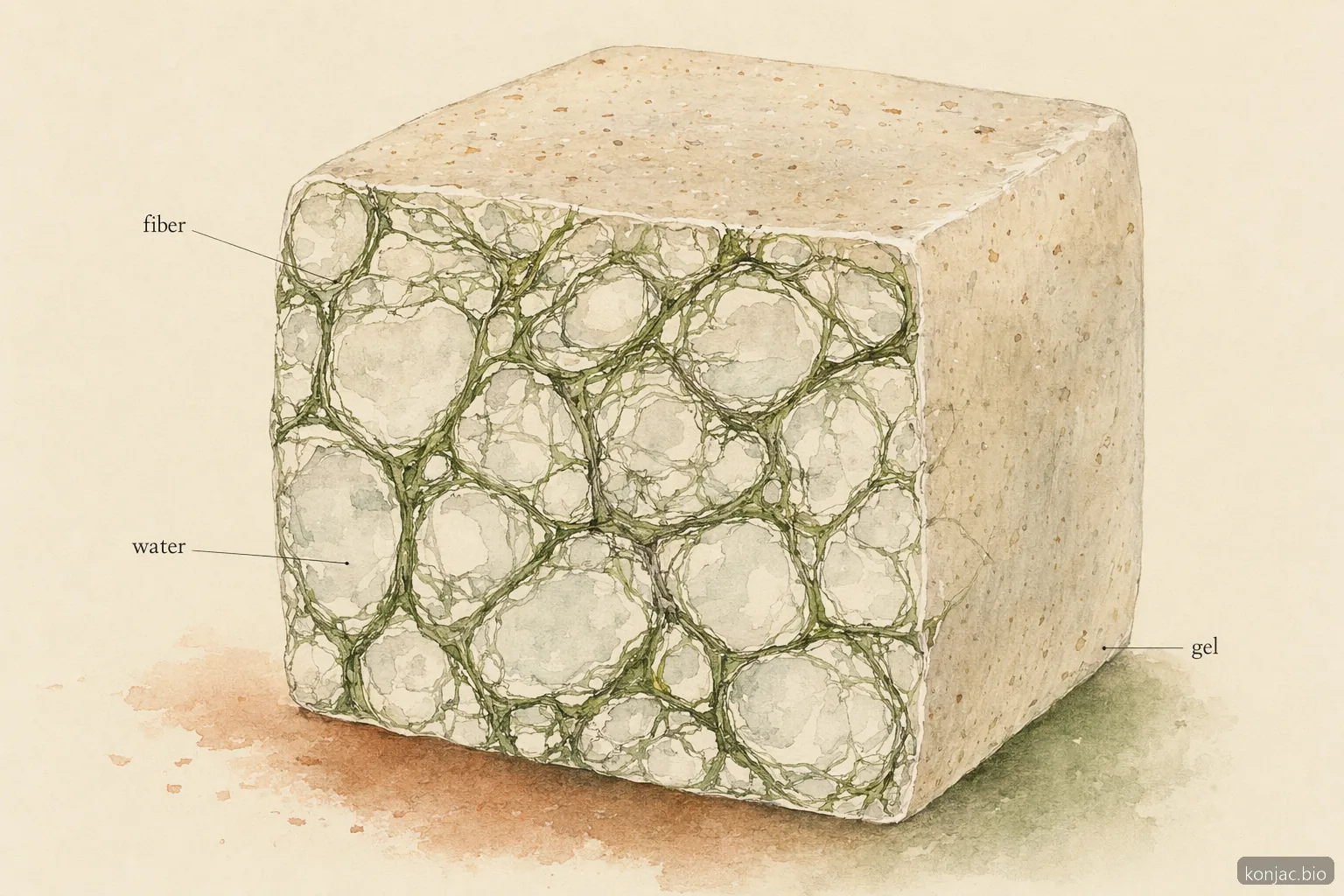
The key ingredient is konjac glucomannan, a soluble fiber from Amorphophallus konjac, a plant used to make konjac foods and gelling ingredients [EFSA opinion](https://www.efsa.europa.eu/en/efsajournal/pub/1798). Glucomannan absorbs water and forms a viscous gel, which is why konjac jelly has a bouncy, elastic bite.
A practical serving is usually one small pouch or cup, not several packages in one sitting. For calorie-focused shoppers, compare the Nutrition Facts panel, especially total calories, added sugars, and fiber grams; for a deeper product label walkthrough, see our konjac jelly calories guide.
- Best fit: a small sweet snack after a meal.
- Watch point: sugar can turn a light jelly into a candy-like product.
- Texture rule: chew fully and avoid suction-style swallowing.
Is konjac jelly good for you if it has sugar?
Konjac jelly with sugar can still fit a balanced diet, but it is less compelling as a better-for-you snack when added sugar is high. In the United States, packaged foods list added sugars on the Nutrition Facts label, which helps shoppers compare similar products [added sugars](https://www.fda.gov/food/nutrition-facts-label/added-sugars-nutrition-facts-label).
The healthiest version is not always the one with the lowest calories. Some sugar-free jellies rely on high-intensity sweeteners or sugar alcohols, while some lightly sweetened versions use fruit juice, cane sugar, or allulose. The right choice depends on taste, digestive comfort, and total daily sugar intake.
| Label clue | What it means | Better choice |
|---|---|---|
| Added sugars | Sweetener added beyond whole fruit | Lower grams per serving |
| Fiber | Often from glucomannan or other fibers | Clear grams listed |
| Serving size | The basis for calories and sugar | One pouch or cup |
| Warning label | May address choking risk | Follow exactly |
For most adults, the better daily habit is simple: choose a serving with a short ingredient list, visible fiber data, and moderate sweetness. A konjac jelly that tastes like dessert is fine occasionally, but the nutrition profile should match the reason you are buying it.
What does glucomannan do in konjac jelly?
Glucomannan gives konjac jelly its gel texture and may support fullness when consumed with enough water. EFSA’s approved weight-management wording is: “Glucomannan in the context of an energy restricted diet contributes to weight loss” [EFSA claim](https://www.efsa.europa.eu/en/efsajournal/pub/1798).
That claim has conditions. EFSA states the claimed effect is obtained with 3 grams of glucomannan daily, taken as 1 gram portions with 1 to 2 glasses of water before meals, within an energy-restricted diet [EFSA claim](https://www.efsa.europa.eu/en/efsajournal/pub/1798). A single konjac jelly pouch may contain far less than 1 gram of glucomannan, so the label matters.
EFSA also authorizes the wording “Glucomannan contributes to the maintenance of normal blood cholesterol levels” when 4 grams are consumed daily [EU register](https://ec.europa.eu/food/food-feed-portal/screen/health-claims/eu-register). This does not mean every jelly cup delivers that intake, and it does not make konjac jelly a substitute for a varied diet.
A PubMed-indexed review describes glucomannan as a water-soluble dietary fiber that has been studied for satiety and body weight outcomes [PubMed review](https://pubmed.ncbi.nlm.nih.gov/15654804/). The strongest consumer takeaway is measured: konjac jelly can help a snack feel more satisfying, but only the full product label can show how much fiber you actually get.
Safety, texture, and choking risk
Konjac jelly safety depends heavily on shape, firmness, and how the product is eaten. The U.S. Food and Drug Administration has warned consumers about certain mini-cup gel candies because their size, shape, and consistency can pose a choking risk [FDA alert](https://www.fda.gov/food/alerts-advisories-safety-information/fda-warns-consumers-not-eat-mini-cup-gel-candies).
FDA Import Alert 33-15 covers some gel candies containing konjac and describes concerns with mini-cup formats that may be sucked from a cup rather than chewed [FDA import](https://www.accessdata.fda.gov/cms_ia/importalert_111.html). This is a form-factor issue, not a reason to reject all konjac foods.
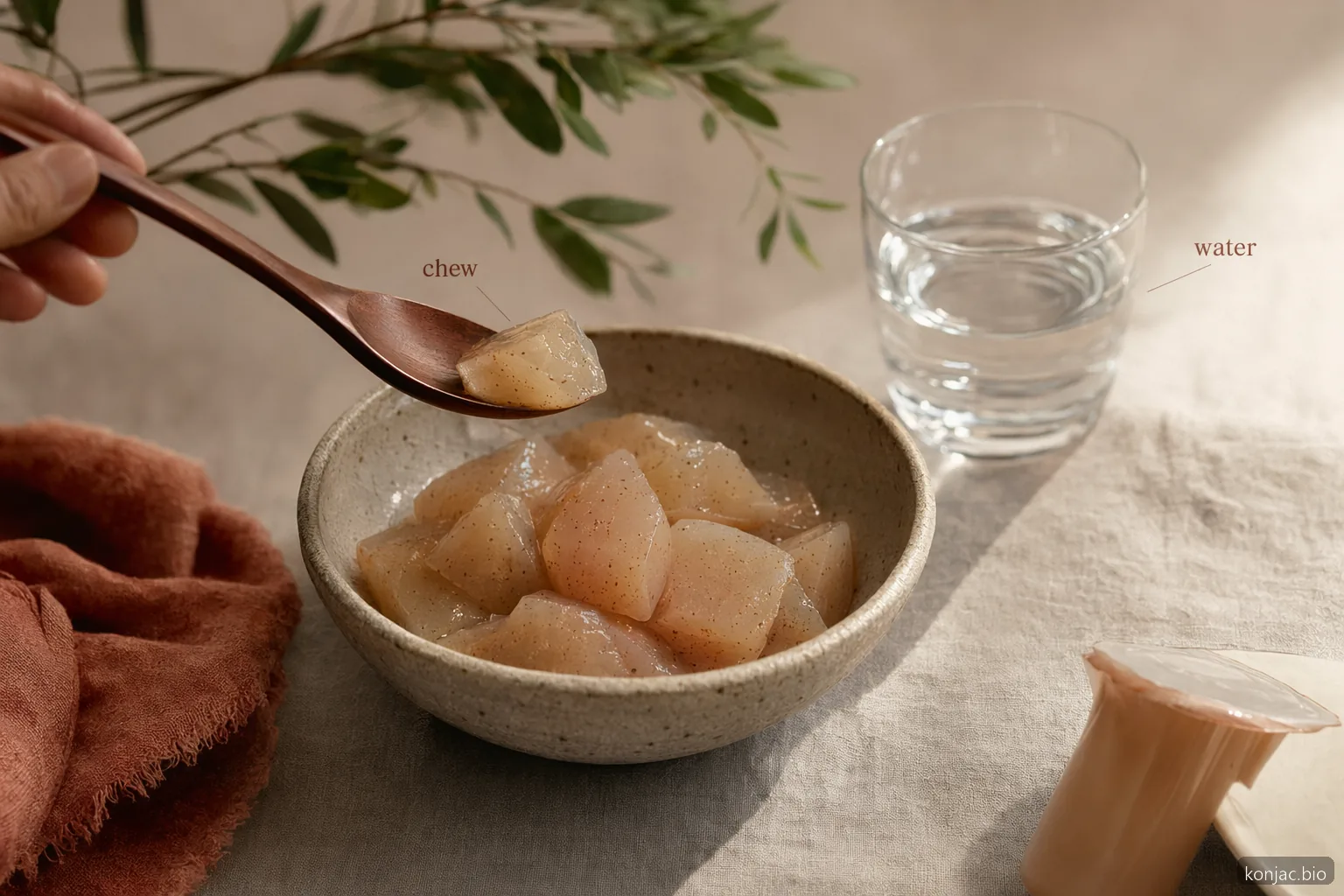
Safer formats are spoonable, squeezable, or cut into chewable pieces. Products should carry clear warnings when appropriate, and caregivers should avoid giving firm mini-cup gels to young children who may swallow slippery foods whole.
For manufacturers, texture testing is not cosmetic. Gel strength, cup diameter, suction release, and bite size can change the real eating experience. Food businesses often pair formulation controls with systems such as ISO 22000, a food safety management standard published by the International Organization for Standardization [ISO 22000](https://www.iso.org/standard/65464.html).
For a focused packaging and consumer-use checklist, see our konjac jelly safety guide.
A practical scorecard for choosing konjac jelly
A good konjac jelly is easy to evaluate with a 5-point scorecard: sugar, fiber, serving size, texture, and labeling. If the product fails on choking design or hides its sugar load, the konjac ingredient alone does not make it a strong choice.
- Sugar: choose lower added sugar when you want a daily snack.
- Fiber: look for listed grams, not just “konjac” in the ingredient list.
- Serving size: compare one realistic pouch or cup, not 100 grams only.
- Texture: prefer chewable or spoonable formats over suction mini-cups.
- Labeling: follow age, chewing, and storage instructions.
Konjac jelly works best as a small sweet bite after lunch, a portion-controlled dessert, or a textural inclusion in beverages. It is less useful when it encourages grazing through multiple pouches or replaces higher-nutrient foods such as fruit, yogurt, nuts, or balanced meals.
For food brands, konjac.bio sources wholesale konjac ingredients for jelly, gel cups, and beverage inclusions; contact konjac.bio for specifications and wholesale pricing.
The simple answer is balanced: konjac jelly can be good for you when formulation and format are good. The best products combine moderate sweetness, measurable fiber, clear warnings, and a texture designed for chewing.
Frequently asked questions
01 Is konjac jelly good for you every day?
02 Does konjac jelly help with weight management?
03 Is konjac jelly safe for children?
04 Is sugar-free konjac jelly healthier than regular konjac jelly?
05 Can konjac jelly replace a meal?
- Scientific Opinion on konjac mannan health claims · European Food Safety Authority · 2010
- FDA alert on mini-cup gel candies · U.S. Food and Drug Administration · 2002
- Import Alert 33-15 · U.S. Food and Drug Administration · 2024
- Glucomannan and body weight review · PubMed · 2005
- Added Sugars on the Nutrition Facts Label · U.S. Food and Drug Administration · 2023