What are konjac chips?
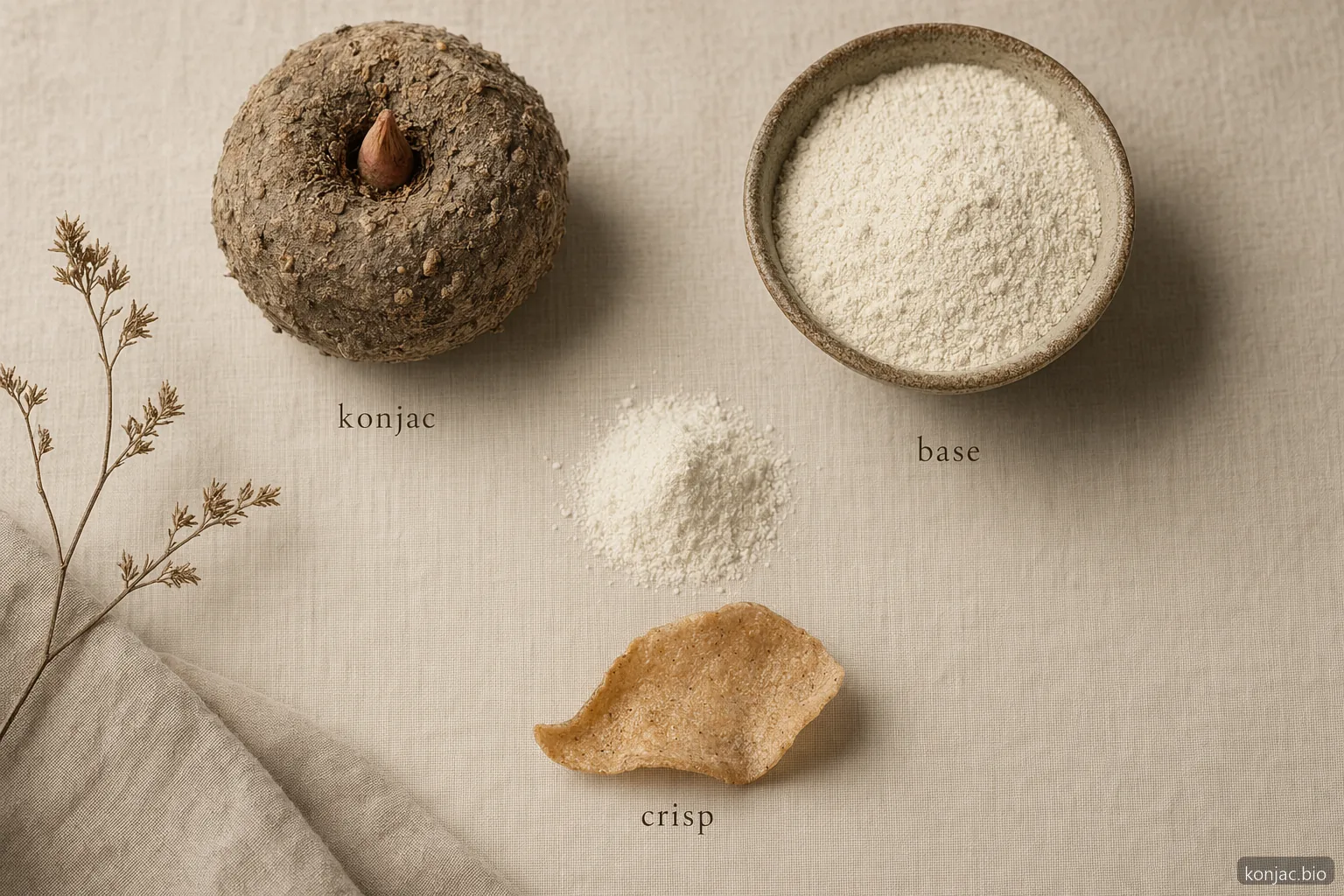
Konjac chips are crunchy snacks made with konjac flour, glucomannan, or a konjac-based hydrocolloid blend plus a crisping base such as rice, potato, tapioca, pea, or lentil flour.
The konjac plant is Amorphophallus konjac, a corm-forming plant listed by Kew as [Amorphophallus konjac](https://powo.science.kew.org/taxon/urn:lsid:ipni.org:names:84460-1). Its best-known food component is glucomannan, a water-soluble polysaccharide identified by NIH PubChem under [NIH entry](https://pubchem.ncbi.nlm.nih.gov/compound/Glucomannan).
Most konjac chips are not 100% konjac because hydrated konjac forms a gel instead of a brittle chip. Formulators use konjac at low percentages to improve binding, fiber content, expansion, or mouthfeel while other starches create the snap.
Within the wider Konjac Snacks: Chips, Candy, and Popping Boba category, konjac chips sit closest to savory snacks. They compete with rice crisps, lentil chips, veggie chips, and baked potato-style snacks.
How are konjac chips made?
Konjac chips are made by hydrating konjac flour or glucomannan, blending it with a starch or pulse base, shaping the dough, then baking, air-drying, popping, or frying it to a crisp texture.
A typical commercial process has 6 stages:
- Dry blending: Konjac flour is mixed with rice flour, potato starch, tapioca starch, pea protein, lentil flour, seasonings, and salt.
- Hydration: Water is added slowly because glucomannan thickens quickly and can clump if dispersed poorly.
- Sheeting or extrusion: The hydrated dough is rolled, cut, extruded, or deposited into chip shapes.
- Gel setting: Some formulas use heat, pH control, calcium salts, or starch gelatinization to set structure.
- Moisture reduction: Baking, air drying, vacuum frying, or conventional frying lowers water activity and creates crunch.
- Seasoning and packing: Seasoning oil, dry spices, oxygen control, and moisture-barrier packaging protect texture.
The key manufacturing variable is water. Too little hydration produces gritty particles, while too much hydration gives a leathery bite instead of a crisp snap. Practical R&D usually tests water addition, konjac percentage, cook temperature, finished moisture, and hold time after seasoning.
For snack brands, konjac.bio sources konjac ingredients at wholesale scale and can discuss specifications through /contact/.
What do konjac chips taste like?
Konjac chips usually taste neutral, so their flavor comes mainly from the base flour, frying or baking method, and seasoning system.
Konjac itself has very little flavor compared with potato, corn, cheese powder, chili, barbecue seasoning, or seaweed seasoning. That neutrality is useful for product developers because one konjac base can support multiple flavor lines.
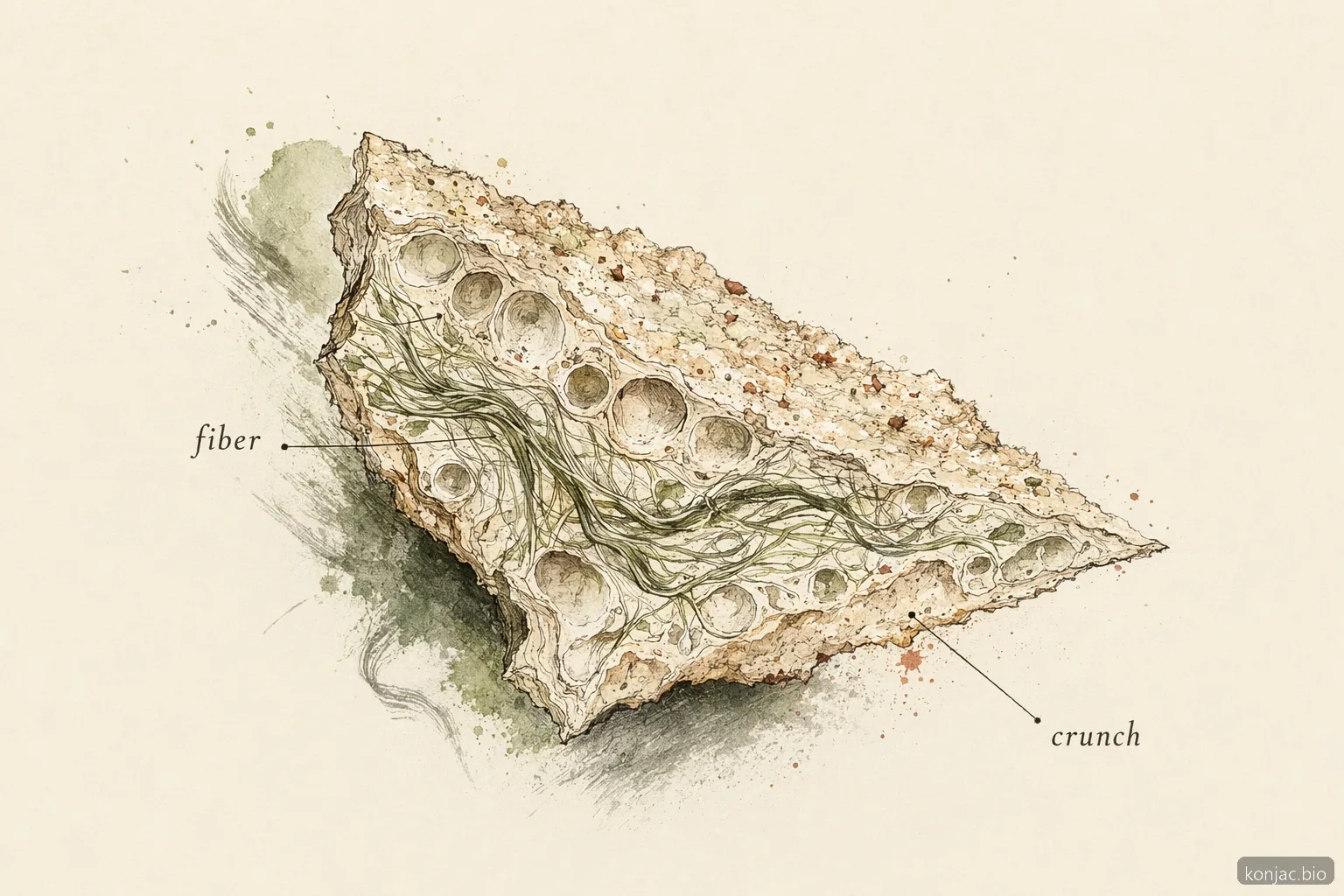
Texture is more important than flavor in this category. A strong konjac chip should have a clean bite, low gumminess, and low tooth-packing. If the formula uses too much hydrated konjac, the chip may feel dense or elastic instead of airy.
Common sensory targets include:
| Attribute | Good result | Common defect |
|---|---|---|
| Crunch | Fast, clean snap | Hard or leathery bite |
| Flavor | Seasoning-forward | Flat, starchy, or overly salty |
| Mouthfeel | Light and dry | Sticky or gummy residue |
| Aftertaste | Neutral | Earthy or alkaline notes |
Sweet snack formats use similar texture logic. If a brand is building a broader konjac snack range, konjac candy and konjac popping boba have different water, gel, and chew requirements than chips.
Nutrition and ingredient checklist for konjac chips
Konjac chips should be judged by the full Nutrition Facts panel, not by a front-label claim alone. The most useful checks are serving size, calories, total carbohydrate, dietary fiber, sodium, added sugars, fat source, and allergen statement.
In the United States, packaged foods use the Nutrition Facts label format described by the [FDA label](https://www.fda.gov/food/nutrition-facts-label/how-understand-and-use-nutrition-facts-label). That matters because a low-calorie claim can look attractive while the serving size is smaller than a shopper expects.
| What to check | Why it matters | Practical target |
|---|---|---|
| Serving size | Controls calories, sodium, and fiber per serving | Compare grams, not just servings |
| Dietary fiber | Shows whether konjac is nutritionally meaningful | Look for declared grams per serving |
| Sodium | Seasoned chips can climb quickly | Compare against similar savory snacks |
| Fat source | Fried and baked chips differ sharply | Check oil type and total fat |
| Base ingredient | Rice, potato, pea, and lentil change texture and allergens | Match base to diet and label goals |
Glucomannan has been evaluated for health claims in Europe. The EFSA-approved wording is: "Glucomannan in the context of an energy restricted diet contributes to weight loss" [EFSA claim](https://www.efsa.europa.eu/en/efsajournal/pub/1798). A snack label should not imply that chips alone produce that outcome because the authorized wording depends on diet context and use conditions.
For shoppers, the simplest rule is to compare konjac chips with the snack they are replacing. If calories are lower, fiber is higher, and sodium is similar or lower, the product has a clear nutritional role.
Safety, labeling, and quality specs for konjac chips
Konjac chips should be dry, crisp, clearly labeled, and manufactured under food safety controls appropriate for snack production. The main technical risks are poor hydration, moisture pickup, allergen cross-contact, and misleading front-label claims.
Konjac has a separate safety history in mini-cup gel candies because small, firm gels can create a choking hazard. The FDA maintains an import alert covering konjac candy in that specific format [FDA alert](https://www.accessdata.fda.gov/cms_ia/importalert_117.html). Dry chips are a different format, but the lesson for developers is direct: shape, texture, hydration, and consumer age group matter.
Quality documentation for B2B buyers often includes particle size, viscosity range, moisture, ash, sulfur dioxide status where relevant, microbial limits, heavy metal limits, allergen statement, country of origin, and certificate of analysis. Facilities may also use third-party food safety systems such as [ISO 22000](https://www.iso.org/iso-22000-food-safety-management.html).
Brands should validate these 5 specs before launch:
- Finished moisture: Crunch should survive shipping and normal shelf life.
- Water activity: The packed chip should remain microbiologically stable for its category.
- Texture drift: Chips should not soften quickly after seasoning.
- Label accuracy: Fiber, calories, sodium, allergens, and claims should match lab data.
- Pack barrier: Film should protect against humidity and oxygen if oil is present.
A well-built konjac chip is not just a fiber story. It is a formulation system where hydrocolloid behavior, starch expansion, seasoning adhesion, and packaging all have to work together.
Frequently asked questions
01 Are konjac chips actually made from konjac?
02 Are konjac chips low calorie?
03 Do konjac chips contain fiber?
04 Are konjac chips the same as shirataki chips?
05 Can food brands make gluten-free konjac chips?
06 What should buyers ask suppliers before ordering konjac for chips?
- Glucomannan Compound Summary · National Institutes of Health, PubChem · 2025
- Scientific Opinion on health claims related to konjac mannan · European Food Safety Authority · 2010
- How to Understand and Use the Nutrition Facts Label · U.S. Food and Drug Administration · 2024
- Import Alert 33-15: Detention Without Physical Examination of Konjac Candy · U.S. Food and Drug Administration · 2024
- ISO 22000 Food Safety Management · International Organization for Standardization · 2024