What is a face konjac sponge?
A face konjac sponge is a soft, porous cleansing pad made by hydrating, shaping, and drying konjac glucomannan from Amorphophallus konjac. Konjac glucomannan is a high-molecular-weight polysaccharide studied for its water-binding gel structure [konjac review](https://pubmed.ncbi.nlm.nih.gov/29602040/), which explains why the dry sponge becomes cushiony after soaking.
The sponge is used on the face with water alone or with a small amount of cleanser. It is not a chemical exfoliant like glycolic acid or salicylic acid. It works by gentle friction, water, and the sponge’s elastic texture.
For a broader overview of sponge forms, plant source, and product categories, see the parent guide: Konjac Sponge: The Natural Skincare Tool. For step-by-step routine details, see how to use a konjac sponge.
| Feature | Face sponge detail |
|---|---|
| Primary material | Konjac glucomannan from Amorphophallus konjac |
| Texture when dry | Hard and lightweight |
| Texture when soaked | Soft, springy, and flexible |
| Typical use time | 30 to 60 seconds per cleanse |
| Typical replacement | 4 to 8 weeks with proper drying |
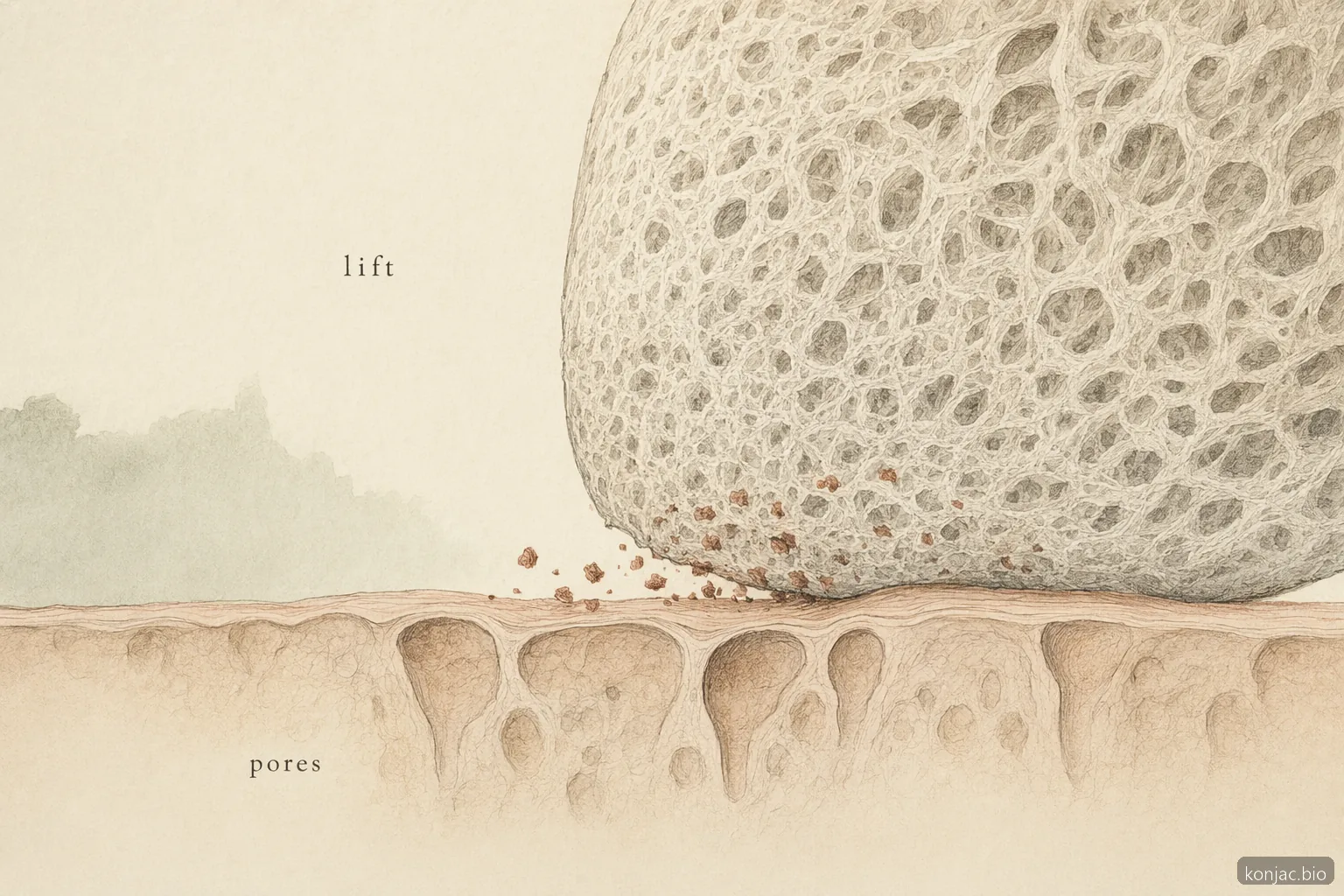
How does a face konjac sponge exfoliate?
A face konjac sponge exfoliates by using soft mechanical friction to loosen surface buildup while the sponge is wet and flexible. The outermost skin layer, the stratum corneum, is made of flattened corneocytes and lipids that form a protective barrier [skin barrier](https://www.ncbi.nlm.nih.gov/books/NBK546700/), so pressure matters more than speed.
Use the sponge as a cushion, not a scrub brush. A soaked sponge should glide over the skin with almost no dragging. If the sponge feels scratchy, it is not hydrated enough.
- Soak: Hold under warm water for 1 to 3 minutes until fully soft.
- Squeeze: Press out excess water without twisting aggressively.
- Cleanse: Move in small circles for 30 to 60 seconds.
- Rinse: Wash the sponge until water runs clear.
- Dry: Hang in moving air, not inside a closed shower shelf.
People who already use leave-on exfoliating acids should use the sponge less often. The U.S. FDA notes that alpha hydroxy acids can increase sun sensitivity [AHA guidance](https://www.fda.gov/cosmetics/cosmetic-ingredients/alpha-hydroxy-acids), so stacking frequent acid use with vigorous rubbing can leave skin feeling tight or over-polished.
Face konjac sponge benefits by skin type
A face konjac sponge can fit many skin types because it is used wet, soft, and briefly. The safest starting point is a plain white sponge with no added charcoal, clay, fragrance, or botanical powder, especially for first-time users.
For oily-feeling skin, the sponge can help distribute cleanser evenly around the nose, chin, and forehead. For dry-feeling skin, the main benefit is gentle cleansing without a rough washcloth. For combination skin, use lighter pressure on cheeks and slightly more time around the T-zone.
| Skin type | Suggested frequency | Best practice |
|---|---|---|
| Balanced | 3 to 7 times weekly | Use with water or mild cleanser |
| Dry-feeling | 1 to 3 times weekly | Keep contact under 45 seconds |
| Oily-feeling | 3 to 7 times weekly | Focus on cleanser spread, not pressure |
| Reactive-feeling | Start once weekly | Choose plain white and stop if stinging occurs |
| Post-shave | Skip same day if tender | Use the following day with light pressure |
Konjac sponge benefits come from format and use, not from dramatic ingredient claims. For a more detailed comparison of texture, cleansing feel, and routine fit, see konjac sponge benefits.
B2B note: konjac.bio sources konjac materials for brands, formulators, and distributors at wholesale scale. For specifications, volumes, and lead times, contact the team at /contact/.
How should you use a face konjac sponge safely?
You should use a face konjac sponge only after it is fully hydrated, with light pressure, for less than one minute on the face. A dry or half-soaked sponge is too firm for facial use and can create unnecessary friction.
Start with evening cleansing 2 to 3 times per week. If your skin feels comfortable for two weeks, increase frequency gradually. If your skin feels tight, shiny, hot, or stings after moisturizer, reduce use or pause.
- Do not use on broken or actively irritated skin.
- Do not press hard around the nose, mouth corners, or under-eye area.
- Do not share one sponge between people.
- Do not store it wet in a sealed travel case.
- Do not microwave, boil, or bleach the sponge unless the supplier specifically validates that process.
The U.S. FDA classifies cosmetics by intended use and labeling, including products applied for cleansing or beautifying [cosmetic rules](https://www.fda.gov/cosmetics/cosmetics-laws-regulations/federal-food-drug-and-cosmetic-act-fdc-act). A konjac sponge should be positioned as a cleansing accessory, not as a product making medical or skin-condition claims.
If you use retinoids, benzoyl peroxide, exfoliating acids, or strong aftershave products, keep sponge use conservative. A low-friction routine is usually more sustainable than an aggressive routine that feels smooth for one day and uncomfortable by day three.
Care, drying, and replacement timeline
Good sponge hygiene depends on rinsing, airflow, and replacement timing. A plant-based porous sponge holds water after use, so drying speed matters.
Rinse the sponge under running water after every cleanse until there is no visible foam or makeup tint. Press water out between clean palms. Avoid wringing, because twisting can break the internal sponge structure and shorten usable life.
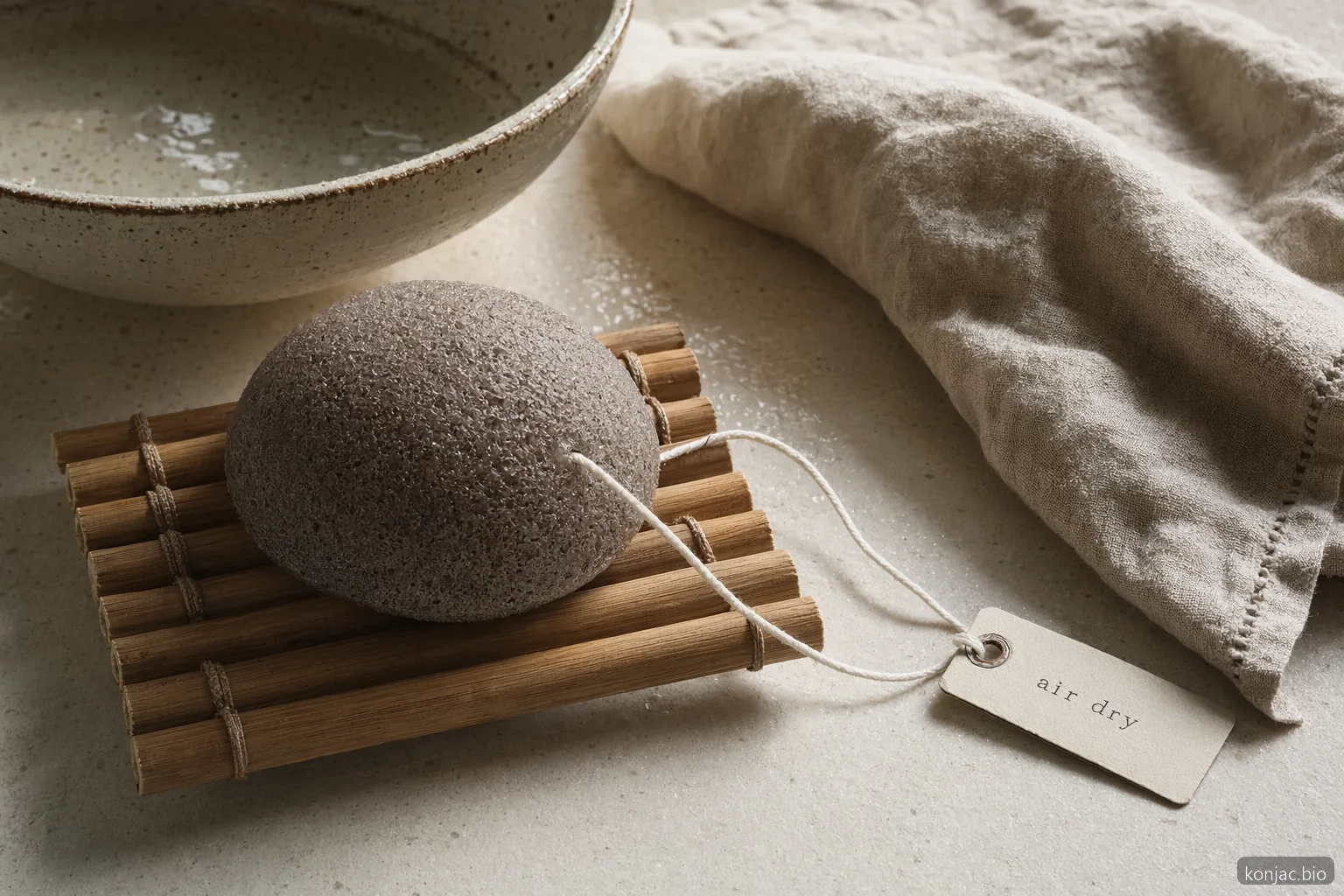
Hang the sponge by its string in open air. A bright, ventilated shelf is better than a damp shower corner. A closed soap dish, toiletry bag, or drawer slows drying and can create odor.
| Signal | Action |
|---|---|
| Sponge stays firm after soaking | Replace it |
| Surface cracks or flakes | Replace it |
| Musty odor after rinsing | Replace it immediately |
| Dark spots appear | Discard it |
| Normal daily use for 4 to 8 weeks | Plan replacement |
For travel, let the sponge dry fully before packing. If packing damp is unavoidable, use a breathable pouch for a short trip and rinse again before facial use. A backup dry sponge is the cleaner option for flights, gym bags, and multi-day travel.
Frequently asked questions
01 Can I use a face konjac sponge every day?
02 Is a face konjac sponge better with cleanser or water?
03 Which face konjac sponge is best for sensitive-feeling skin?
04 How often should I replace a face konjac sponge?
05 Can a face konjac sponge remove makeup?
06 Is a konjac sponge different from a washcloth?
- Konjac glucomannan: a review of structure, physicochemical properties, and applications · PubMed · 2018
- Anatomy, Skin, Stratum Corneum · NCBI Bookshelf · 2023
- Alpha Hydroxy Acids · U.S. Food and Drug Administration · 2022
- Federal Food, Drug, and Cosmetic Act: Cosmetics Laws and Regulations · U.S. Food and Drug Administration · 2024